The Unlikely Heroics of Sam Holloway by Rhys Thomas

img_1497

Rhys Thomas: The Unlikely Heroics of Sam Holloway

Published By: Wildfire on 9 August 2018

Buy It Here: here

What The Blurb Says:

This is no ordinary love story and Sam is no typical hero…but he is a hero.

Charming, quirky, and absolutely bursting with heart, this is the perfect book club read for fans ofThe Rosie Project, A Man Called Ove, and Eleanor Oliphant.

Sam Holloway has survived the worst that life can throw at you. But he’s not really living. His meticulous routines keep everything nice and safe – with just one exception…

Three nights a week, Sam dons his superhero costume and patrols the streets. It makes him feel invincible – but his unlikely heroics are getting him into some sticky, and increasingly dangerous, situations.

Then a girl comes into his life, and his ordered world is thrown into chaos … and now Sam needs to decide whether he can be brave enough to finally take off the mask.

Both hilarious and heart-warming, this is a story about love, loneliness, grief, and the life-changing power of kindness.

What I Say:

“…there will be a moment, just a small moment, when her words fall away and he will see her for all that she is, this incredible force of life that puts an excitement in him every day, because he is lucky, in a way, gifted a unique perspective where he is able to perceive how good life is.”

The idea of a twenty six year old man, working in a Japanese screw factory by day, and solving crime by night is not usually a novel that would appeal to me.

However, I defy you not to fall in love with a superhero called the Phantasm whose utility belt includes a selection of chocolate bars and some fizzy drinks?!  Sam Holloway lives an ordered, measured and seemingly ordinary life.  He has gone through a terrible, life changing Event which meant his love of comics and the superheroes who inhabit them are the only thing that gives him the stability he needs.

After working all day in the factory, where he is a model employee, he goes home, has his tea, and then goes onto the mean streets of his neighbourhood to fight small time crime.  No one has any clue that he does this, but for Sam, it is everything.  Just to add, that not one of these capers goes smoothly, and I promise you that every single one of them will have you laughing out loud!  The Phantasm is the most un co-ordinated, clumsy, kind hearted superhero that you will ever meet.

So far, so uncomplicated.  It isn’t a coventional lifestyle by any means, but it gives Sam the security and comfort he needs.  That is until he meets Sarah. He first notices her in a local bakery, and then in the pub he goes to with his mates Tango and Blotchy.  For so long. after the Event, Sam has put a wall around his heart to avoid any more pain, and now that is in danger of falling down.  Little by little, Sam allows himself to open up to Sarah, and realises that she could be the person he needs to bring him back into the real world. He starts to realise that he is falling in love with her.

The only thing is, that he can’t tell her about his secret night time adventures.  How can he explain to the woman he loves, that at night, he puts on a specially commissioned costume and heads out on his bike or in his car to help the local people?  The wonderful thing about Rhys’ novel, is that you really feel every painful decision that Sam has to make.  You see how absolutely heartbreaking the Event (nope, am not telling you!) has been. and that he is now left with crushing anxiety and a sense that he is left behind struggling with his guilt.

For me, some of the most poignant scenes in the novel were where you see Sam’s thought process and how his anxiety manifests itself in an uncensored stream of consciousness. It is heartbreaking to read, but also gives a real insight into what it must feel like to suffer from this crippling anxiety.  It is during those awful times for Sam, that I wanted to reach into the novel and tell him that everything was going to be okay.

As the novel moves on, Sam is seemingly torn between his need to keep being a superhero, and his frustration at not being able to be completely honest with Sarah.  Unfortunately, when one of the Phantasm’s identity is revealed, it sets Sam off on a course that puts him at odds with himself, and you feel the pain and turmoil he has. From this point on, he has a new battle as he realises that he can no longer hide behind the identity of the Phantasm.  It is interesting to see that the one thing it does it bring out his reckless side, that it unleashes in him all the guilt and pain he has felt, and that he doesn’t know how to cope with the outpouring of grief and emotion that he has held inside him for so long.

Sarah and Sam also have to face the fact that neither of them are being completely honest with each other, as Sarah’s past is threatening to come back to haunt her.  She refuses to tell Sam exactly what her ex has on her, what has made her leave her family and home town and why she constantly changes the topic when it gets too personal.

The Unlikely Heroics of Sam Holloway is an engaging and heart rending read.  It is full of hope and promise, it is about the lengths we go to when we cannot face the reality of our lives, and more importantly about the wonderful things that can happen when we give ourselves permission to live and more importantly, love again.

I loved it.
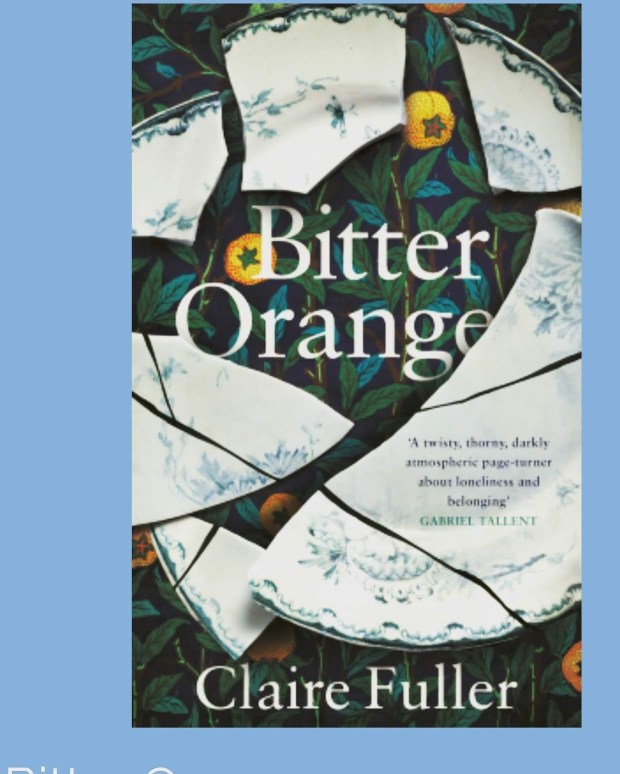
Bitter Orange by Claire Fuller

img_11552

Claire Fuller: Bitter Orange

Published By: Fig Tree

Buy It: here

What The Blurb Says:

From the attic of a dilapidated English country house, she sees them – Cara first: dark and beautiful, clinging to a marble fountain of Cupid, and Peter, an Apollo. It is 1969 and they are spending the summer in the rooms below hers while Frances writes a report on the follies in the garden for the absent American owner. But she is distracted. Beneath a floorboard in her bathroom, she discovers a peephole which gives her access to her neighbours’ private lives.

To Frances’ surprise, Cara and Peter are keen to spend time with her. It is the first occasion that she has had anybody to call a friend, and before long they are spending every day together: eating lavish dinners, drinking bottle after bottle of wine, and smoking cigarettes till the ash piles up on the crumbling furniture. Frances is dazzled.

But as the hot summer rolls lazily on, it becomes clear that not everything is right between Cara and Peter. The stories that Cara tells don’t quite add up – and as Frances becomes increasingly entangled in the lives of the glamorous, hedonistic couple, the boundaries between truth and lies, right and wrong, begin to blur.

Amid the decadence of that summer, a small crime brings on a bigger one: a crime so terrible that it will brand all their lives forever.

What I Say:

Thank you to NetGalley for an advance e-copy of Bitter Orange in exchange for an honest review.

I kept seeing bookish people on Twitter raving about Claire’s new novel Bitter Orange.  After valiantly failing to get a printed proof via various competitions and offering to sell my children and dog, I was absolutely ecstatic to be able to access Bitter Orange via Netgalley.

So, what did I think?  Quite simply, Bitter Orange is one of those few novels that pulls you in from the first page, keeps you close throughout, and then leaves you feeling bereft when you realise you have finished it. I can honestly say that it is one of the few e-novels I have read, that I need to own a physical copy of as I want to read it again to really savour every page.

We first meet Frances Jellico as she lies on her deathbed, talking to Victor who is a vicar and her long standing friend.  As she meanders in and out of consciousness, she remembers her life, especially the hot and claustrophobic summer of 1969.

Frances has been commissioned to write a report about the follies which are in the gardens of the majestic Lyntons House.  She has left the drab and lonely existence she has in London, and is now facing a summer in an isolated and somewhat dilapidated country house as she undertakes her seemingly overwhelming task.

It is as she moves into her sparse attic room, that she meets the charismatic Peter and Cara, who are staying in the rooms below her.  Like Frances, Peter has been commissioned to write a report for the buyer of Lyntons House, and from the first time she meets the two intoxicating strangers, Frances falls immediately under their spell.

As she settles in to her attic rooms, Frances stumbles upon a telescope, embedded in the floor, which looks directly down into the bathroom that Peter and Cara share, which gives her an illicit view of the couple that she knows is wrong to look at, but can’t draw her eyes away – especially from their most private moments.

As the three strangers start to talk to each other, Frances notices that Cara seems to be evasive about her life before arriving at Lyntons, but is vocal of her love of Italy and its language, and Peter seems to be the stabilising influence she needs. Frances is a sometimes unwilling participant in their alcohol fuelled arguments, but is ultimately bewitched by her passionate and worldly wise neighbours.

The heat of the summer and the geographical isolation of Lyntons House mean that Peter, Cara and Frances start to gravitate towards each other, sharing food and free time and they begin to confide as to the paths which have brought them here.  One of the many wonderful things about Bitter Orange, (and believe me, there are many), is that Claire’s writing eloquently conveys the sense of them being almost out of step with the real world, living day to day, as they wish, with no routine or timetable, against the backdrop of a languid and all encompassing landscape that in reality seems to be closing in on them.

Life at Lyntons initially seems to suit all three of them, and very gradually, Frances starts to unwind and lose her staid and rigid routines.  She realises that she is becoming increasingly attracted to Peter, and as they get closer, he tells Frances in confidence that she shouldn’t always believe what Cara says, and that her mental state and recollection of events is at times precarious.

The balance of their relationships start to shift- Cara is now being watched by both Peter and Frances, Frances and Cara both love Peter, and Cara is becoming wary of Frances and her obvious attachment to Peter. One day, they stumble upon a door in the house which contains everything that the Lyntons owned – including furniture, crockery, china, jewellery and exquisite paintings.

Frances, Cara and Peter then make a moral choice about their discovery which will not only change everything, but will seep into the already tenuous cracks of their now brittle relationships.

Not one of them is innocent, and from this point onwards in Bitter Orange, the spell of their idyllic summer is irrevocably broken.

Day by day they start to turn on each other, uneasy and untrusting, loyalties are tested and secrets are revealed. This is what makes the characters in Bitter Orange so engaging – that Frances, Cara and Peter are flawed in their different ways, but ultimately they are just three young people, trying to find love and their place in the ever changing world that they will have to return to eventually.

Bitter Orange culminates in a truly shocking and unexpected ending, which is absolutely perfectly executed – and Frances’ deathbed confessions will, believe me, take your breath away.

Emma Healey, another of my favourite authors, has said that on reading Bitter Orange that she had to keep reminding herself that she wasn’t reading a forgotten classic. I would absolutely agree, and also add, that in writing the haunting and elegiac Bitter Orange, Claire Fuller has written a brilliant future classic novel that should be lauded and read as widely as possible.

I loved it.

Promising Young Women by Caroline O’Donoghue


img_1516


Caroline O’Donoghue: Promising Young Women

Published By: Virago

Buy It: here

What The Blurb Says:

Jane Peters is an adrift twenty-something by day, and a world-weary agony aunt by night. But when an office party goes too far, Jane dissolves into the high-stakes world of being the Other Woman: a role she has the right advice for, but not the smarts to follow through on.

What starts out as a drunken mistake quickly unravels as Jane discovers that sex and power go hand-in-hand, and that it’s hard to keep your head when you’ve become someone else’s dirty little secret. And soon, her friendships, her sanity and even her life are put into jeopardy…

What I Say:

“We women are taught to make everything we do seem unimportant. And most of us buy into it…. ‘Oh, I just do the press releases,’ or, ‘Oh, I just have the children.’ It’s all bollocks.  It really is.”

As you all know, Bookish Twitter and Instagram is a huge part of my blog –  many of my recommendations and blog posts come about as a result of reading lots of things, and I use social media endlessly, like most people I know.  This is how I found out about Promising Young Women, and I knew that I needed to read it!

Social media and the preconceptions of women in society is a huge part of this novel.  It is always in the background – from the advice column that Jane writes anonymously as JollyPolitely, through to the way in which she collates information about women for her pitches in her role as an account manager for an Advertising Company.  The power of social media, and the way in which strangers believe they have a right to have an opinion on you and your life is something we can all relate to.  It is increasingly permeating every part of our lives, we filter, edit, photoshop and present to the world an image we want to get the most likes and retweets for.  I’ve done it, I am sure that we all have.  As women our lives are determined by other people telling us what we should be wearing, eating. listening to, reading and what we should be doing with our bodies.

The politics of work and the way in which women are perceived in the workplace is the prevalent theme that runs throughout Promising Young Women.  Jane, a twenty something, has an unremarkable role in a company, has just broken up with her boyfriend (who has promptly moved on with someone else), and like many of us when we were in our twenties, seems almost stunned that she is where she is.  How many of us believed that when we were starting our working lives that we would be the women that changed the world, that we wouldn’t make the mistakes our mothers had made, and that there was no way we would allow men to talk to us or treat us in an inappropriate way.  The trouble with that argument for me, is when I worked in offices in my twenties, those entrenched traditional values and the shrugs of that ‘that’s just the way it is’, meant that little by little, fighting became too hard, too overwhelming.  I was young and just wanted a job that paid my bills and meant that I had a chance to live a little.

I left my last job nearly fourteen years ago, to look after my children.  When I picked up Promising Young Women, it was like going back in time – so much of what Jane and the female employees go through was happening then.  Being referred to as ‘girls’, the assumption that when coffees and teas were needed that we would make them, and of course, the ever present unspoken question of our commitment to our role with the notion of pregnancy and childcare assumed to be part of our futures.

When Jane falls into bed with Clem, the boss with whom she has been singled out to work on a Pizza account, we can only watch from the sidelines as we realise that this is not a burgeoning office romance, but the calculated modus operandi of a married office predator.  Clem thrives on his position of power, his ability to charm the younger women he targets, building up their confidence and devotion to him by facilitating their movement up the career ladder.  His confidence and absolute disregard for the women he thinks he is doing a favour for, interestingly diverts his bosses from his mediocrity in his role.  Just because he shouts the loudest, and has the gift of the gab, doesn’t mean he has the experience to back it up – he has no qualms about passing off other people’s ideas as his own.  We discover that Jane is far from his first affair, certainly won’t be the last, and that Clem’s wife has an interesting perspective on his behaviour.

As Jane starts to make progress in her career, people begin to take her seriously and her insight and opinion counts for something – because she is in Clem’s favour.  As the novel moves on, the almost gothic relationship with Clem becomes increasingly corrosive, and Jane finds herself emotionally dependent on him if and when he deigns to give her attention.  Jane might believe she is a promising young woman, finally finding her place in the professional world, but it is Clem who is controlling her every move.

Jane starts to unravel, little by little as her physical and mental health start to suffer.  She is working relentlessly, not eating properly and living hour by hour waiting to be fed any sort of crumb of attention from Clem.  For me, I felt this was dealt with in a gradual and entirely believable way.  There is not one major incident that starts her decline –  Jane simply starts to disintegrate, and the career she has worked so hard for is simply pulled away from her because she is no longer useful.  Every piece of work she has done is sidelined to Darla, who was once Jane’s best friend, but is now Clem’s next target. The chilling thing is that Jane cannot do anything about what is happening to her without seeming to be the hysterical young woman Clem is telling everyone she is.  When she finally stops Clem, it is brutal and shocking, but necessary and makes perfect sense.

It is at times an uncomfortable read, seeing what not only people will do to become successful, but what they are prepared to do each other too.  It is a brilliant indictment of a world that we have all been party to and continue to exist in, and I was utterly entranced by it.

Promising Young Women should not only be required reading for anyone working in an office, but more importantly must be used to start the crucial conversations we need to have about what it truly means to be a woman today.

I loved it.


The Possible World by Liese O’Halloran Schwarz

img_1456

Liese O’Halloran Schwarz: The Possible World

Published By: Hutchinson

Buy It: here


What The Blurb Says :

Ben is the sole survivor of a crime that claims his mother and countless others. He is just six years old, and already he must find a new place for himself in the world.

Lucy, the doctor who tends to Ben, is grappling with a personal upheaval of her own. She feels a profound connection to the little boy who has lived through the unthinkable. Will recovering his memory heal him, or damage him further?

Clare has long believed that the lifetime of secrets she’s been keeping don’t matter to anyone anymore, until an unexpected encounter prompts her to tell her story.

As they each struggle to confront the events – past and present – that have defined their lives, something stronger than fate is working to bring them together…


What I Say:

“A red blood cell lives 120 days and then dies, part of the natural senescence happening all over our bodies all the time.  Everything about us is constantly dying and regenerating.”

It is hard sometimes to pick up a book and read it when you have heard so much about it.  There is always that niggling doubt that you will not love it, that you won’t understand what all the hype is about, and more crushingly, that you simply won’t finish it (hence my Years Of Reading philosophy!).

The Possible World brings us into the world of three characters – Ben, Lucy and Clare.

Ben, is six, and is brought to hospital after surviving a gun attack at a friend’s birthday party, where all his friends and Mum are killed in cold blood by a man who perversely sees himself as doing Ben a favour by not taking his life.

Lucy is the doctor who looks after Ben when he is initially admitted to hospital.  There is a scene near the start of the novel, where Ben is being examined by Lucy, and she realises his hair is matted, not because it is dirty, but because it is coated in blood.  The power of that scene for me is breathtaking, as Lucy realises what Ben has been through, and although immensely moved by what he has seen, she still has a professional duty to treat him as she would any other patient.

It soon becomes apparent that Ben will not answer to his name.  After some careful guidance, he reveals that his name is Leo.  His reluctance to talk about what has happened is seen as his state of mind, and everyone assumes that Leo is a facet of Ben’s personality he is using to hide behind as he comes to terms with the reality of the attack.  Lucy starts to spend time with him, to try to unravel what has happened, and why he is so desperate to find a woman called Clare.

I have to admit, that I thought at first The Possible World was going to be simply a novel about a woman bringing a child back from the brink, and that Clare would turn out to be a neighbour or Ben’s Grandma, who would reconcile with him and they would all live happily ever after.

It is very difficult to succinctly explain to you how much more The Possible World is.  It is an epic novel about love, loss, grief and the possibility that our world is far more complex that we can ultimately comprehend.  It is at times brutal and uncompromising, but is imbued with such tenderness and compassion that you cannot fail to be moved by it.

Clare, it transpires, is an elderly resident of a nursing home, an unwilling participant of the day-to-day activities, who has resolutely denied herself the opportunity of getting to know anyone, for fear of having to reveal something of herself.  When she meets Gloria, a vibrant, passionate and fearless fellow resident, she is persuaded to tell her the story of her life, which Gloria records.

Through Clare’s retelling of her story, we learn how she came to be living in a remote cottage, near an extremely strict Boys Residential School.  Apparently alone in the world, she is attempting to create a life for herself, away from the confines and expectations of a society she feels has done nothing except disappoint her.  Clare has experienced an unhappy marriage and devastating losses, and the physical labour and solitary existence she craves give her the chance to heal and live in peace.

Into this solitude bursts Leo, one of the young boys from the school, who has been placed there by his mother for fear of upsetting her violent husband.  Clare is reluctant to let Leo in to her life, but she is astute enough to realise that they are perhaps kindred spirits, pushed into an unhappy life that they have done nothing to deserve.  Together, Clare and Leo work the land and start to realise that in each other they may have found the familial bonds they have been missing.

The novel moves between the stories and lives of Leo/Ben, Lucy and Clare, pulling us backwards and forwards in time, moving between the characters at a pace which at times cleverly serves to disorientate us, giving us a real sense of the confusion Leo feels, as he battles with the very strong realisation he needs to get to Clare as soon as possible.  This is one of the many staggeringly astounding things about The Possible World.  The narratives shift constantly, and little by little, the connections between Leo and Clare are revealed – the stories which at first seemed entirely disparate, are in fact so tightly bound together, that you understand every page that Liese has written has been plotted so tightly, the execution is seamless.

When I had finished the novel, I was reading back through the chapters to check a couple of things, and I noticed sentence that Leo said, a feeling that Clare had, and realised how truly magnificent a feat this novel is. Right from the start, the seeds of what is really happening are sown, and little by little, you understand exactly why Leo has to see Clare.

The Possible World is one of those books that when you finish it, you can’t quite believe it is over.  It is an engaging, thoughtful and powerful novel, with characters you love, and want only the best for.  The complex relationships between Leo, Clare and Lucy are so tenderly written, that you never doubt for a minute how strong the bonds between them are.

The Possible World is a gloriously different and challenging novel, that will pull you in from the start and leave you stunned when you finish.

I loved it.

Before they were so many gaps; now they are filled, right to the smallest warm corners. Nothing important is missing”.


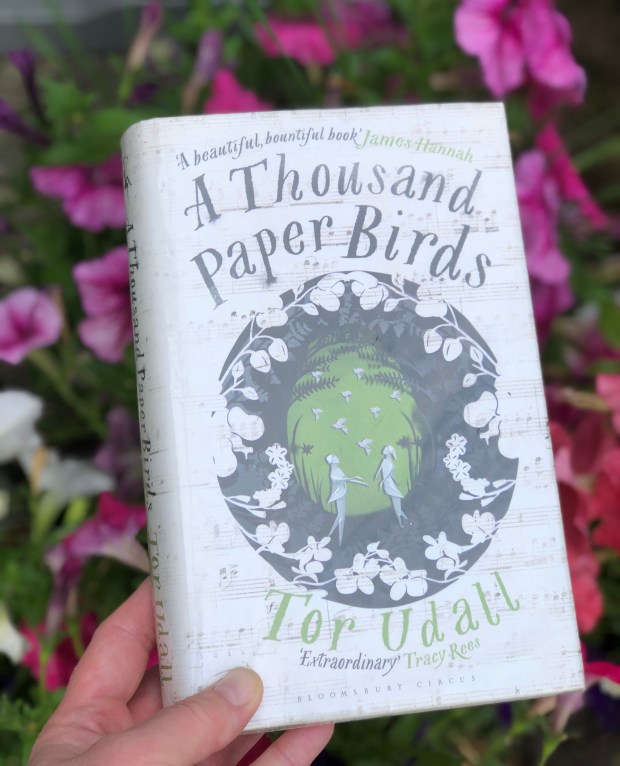
A Thousand Paper Birds by Tor Udall

img_1403

Tor Udall: A Thousand Paper Birds

Published By: Bloomsbury Circus

Buy Ithere


What The Blurb Says:

Jonah roams Kew Gardens trying to reassemble the shattered pieces of his life after the death of his wife, Audrey. Weathering the seasons and learning to love again, he meets Chloe, an enigmatic origami artist who is hesitant to let down her own walls.

In the gardens he also meets ten-year-old Milly, and Harry, a gardener, both of whom have secrets of their own to keep – and mysteries to solve.

What I Say:

“Perhaps,” says Jonah, ‘love is when you hold on to something and fall through the air.  You don’t know if you’re flying or falling – ‘

‘Until you crash,’ she says.

I have to tell you straight away that I had no intention of blogging about A Thousand Paper Birds.  I had it on my Reading Pile, one that is just for me, so I don’t put myself under any pressure by promising reviews when sometimes all I want to do is read.

The thing is, when you start reading a novel like A Thousand Paper Birds, it needs to be shouted about, recommended and pushed into the hands of anyone who has ever known what it is to love or be loved.

Jonah’s wife Audrey has passed away.  He understands how important Kew Gardens was to her, and so as well as arranging for a bench dedicated to her to be installed, Jonah spends many hours roaming the gardens in an attempt to feel closer to her.  While he is there, he meets Chloe, a young artist who is passionate about origami, and as they start to form a connection, Jonah finds himself feeling conflicted about opening his heart to someone else whilst the presence of Audrey is everywhere.

Harry has dedicated his life to working in Kew Gardens, and works tirelessly to ensure that it stays as beautiful as he can make it.  Milly is a typical ten-year old, energetic, inquisitive and seemingly fearless.  Jonah encounters them on his trips to Kew, and as he starts to try to get over his devastating loss, Chloe, Henry and Milly all provide him with different things he needs to help him move forward.

So far so straightforward? Sounds like a feel good novel that will have Jonah, Chloe, Harry and Milly living happily ever after?

A Thousand Paper Birds will not give you a formulaic feel good, tick box neat story.  It is so much more than that. It is a complex and passionate novel about what love is, what it means, and the lengths we will go to in that elusive search for happiness.  It tackles many different issues, such as death, grief, what it means to be a parent, and what dying means for those who are left behind.

One of the many things I loved about the novel are the characters who inhabit Kew Gardens. Jonah is a grieving husband, but he is not a model of decorum and mourning.  He attempts to forget about Audrey by sleeping with numerous women, trying to find a way back to some sort of normality that will start him living his life again.  Chloe is the same, brittle and wary of forming any connection that will make her confront her past and what she has witnessed.  For me, that made the novel even better – I want real, relatable people, who react in ways that I can understand, and make me want to see them find the resolution they need.

Harry and Milly initially seem always to be just on the edge of Jonah and Chloe’s world, but they in fact are so pivotal to their lives, that without them, they will not be able to move past the grief they both hold inside.  Page by page, chapter by chapter, Harry and Milly move from the background of Kew, into the centre of the plot, and we start to understand exactly why they are there, and so interested in Jonah and Chloe.

All the time, the magnificent and stately Kew Gardens weaves its way through the story.  Most of the novel takes place here, and like an all-seeing and all-knowing entity, it holds the key to why all the characters are drawn here.  The ethereal quality that Kew has, provides the perfect backdrop, as the novel progresses and we start to understand that all is not what it seems.  All the time, Kew is there, bringing people in to its heart and holding them there until they are ready to move on.

Audrey is the link between all these characters, and like them, before she died, she too was dealing with her own grief.  Unable to carry a child to full term, she and Jonah move further apart as they bluster through their daily lives, never really talking about their marriage, or how sad they feel.  Like all the people in A Thousand Paper Birds, Audrey is not held up as a paragon of virtue.  She is increasingly drawn to Harry, wondering whether their shared love of nature and gardening is a solid enough foundation to risk her ending her marriage to Jonah.

However, as we know, Audrey dies, and leaves behind her four people who are trying to make sense of what has happened.  When Chloe stumbles on Audrey’s diary, explaining her feelings towards Jonah and her growing attraction to Harry, she knows she has stumbled on something which will blow apart their lives and ultimately risk her own growing relationship with Jonah.

As the novel moves seamlessly towards its conclusion, there are subtle clues, which become more and more blatant, and finally reveal to us who Harry and Milly are, and Audrey’s involvement in their lives.   I could tell you what it means, but as you know by now, I am not going to ruin it for you.

All I will say is that A Thousand Paper Birds is a beautifully poignant, poetic and courageous novel.  Tor eloquently deals with many themes in a unique, almost magical way.  It is a book that I didn’t want to finish, and had to think about how on earth I was going to be able to articulate this review to convey its power and tenderness about love, life and death.

If you haven’t read A Thousand Paper Birds yet, I would urge you to add it to your reading list immediately.  Savour it, fall in love with Tor Udall’s wonderful writing and the Kew Gardens inhabitants, and appreciate your loved ones and the time you spend with them.

I loved it.

The Wives by Lauren Weisberger

img_1028

Lauren Weisberger: The Wives

Published By: HarperCollins

Buy It: here

What the Blurb Says:

He set her up. They’ll bring him down.

Emily Charlton does not do the suburbs. A successful stylist and image consultant to Hollywood stars, she cut her teeth as assistant to legendary fashion editor Miranda Priestly in New York. But with Snapchatting millennials stealing her clients, Emily needs to get back in the game – and fast.

She holes up at the home of her oldest friend Miriam in the upscale suburb of Greenwich. And when Miriam’s friend, model Karolina Hartwell, is publicly dumped by her husband Graham, a senator with presidential ambitions, Emily scents the client of a lifetime.

It’s not just Karolina’s reputation that’s ruined. It’s her family. And Miriam and Emily are determined he won’t get away with it. First they’ll get Karolina’s son back. Then they’ll help her get her own back. Because the wives are mad as hell . .

What I Say :

Many Thanks to LoveReading and Harper Collins for a copy of The Wives in exchange for an honest review.

Emily, Miriam and Karolina are three successful women who are all in the throes of coming to terms with changes in their once successful and privileged lifestyles.
When Emily’s business starts to suffer at the hands of a younger rival, she decides to visit her friend Miriam, once a successful lawyer and now a stay at home mum.  Miriam’s friend Karolina is set up by her husband to appear that she has been driving her step-son and some other children whilst under the influence of alcohol.  The reason – so that Graham has a way to seamlessly and blamelessly exit their marriage, for a younger and more career enhancing model.  

The Wives know what they have to do – they have to work together to save their friend and bring Graham down..

To do this, they have to use all the professional knowledge and power that they have to ensure that Graham is punished for what he has done.  Karolina knows a huge secret about Graham’s past, that would undoubtedly shatter the Presidential aspirations that he has, and it is a race against time that pits the women against the assured and suave politician as they strive to make sure he is made to pay for his behaviour.

Emily’s talent for dealing with difficult celebrities and their sometimes unsavoury situations, means that she knows exactly what to do to make sure that Karolina’s reputation is restored. She knows that image is everything, and that what matters is that Karolina is portrayed as the victim rather than the villain in order to sway the public towards her.  The three women head to a luxurious spa under the pretence of Karolina needing to ‘contemplate’ her actions, and while they are there, the plans for revenge are laid.

Add a little of the fabulous Miranda Priestly to the mix – a gloriously unapologetic character who helps Emily gain some more information on Graham, in exchange for Emily’s time, and the women are ready to strike.  It is when Miriam inadvertently discovers the biggest deception of all that Graham has been hiding, that Karolina finds the strength she needs to work with Emily and Miriam to bring her husband down once and for all.

As the novel progresses, The Wives learn about themselves and each other, their strengths and weaknesses, their power as women and as friends.  It is as it heads towards its brilliant page turning conclusion that Emily, Miriam and Karolina find the peace and satisfaction they have been looking for.

Is The Wives glamorous, hedonistic and escapist?  Absolutely.  Are the characters living lives we could only dream of? Completely, but that is what is so refreshing about this novel, that Lauren Weisberger defiantly and confidently writes about these women, and makes us feel empathy for them.  The characters are real, three dimensional women, who in spite of the luxurious lives and bottomless bank balances, are still concerned about the same things that we are.  Not once did I resent them, instead I wished I knew people like that too..

The Wives is a whip smart, funny and brilliant read. It not only shows the power of female friendship, and the amazing things that happen when women work together, but also that when the worst things possible happen to you, that we all need our women friends right behind us to face the world.

Lauren Weisberger writes like a dream, her descriptions of excruciating social situations and relevant cultural references are acerbic and spot on every single time. There is not one wasted sentence.

I read The Wives in two days – I loved every single page, and as a huge fan of The Devil Wears Prada, I cannot tell you how fabulous it was to meet Emily and Miranda Priestly all over again.

If you pack just one book for your summer read this year, make sure that it’s The Wives.

I loved it.


The Lost Letters of William Woolf by Helen Cullen

img_1021

Helen Cullen: The Lost Letters of William Woolf

Published By: Michael Joseph

Buy It: here

What The Blurb Says:

Inside the Dead Letters Depot in East London, William Woolf is one of thirty letter detectives who spend their days solving mysteries. Missing postcodes, illegible handwriting, rain-smudged ink, lost address labels, torn packages, forgotten street names – they are all the culprits of missed birthdays, broken hearts, unheard confessions, pointless accusations, unpaid bills and unanswered prayers.

When William discovers letters addressed simply to ‘My Great Love’ his work takes on new meaning.

Written by a woman to a soulmate she hasn’t met yet, the missives stir William in ways he didn’t know were possible. Soon he begins to wonder: Could William be her great love?

William must follow the clues in Winter’s letters to solve his most important mystery yet: the human heart.

What I Say:

Thank you to Netgalley and Michael Joseph for a copy of this novel in exchange for an honest review.

I had heard a lot about The Lost Letters of William Woolf, and realising that it won’t be out until July meant that I knew I had to get hold of a copy somehow.

That turned out to be one of the best decisions I have made.  In the past few weeks, as the release date has edged ever closer, it has been getting increasingly difficult to stop shouting about The Lost Letters, as it is a novel that needs to be shouted about from the rooftops!

This novel is simply exquisite. The writing is beautiful and achingly poignant. I wanted to underline so many lines and paragraphs, because it is so well written. Every page resonates with a perfectly pitched tone, and a narrative that sweeps you up and holds you absolutely in its thrall.

William Woolf, once an aspiring writer, is now plagued by writers block, and spends his days at The Lost Letters Depot attempting to reunite lost letters with their intended recipients.

Part of the magical quality of the novel is that we, like William read them too and the reasons why they have been written. Helen Cullen has a unique skill in adapting the voice of each letter writer, and they take on a power all of their own as we read of love, loss and a myriad of emotions in-between.

I loved the idea of a Lost Letters Depot, and it also made me realise that the art of writing letters is one that is becoming something consigned to a time before mobile phones. The clever way in which Helen Cullen intersperses heart rending stories from the letters which have arrived at the depot, alongside the trials and tribulations of William and Clare’s marriage, works so well. It is seamlessly executed, but also makes you feel, like William, a need to find a resolution for the senders of the letters.

As we see how William and Clare realise that they have lost each other in the routine of marriage, it made me think about how much we too often take our loved ones for granted. William and Clare love each other deeply, it is just their perception of each other that needs to be realigned. Like so many of us, the day to day routine of their relationship becomes the norm, and they simply live each day as the one before, not willing to really say what they feel.

Throughout the novel, I enjoyed the narrative style, and the way that we learnt all about how William and Clare came to the place they were at today.  The story was so perfectly pitched and the strength of the writing meant that the characters were real, flawed and relatable humans. I loved William and Clare, and the twists and turns that their relationship took were so real. You really felt that they were made for each other, but that they needed to go through the pain and doubts they had to find their way back to the rest of their lives – and hopefully each other.

With an almost magical air, William somehow constantly starts to pick letters out of his post bags from someone called Winter to their ‘One True Love’. Winter writes of all the things she and her love will do when she finds them, and this ignites something in William, and he decides to try and find her. Perhaps believing that the idealised vision he has of Winter is the antidote to his stagnant marriage. I thought that this was a brilliant plot device and the letters she wrote to her love were timeless and heart-stoppingly passionate. I felt that they were what made William go on his journey to find his way back to Clare.

I loved every single page of The Lost Letters of William Woolf, and can’t wait to get hold of a physical finished copy, so I can read it again, and savour every page.

I would absolutely recommend this novel to everyone and hope it makes your heart sing, pull your loved ones a little closer, and that they like me, want to start writing (properly addressed!) letters.

I loved The Lost Letters of William Woolf, and hope you do too.

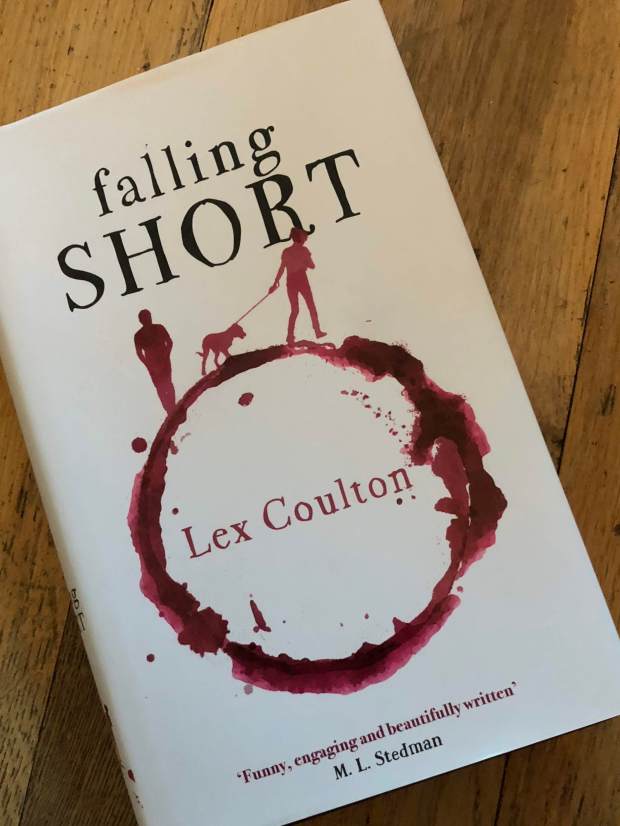
Falling Short by Lex Coulton

img_1184

Lex Coulton: Falling Short

Published By: John Murray

Buy It: here

What The Blurb Says: 

Review

A remarkable book: warm, moving and very funny (Jess Kidd)

Taking up the mantle of acute, humane observation from Muriel Spark, Falling Short is funny, engaging and beautifully written. A really refreshing read (M. L. Stedman)

A remarkable book: warm, moving and very funny

Taking up the mantle of acute, humane observation from Muriel Spark, Falling Short is funny, engaging and beautifully written. A really refreshing read

Book Description

A witty, charming and moving novel about finding things where you least expect them

About the Author

Lex Coulton studied English and later creative writing at Oxford. She spent fourteen years teaching English in secondary schools before taking a sabbatical year in Paris, to focus on her writing. Lex grew up in Herefordshire, and has recently returned to live there with her husband, John, and their dogs Bazil and Sadie.

What I Say:

Thank you to John Murray who sent me a copy of Lex’s novel, and it was so good, that I decided I had to write this blog post to tell everyone about it!

I had seen Falling Short talked about a lot on social media, and knew that it would be the sort of book that I would really enjoy – and I was right!

Frances Pilgrim is thirty-nine, teaching Shakespeare to sixth formers and has fallen out with her best friend, Jackson, who also teaches at the school.  As well as having to deal with the daily grind of being an adult in a world where you have to keep going because you can’t stop, Frances’ Mum is behaving in an increasingly erratic way as she battles Alzheimer’s.

Frances is an only child, and has always believed that her father disappeared at sea when she was five years old, and she is now having to juggle her professional life with the increasing demands of her personal one.

Falling Short eloquently shows how the cared for becomes the carer, an issue so many of us can relate to, and like Frances, we don’t just live around the corner from our parents.  Frances’ days are filled with numerous demands and pressures, trying to ensure she can maintain her professional reputation at school, whilst at the same time shuttling back and forth between her flat and her mother’s home as her mental health deteriorates.

Jackson is back in the UK, after having spent some time away in South Africa – the country where he grew up.  As the novel progresses, we learn exactly why Jackson had to leave the country so quickly, and why he is now sliding towards retirement in a school which seems to irritate him in every way.  His relationship history is, to be diplomatic, a rather colourful one, and he still has a reluctance to settle down.  Jackson seems at odds with the world, around him and simply wants an easy life.  He attends training sessions with the weary resignation of someone who has seen it all before and knows that fancy ideology does not work when you are at the coalface on a day-to-day basis.

Frances and Jackson have been great friends, but one night when the line is crossed, and they spend the night together, everything changes.  Frances distances herself from Jackson, and as she spurns his attempts to contact her, the friendship lies in tatters. What Lex does in an understated way throughout Falling Short is to make it obvious to us that Frances and Jackson are in love, and that they are the only ones who cannot see it.

All through the novel, I was willing one of them to make the first move, as they circle around each other, never quite getting close enough to say the right thing.  As they have to work together at school, you can really feel the unease and awkwardness between them as they try to professionally co-exist in an environment which throws them together constantly.

What elevates Falling Short for me, is the revelation that sends Frances off on a road trip like no other.  Her mum lets slip that her father did not pass away, and Jean, the neighbour who treats Frances like one of her own, confirms it.


Everything Frances has ever believed about her father and mother has been turned on its head, and now she has to decide whether she wants to take a chance and make contact with him.  Frances and her dog (brilliantly called Dog!) embark on a road trip to Yorkshire to discover the truth, to find her Dad, and Frances’ place in the world.  When Jackson and her friend Silv, discover what she is up to, and are unable to contact her, they too make the rash decision to follow her and for Jackson, he slowly realises what we knew all along, that he is in love with Frances.

I am of course, not going to give away what happens when Frances arrives at her father’s house, but the way in which the closing chapters of the novel use of the harshness and energy of the landscape are all-encompassing and powerful, as they seep out of the pages and into our desire to see Frances finally find the happiness and resolution she craves.

Falling Short is a stunning debut novel full of flawed, relatable characters, who flail around trying to make sense of each other and the world around them.  However, this is one of the many brilliant and endearing things about the novel – that for a change, our heroine and hero are not perfect, tee total, whip smart, organic vegetable eating, clean living yoga buddies.  They are just like us  – getting through every day in the best way they can, and I loved them all the more for it.

I loved it.


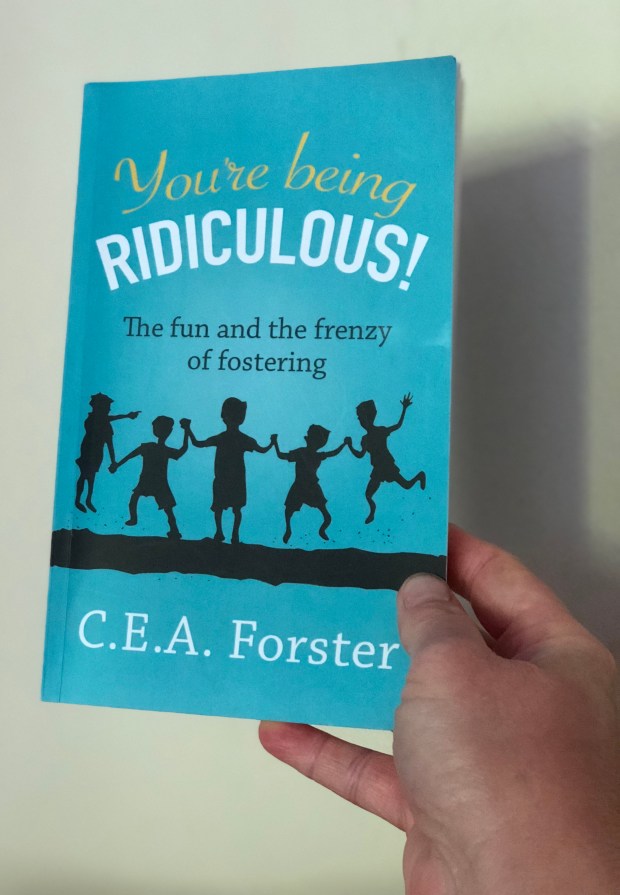
You’re Being Ridiculous by C.E.A. Forster

img_1119

C.E.A. Forster: You’re Being Ridiculous

Published By: C.E.A. Forster

Buy it: here


What the Blurb Says: 

A new authorial voice relaying true stories that are likely to both horrify you and make you laugh out loud. Events and conversations are told with pace, humour and humanity as the author shares with you her memories of the situations she has lovingly endured while at the mercy of her numerous foster boys.

It is heart warming, heart breaking and heartfelt in equal measures. It is a memoir of sorts but it is definitely not a misery memoir. C.E.A. Forster is youngish, conceivably pushing middle age, although she would argue as to where that line is drawn, and she is just wanting to share with you the trials, tribulations and sheer joy of her time as a foster carer.

She writes of the sounds of bystanders that she can still to this day hear ringing in her ears, tutting at her apparent inability to control the children in her care and of the mayhem that follows them everywhere, along with her repeated admonition to them of “you’re being ridiculous!” .

Claire has experienced those awful questions in the most public of places concerning the differences between boys and girls and has been informed by a six year old on the habits of mating Turtles. Have you ever heard of pee wars? Have you ever crash landed in a World War II plane and lived to tell the tale? Not to mention some of the topics discussed at the dinner table that would make even the most bold of us blush.

Claire won’t mind you laughing at her or with her and she will leave you knowing, in no uncertain terms, just how much she grew to love these boys and how they will always have a special place in her heart. She hopes that maybe one day they will come back into her life to remind her of their own memories.

What I Say:

Thank you very much to C.E.A. Forster for supplying me with a copy of her book in exchange for an honest review.

I have to admit that I wanted to review this book because I was curious about the world of fostering, having had no experience of it whatsoever.  I naively assumed that because I am a parent, I would understand what it takes to be a foster carer  – I could not have been more wrong!

You’re Being Ridiculous is the story of how Claire started fostering children and how she dealt with the everyday and not so everyday situations she found herself in!

What I found really refreshing about this book is that Claire does not claim to be any sort of foster carer expert, instead we see each situation as she deals with it, and the questions she has to ask herself as to how she should react appropriately.

As a mum, you can pretty much react in any way you want, and say whatever gets you through the tricky situation – as a foster carer, there is an added layer of responsibility and set of guidelines you are expected to follow which only adds to Claire’s dilemmas as she deals with the children in her care.

The situations that Claire and her foster children find themselves in are at times simply hilarious, and the scene in Aldi (you have to read it to believe it!), made me really laugh out loud. That is undoubtedly down to the no nonsense,  relatable way in which Claire writes.

It was also interesting to see how other people in the big wide world react to the sometimes unpredictable behaviour of the children, and that tutting is definitely the universal language of misunderstanding!  As a parent of a child with special needs that really resonated with me, as I have lost count of the number of times I have had to deal with stares and exaggerated tutting when my son doesn’t behave in a certain way.  I always think it would be very interesting to see how people would behave if they had to walk a mile in my shoes, and am sure that Claire must feel the same!

This is not to say that the book is just about the funny things that happen as Claire ventures into the world of fostering.  It is also balanced by the reality of what the young people in Claire’s care are going through.  We don’t know what place they are in their lives, and what they have seen or heard, and cannot begin to comprehend what they are thinking about as they find themselves in the house of a stranger for the first time.  Some of the most poignant scenes are where the children are trying to process what is happening to them, and how they deal with having been placed in Claire’s house.

For me, this is the strength of You’re Being Ridiculous – it could have been a flippant book filled with funny stories, but you can really feel the passion and love that Claire has for what she is doing.  As she gains experience (and that you need to have spares of everything just in case!), she learns how to adapt to each child, and that though one child may be really introverted and another is a non-stop dynamo, the most important thing you can do is just be there for the child when they need you.

You’re Being Ridiculous is not a long book – it comes in at two hundred pages, but it is full of emotion, laughter and compassion, something that jumps out at you from every page.  Claire has clearly found her vocation in foster caring, and her ability to tell her story so well and with so much love for the children who are lucky enough to come into her care, is a joy to read.

I hope that she is going to keep writing it all down for us, and hopefully we will see a sequel to You’re Being Ridiculous soon!


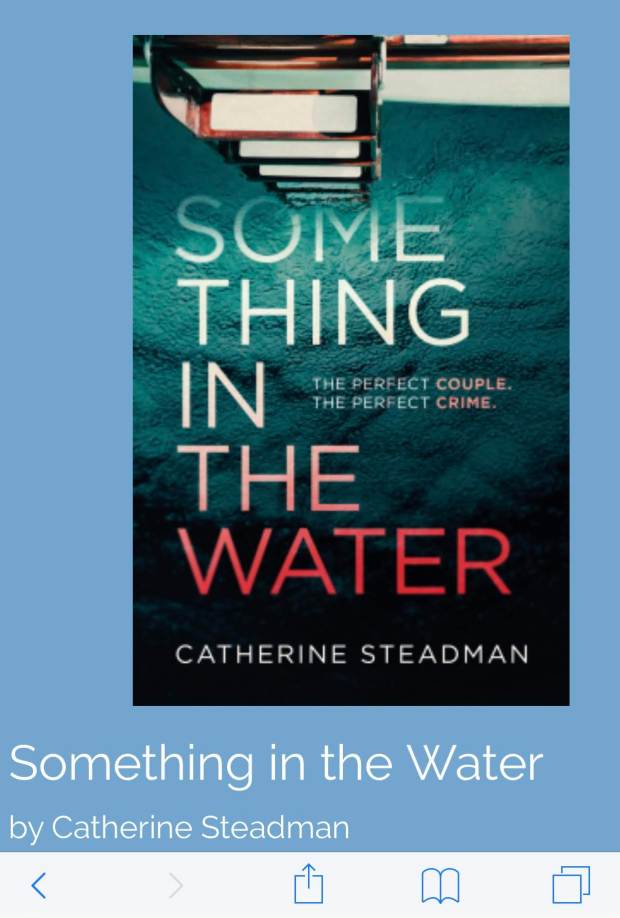
Something In The Water by Catherine Steadman

img_1114


Catherine Steadman: Something In The Water

Published By: Simon & Schuster UK (26 July 2018)

Buy It: here


What The Blurb Says:

Erin is a documentary filmmaker on the brink of a professional breakthrough; Mark a handsome investment banker with a bright future. They seem to have it all, until Mark loses his job and cracks start to appear in their perfect life.

But they’re determined to make it work. They book their dream honeymoon and trust that things will work out – after all, they have each other.

On the tropical island of Bora Bora Mark takes Erin scuba diving. Mark is with her – she knows he’ll keep her safe. Everything will be fine. Until they find something in the water.

Erin and Mark decide to keep their discovery a secret — after all, if no one else knows, who would be hurt? Their decision will trigger a devastating chain of events…  which will endanger everything they hold dear.

What I Say:

Thanks to NetGalley and Simon & Schuster UK for an advance e-copy of Something In The Water, in advance for an honest review.

There has been so much buzz about this novel already, and at the time of reading and writing my blog, Reese Witherspoon has selected Something In The Water as her June Book Club Selection, so with credentials like that, you know that this is going to be something special!

The other issue, is that the opening chapter sets the scene for the whole novel, and without giving away any massive plot spoilers, suffice it to say, it’s one of the best first chapters I have ever read.  That unsettling start, sets the tone for the entire novel – nothing is as it seems, and everyone is out for something.

To make sure we understand how we have got to that point, we move back to the very start of the story – when Erin and Mark met and fell in love.

Erin Locke and Mark Roberts seem like the couple who have it all – she is a film maker about to make a career changing documentary, and he is an investment banker who is on a career high.  Life for the two of them is perfect – until Mark loses his job, and the reality of him not being able to find a new one suddenly starts to hit home.

They are supposed to be getting married, but both realise that the expense of a wedding, coupled with an expensive mortgage and no immediate job offer for Mark, their once Instagram Perfect life looks like it could be snatched away from them.

Erin is making a documentary about the lives of three prison inmates – Holli – a young woman who committed arson during the London Riots, Alexa – who assisted in her terminally ill mother’s suicide and Eddie – who has mob connections and a sentence for money laundering.  It also seems that Eddie appears to have numerous connections to the criminal underworld and has an intense interest in what Erin is doing – in her personal life as well as in her career..

In an attempt to try and reconnect and decide how they can move forward with Mark out of work, they decide to go on their honeymoon to Bora Bora.  After a horrendous storm, Mark and Erin go scuba diving.  On the way back, something hits the side of the boat, and they decide to bring the seemingly innocuous duffel bag on board.

After an agonising should they, shouldn’t they debate, Erin and Mark open the bag, and realise that the four packs of contents inside, have the power to change their lives forever.

From that moment on, Something In The Water shifts up another gear as Erin and Mark’s life changes irrevocably.  The seemingly stable and perhaps smug world they have inhabited is shattered, and the question that dominates the novel is – when your life is on the line, who can you really trust?

Mark and Erin are forced to make a number of decisions – some measured, many rash,  and are becoming increasingly out of their depth, in a world of silent voicemail messages and evil people. They start to question not only what they have got into,  but also the strength they have within themselves to ensure that they can survive.

Of course, I could tell you what was in the duffel bag, and what happens to Erin and Mark, but as any good book blogger knows, that is not how I operate!  So, all I can say, is you need to get a copy of this book – because I guarantee that everyone will be talking about it this Summer.

Something In The Water is a sumptuous read, packed with numerous cinematic scenes and a plot that will make your head spin.  It is brilliantly written, the characters are flawed but relatable, and it is truly ambitious in its scope and premise.  Catherine Steadman has achieved that rare thing in a novel, where you care deeply what happens to Erin, but also understand at how in times of crisis, people will do whatever it takes to protect what really matters to them – whatever the cost…

I loved it.