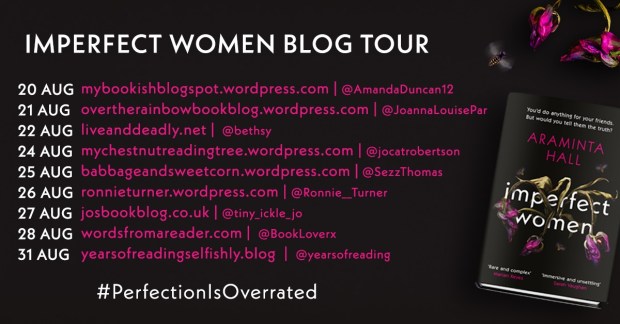
Imperfect Women by Araminta Hall

Imperfect Women by Araminta Hall

Published by Orion Books

Available from all Good Bookshops and Online

What They Say

Nancy, Eleanor and Mary met at college and have been friends ever since, through marriages, children and love affairs. 

Eleanor is calm and driven, with a deep sense of responsibility, a brilliant career and a love of being single and free – despite her soft spot for her best friend’s husband.

Mary is deeply intelligent with a love of learning, derailed by three children and a mean, demanding husband – she is now unrecognisable to herself and her friends.

Nancy is seemingly perfect: bright, beautiful and rich with an adoring husband and daughter – but beneath the surface her discontent is going to affect them all in terrible ways. 

When Nancy is murdered, Eleanor and Mary must align themselves to uncover her killer. And as each of their stories unfold, they realise that there are many different truths to find, and many different ways to bring justice for those we love…

What I Say

Women, Eleanor thought, carry guilt and responsibility like a second skin, so much it weighs them down and stops them ever achieving quite everything they should.

Over the years, I have come to realise that the kind of novels I love to read are ones where they are female led, the same age as I am, but most importantly with a moral and ethical code far removed from mine. Why? Well, in my opinion they make the most interesting and compelling stories.

Close enough to me so I can relate to their hopes and fears, but just deliciously twisted enough so that I can delight in the dilemmas and situations they find themselves in!

Do I seem that sort of person? Maybe you have a different view as to what kind of person I am, and that right there is the whole crux of Imperfect Women. Who really knows us, and what is the difference between our public and private selves? After all, we know that #PerfectionIsOverrated don’t we?

Three seemingly close friends Mary, Nancy and Eleanor met at University and have been together ever since. They have been there to support each other through affairs, marriage, childbirth and secrets.

These women seem to be the perfect and supportive friend group – until one day Nancy goes missing after having dinner with Eleanor and she is found dead. Instantly their world is turned upside down, and when Eleanor goes to Nancy’s house, Nancy’s husband Robert, confesses he believed that Nancy was having an affair. The thing is, Eleanor knew – but only that the man was called David and she had met him at work.

From this point on, the lives that these women have held together for so long starts to unravel in ways they could never have imagined. Eleanor and Mary are left facing the reality that the woman they believed they knew so well was someone they didn’t really know at all. Eleanor and Mary are desperate to find out what happened to their friend, but don’t for one minute think this novel is a murder mystery.

Imperfect Women is so much more.

As we hear the stories of each of the women – each has a section of the novel’s narrative to herself, what becomes increasingly apparent is this is a novel about the choices women make or are expected to make. It also shows the unpalatable truth that whichever one you choose it won’t be the right one. Nancy is a stay at home mum with an apparently fabulous and carefree lifestyle, Eleanor has dedicated her life to her career working for charity, and Mary has put aside any ambitions to dedicate her life to her ungrateful academic husband and her three children – and she has become invisible to society.

Little by little we start to understand what exactly is going on for each of the women, and how the lives they have lived and projected to the outside world may have seemed to be one thing, but in fact it is only when we read each of their narratives do we understand the way in which they constantly judge themselves and their friends.

Nancy is apparently living a fabulous life – she doesn’t have to work, she has a house in the city and one in the country for weekends, and a husband called Robert who adores her and their wonderful daughter Zara. Scratch beneath the surface and you see a woman who is living in a gilded tower, whose husband has basically forbidden her to work, and has struggled with the isolation and mundanity of motherhood and bringing up a child. It seems understandable that she should be drawn to seeking something beyond the confines of her marriage. I really felt Nancy’s frustration and desperation to feel something, anything that wasn’t what she was told or expected to feel. It seemed almost logical that an affair would give her this sense of liberation from her life – but not that it would culminate in her death.

Eleanor has established herself as the career woman, who is apparently the most independent and driven of the three. She works hard and loves what she does, but as a reader you get the sense that she does question whether she has made the right choices. Having children was not part of the equation for her, and it is interesting to see how everyone else felt it was their place to comment on her choices. I felt she was envious of Nancy, and when the opportunity comes up for her to be closer to Robert – she has no qualms about taking it. This is the thing with all these women. They assure each other that their bond is unbreakable, but at certain key moments, they each prove their morals take second place to their own needs and wants.

Mary was the character I felt closest to. She is married to the unappreciative and quite frankly odious Howard. He has systematically stripped away her self belief and confidence over the years as he slides from affair to affair, all the while berating Mary for not living up to his expectations. Her intelligence and own hopes and dreams have been disregarded as she has to look after her three children (four if you count Howard!) and she is becoming increasingly jaded and accepting of her own life. She loves her children passionately and devotes her life to them, but she has also lost her own identity and I think this is so true of many women over forty. We are someone’s wife, someone’s Mum, but as Mary realises, when the chance presents itself, she has to find the courage to change everything and become Mary again.

As I read the novel, what worked so well for me were the revelations not only about each of the women, but also about the connections they had with each other too. Little by little, Araminta Hall drip feeds little pieces of information that slowly start to come together, and then the realisation hits you as to how much and how little these three friends really know about each other!

When the identity of Nancy’s lover is revealed (no of course I’m not going to tell you, read the book!) the lives of the women are changed forever, and I loved how this gave Eleanor and Mary the impetus to take control of their lives. As the novel moves to its conclusion, which is done so well and is not what I expected, I thought it was poignant how Mary and Eleanor reconnected and how the longevity and unspoken bond of their friendship was what gave them strength to carry on- even though they still weren’t being entirely honest with each other.

Imperfect Women is a novel that will reinforce what you already know about women today – that they can be career orientated or stay at home to raise their families, but that both choices are seen as imperfect, and to mix the two is regarded as taking neither seriously enough. It also raises many complex questions about who decides what women should do, and why we still allow ourselves to be defined by others expectations and needs and desires, and still lack the confidence to put our own demands first.

I loved it.

Thank you very much to Francesca Pearce at Orion for my gifted copy of the book in exchange for an honest review. Check out what these other brilliant bloggers have been saying too..
Comedy Women In Print Shortlist Shadow Panel- Big Girl, Small Town by Michelle Gallen

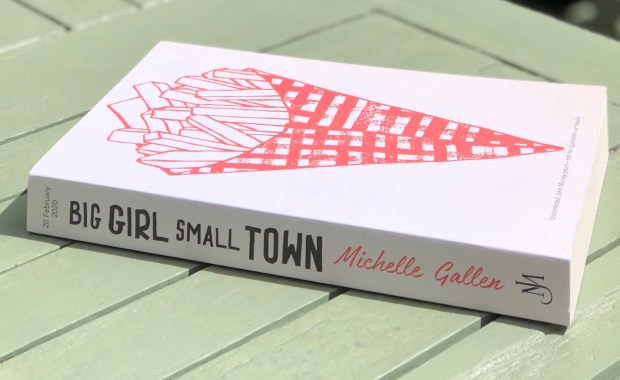
Big Girl, Small Town by Michelle Gallen

Published by John Murray Press

Available at all Good Bookshops and Online

What They Say

Routine makes Majella’s world small but change is about to make it a whole lot bigger.

*Stuff Majella knows*
-God doesn’t punish men with baldness for wearing ladies’ knickers
-Banana-flavoured condoms taste the same as nutrition shakes
-Not everyone gets a volley of gunshots over their grave as they are being lowered into the ground

*Stuff Majella doesn’t know*
-That she is autistic
-Why her ma drinks
-Where her da is

Other people find Majella odd. She keeps herself to herself, she doesn’t like gossip and she isn’t interested in knowing her neighbours’ business. But suddenly everyone in the small town in Northern Ireland where she grew up wants to know all about hers. 

Since her da disappeared during the Troubles, Majella has tried to live a quiet life with her alcoholic mother. She works in the local chip shop (Monday-Saturday, Sunday off), wears the same clothes every day (overalls, too small), has the same dinner each night (fish and chips, nuked in the microwave) and binge watches Dallas (the best show ever aired on TV) from the safety of her single bed. She has no friends and no boyfriend and Majella thinks things are better that way.

But Majella’s safe and predictable existence is shattered when her grandmother dies and as much as she wants things to go back to normal, Majella comes to realise that maybe there is more to life. And it might just be that from tragedy comes Majella’s one chance at escape.

What I Say

As I have got more and more into judging the novels on the Comedy Women In Print Shortlist Prize, one of the many things I have learned is that it means I have a responsibility to read all the books, whether it is one I would choose to read or not. That is the wonderful thing about reading, that in picking up books outside my comfort zone, I have not only found new authors, but also have had the chance to step into the worlds of unlikely protagonists like Majella O’Neill.

Big Girl, Small Town is absolutely and completely Majella’s story and we are with her every step of the way.

It takes place in a Northern Irish town called Aghybogey where Majella lives and works. In fact she has never been anywhere else, and the town she lives in is her world. She works for the minimum wage in a fish and chip shop, and is also dealing with her Mum who is an alcoholic and utterly dependent on Majella. Her father is no longer living with them, having vanished as The Troubles raged around them.

The domestic and mundane life that Majella and her family has, is set against the world around them, and although The Troubles are known as an historical event, in Majella’s world they are part of the fabric of her family’s history too. We learn that her Granny has been murdered in her own home, and in spite of it, Majella has to carry on as normal for her Mum and for herself.

Majella is autistic, although that is never explicitly stated, and we see how she has to naviagate her life by establishing routines and strategies for dealing with the world around her. Everything is very black and white for her, and to cope with situations like the suggestive and rude male customers at the Chippy, she had to ‘learn’ the socially acceptable way to deal with them so that she can function.

I thought Michelle handled this really sensitively – Majella copes by stimming – which for her is rocking on the balls of her feet and flicking her fingers. This isn’t made into a huge part of the story, but as readers we can see it, and it is the little details and quietly mentioned rituals and routines that add poignancy and emotion to what Majella is dealing with.

Her bedroom at home becomes her haven – a place where she can make it just as she wants it, even though the rest of the house is like a bomb site. It is her place to eat, to watch her Dallas DVDs, to think and to be in peace. For me, one of the most touching scenes in the book is when Majella treats herself to a new luxurious duvet set that she has paid for herself. It is joyous to see how wonderful it makes her feel, but tinged with sadness that she has no one to do that for her.

Majella and her mother almost become local celebrities because of her Granny’s murder, but as awkward and uncomfortable as it is for Majella, it almost gives her an air of untouchability and celebrity by association. In a strange way, this helps Majella exist in a world where repetition and the tedium become her comfort.

I would have to say that Big Girl, Small Town is not a cosy, comfortable read. The humour and laughter is balanced by the less than palatable part of Majella’s life. She has unromantic sex with Marty her married work colleague because she wants to have sex, not because she is attracted to him, and through the novel the sex she has is unemotional and without passion. The sex scenes and the way sex is talked in almost a biological sense fit in with the story because Majella is very matter of fact and direct too.

The novel also shows us the stark reality of life for people in a town who do not have a lot of money, and are trying to survive the day to day grind. At times this may seem bleak, but it is also important to note that there is an innate sense of community and at times humour too. Everyone knows everyone else, although it might seem like they don’t, they look out for each other and try to help as much as they can.

Majella’s life outside work consists of her looking after her alcoholic Mum and eating food from the chippy alone in her bedroom. She seemingly just accepts that this is her life, and gets on with it, however heartbreaking it may be for us as the reader to see.

I thought that it was a brilliant plot device of Michelle’s to have Majella working in a chippy, as it is a focal point for the town, and gives the reader a chance to meet all the different characters who go there. It may seem like nothing much happens on a daily basis, but by hearing their stories, we learn about the reality of life in Aghybogey. Going to the chippy is part of their routine and gives some people structure, other people a place to gossip, and for some characters it is their connection to the world beyond their front doors.

Big Girl, Small Town finally offers some hope for Majella after her Grandmother passes away, and a will is read, and when she realises that someone believes in her she finally starts to believe in herself. Majella understands that she has the potential to change her life – all she has to do is to find her courage. If you love a novel that is packed with larger than life characters and writing that moves from laughter to sadness and back again, then Big Girl, Small Town should absolutely be on your reading list.

It is at times undoubtedly challenging to read, as you really feel for Majella and the seemingly bleak life she leads, and it was painful at times to watch what happens to her. This I think is what Michelle is trying to show us – that although Majella is seemingly caught in a world without hope, the chance to change her story is always present – she just needs to believe in herself enough to take the first step.

Comedy Women In Print Shortlist Shadow Panel – Queenie by Candice Carty-Williams

Queenie by Candice Carty-Williams

Published by Trapeze

Available from all Good Bookshops and Online

What They Say

Queenie is a twenty-five-year-old Black woman living in south London, straddling Jamaican and British culture whilst slotting neatly into neither. She works at a national newspaper where she’s constantly forced to compare herself to her white, middle-class peers, and beg to write about Black Lives Matter. After a messy break up from her long-term white boyfriend, Queenie finds herself seeking comfort in all the wrong places. 

As Queenie veers from one regrettable decision to another, she finds herself wondering, What are you doing? Why are you doing it? Who do you want to be? – the questions that every woman today must face in a world that keeps trying to provide the answers for them. 

A darkly comic and bitingly subversive take on life, love, race and family, Queenie will have you nodding in recognition, crying in solidarity and rooting for this unforgettable character every step of the way. A disarmingly honest, boldly political and truly inclusive tale that will speak to anyone who has gone looking for love and acceptance and found something very different in its place. 

What I Say

If like me, you are on bookish social media (a lot in my case!) you cannot have failed to have heard about Queenie. When it was published in 2019, it was everywhere, and I have to admit that for that very reason, I bought a beautiful teal hardback signed copy, and then put it on my shelf and promised myself I would read it. I didn’t.

When I found out it had been shortlisted for the Comedy Women In Print Prize, it was the perfect time to read it, because all the noise around it had quietened down and it meant that I could now give Queenie my undivided attention.

I am so glad I did, because I loved this novel.

Queenie seemingly embraces and lives life to the fullest – she has a supportive family, a group of quite frankly fabulous friends, a great job and a relationship with Tom. The novel opens with Queenie at a Sexual Health Clinic with her Auntie Maggie, but it transpires she has suffered a miscarriage, and that actually her relationship with Tom is on an extended break, and he doesn’t want anything to do with her.

What is also evident throughout the novel is the amount of casual racism which permeates every part of Queenie’s world. Strangers want to touch her hair and men on dating apps make awful sexual and racist comments constantly. Tom is white, and although his family appear to have no issue with him dating a Black woman, it is their thoughtless and internalised racism that comes to the fore in throwaway comments or behaviour.

Queenie has a brilliant group of friends she nicknames ‘The Corgis’ – the fabulous Kyazike, her kind work colleague Darcy, and the ever analytical Cassandra. Queenie has an amazing and enviable bond with these women, and their WhatsApp exchanges are so natural and real, that it felt as if I was part of the group too! Their sense of protectiveness and being true and real with each other really reminded me of how powerful and needed female friendships are.

Although Queenie seems to enjoy her job on a national newspaper, she is frustrated by their lack of embracing her efforts to talk about wider issues that affect Black people. Gina her boss is exasperated at times by Queenie’s disengagement with her role, but you get the sense that Gina sees Queenie’s potential if only she could too.

As Queenie starts to grudgingly accept that she and Tom are over, she starts to meet other men – Queenie wants sex and is unapologetic about it. Some of the sex scenes in Queenie are very graphic, at times brutal and disturbing, and one experience she has with a man called Guy was really difficult to read. In fact when she goes to the sexual health clinic, the staff think she is a sex worker, and that the extent of her injuries give them concerns as to whether she has had consensual sex or has been assaulted.

The men she encounters are not looking for a relationship, and the fact she is Black is something they almost see as a point on their score card. What becomes evident to the reader as the novel progresses is that Queenie is using sex as a way to try and feel something, a connection, a sense of power, but it is really masking her mental deterioration and subsequent breakdown. There is also the sense that something in Queenie’s childhood is always simmering constantly at the back of her mind, and that is has shaped how she sees her own relationships.

This is what really resonated with me about Queenie – is that this young woman who seemingly has so much to look forward to is trying so hard to be so many things to so many people, but is also dealing with the fact that she is estranged from her Mum because of the actions of another man. Queenie’s world starts to unravel – a man she has been pursued by and slept with alleges she has been harrassing him, she is then suspended from her job, loses her home and is forced to move in with her grandparents.

Her decision to seek counselling is something her grandparents find difficult to accept, but eventually they understand why she has to. For me, Queenie’s grandparents were two of my favourite characters. Their love and care for Queenie was such a powerful thing to read, and the fact that they dealt with her in the only way they knew how- by refusing to let her dwell on what she was going through was really affecting for me.

Slowly by confiding in her therapist Janet, Queenie starts to let her and us as readers into her life, and we see exactly what happened and why she is estranged from her Mum. Little by little, Queenie starts to rebuild her life and when the man who got Queenie suspended at work is found to have lied about their consensual sex, it is finally time for Queenie to take the next steps in life, but this time, she is in control.

As a forty-nine year old white woman, I thought I was not the target market for this book. I was wrong.

Candice Carty-Williams has written a novel that draws you in from the first page, and it is witty, warm, and a joy to read. At times it is undeniably challenging too, and honestly I found some of the sex scenes very hard to read. It made me think so much about the world Queenie lives in, and the reality of life for Black women in Britain today. Queenie is a novel that is many things, it is fast moving, funny, tender and at times heartbreaking too.

What is at the heart of this novel for me is the realisation Queenie comes to as to how important and necessary family and friends truly are. Above all, it introduced me to Queenie and her world, and I very much hope I get the chance to meet her again really soon.

The Blessed Girl by Angela Makholwa

The Blessed Girl by Angela Makholwa

Published by Bloomsbury

Available from all Good Bookshops and Online

What They Say.

Young, beautiful and ambitious, Bontle Tau has Johannesburg wrapped around her finger. Her generous admirers are falling over themselves to pay for her Mercedes, her penthouse, and her Instagrammable holidays. It’s her duty to look fabulous – after all, people didn’t sacrifice their lives in the freedom struggle for black women to wear the same cheap T-shirts they wore during apartheid.

Bontle’s come a long way, and it hasn’t been easy. Her shrink keeps wanted to talk about a past she’s put firmly behind her. And what she doesn’t think about can’t hurt her, can it?

Blessed adj. [pronounced bles-id] 
The state of being blessed, often referring to a person, usually female, who lives a luxurious lifestyle funded by an older, often married partner, in return for sexual favours.

What I Say.

“All men are dogs, and I’d rather be crying in a Ferrari than in a Polo Playa, honey.’

I had actually bought a copy of The Blessed Girl before I was asked to be a Shadow Judge for the Comedy Women In Print Prize because it looked just the kind of novel I was looking for! I was thrilled to see it being Shortlisted and now I had the perfect reason to sit down and read it!

Let me tell you right from the very first page, I am so pleased I did.

Make no mistake, Bontle Tau is a protagonist quite unlike anyone you have ever met before. From the moment you start reading The Blessed Girl, it is abundantly clear this young woman is passionate, determined, and defiantly unapologetic for the life she is leading. She seems to live and narrate her life directly to us as if she exists on social media, and is constantly filtering and editing her world until it gets the maximum number of likes.

Bontle has a lifestyle that many of us would be envious of. A gorgeous apartment, designer clothes, a fabulous car and Instagrammable holidays we could only dream about. The thing is, and as she tells us from the start, Bontle is a blessed girl, which means that her lifestyle is solely funded by the powerful and rich older men she sleeps with.

She also knows exactly what she has to do and how she has to look to ensure that the men who bless her stay with her and continue to fund her day to day existence.

We find out that Bontle is actually still legally married to a man called Ntokozo. They met when they were young and got married, much to the disdain of Ntokozo’s family, and for a time seemed to be happy. Unfortunately Ntokozo’s work as a doctor, and the pressure he was under, led to him becoming addicted to drugs. Bontle felt isolated and unhappy, and decided she needed to find a way to live her own life and be free from him.

As Bontle decides to pursue the life of a Blessed Girl, she seems to relish the fact that these men will give her whatever material things she wants in exchange for sleeping with them. Bontle knows this, but doesn’t have a problem with it, and is also running her own hair weave business. She regards these men as transactions in her life as a means to her achieving her own dream of opening up her own boutique. While it may be uncomfortable for us to read about Bontle’s choices, for me, the fact that she was so direct and aware of what she is doing and why, helped my understanding.

As the novel progresses, Bontle is regularly sleeping with three men – Teddy Bear, Mr Emmanuel and Papa Jeff and she has no qualms about stealing them from other women – even her friends, if they will give her what she wants. When Teddy Bear needs her to be the front of his building development she does so half heartedly, but is motivated by the fact that she will receive a nice big payment for doing so!

To assume that this book is simply a light hearted, fluffy story about Bontle’s Blessed world would do Angela Makholwa’s novel a huge disservice. What works so brilliantly is the way in which in a slow and understated way, we start to see how Bontle’s childhood and relationship with her mother and brother Golokile has shaped the choices she makes now. The perfection of her present world is set against the harsh and uncompromising reality of Bontle’s past childhood home, and the way her mother raised her and failed to protect her.

We see how Bontle is trying to cope with both of her lives, help her brother make a better life for himself and for her mother to understand what she did affected Bontle so deeply. When we finally see what happened to Bontle, suddenly I understood why the life she leads now is the one she feels will help her achieve her dreams. It may seem like the men are using her, but Bontle is using them too.

Hand on heart, I absolutely loved The Blessed Girl. It is funny, fast paced and opened my eyes up to a whole new world of Blessed Girls and Blessers that I had never heard of before. It may be uncomfortable reading at times, but the thing about The Blessed Girl is that as readers we need to understand the world Bontle came from and why. Angela’s writing is incisive, smart and puts Bontle front and centre of everything, which is where she absolutely deserves to be.

I loved it.

Thank Goodness I Can Tell You…!

As you may have gathered by now, keeping quiet is perhaps a challenging thing for me at the best of times – especially when it comes to talking about books!

For a while now, I have been keeping a secret that has been so hard not to share with you all because I am really excited about it!

Well, today is finally the day I can reveal all!

I am so thrilled to tell you that I have been asked by the fabulous Comedy Women In Print Prize to be part of their very first Shadow Blogger Panel!

Over the next few months, myself, Susan Corcoran, Janet Emson, Stacey Garrity and Danielle Price will be reading and reviewing all the novels on the Shortlisted Published Comic Novels Authors Shortlist who are:


Michelle Gallen for Big Girl, Small Town from John Murray


Beth O’Leary for The Flatshare from Quercus Books


Angela Makholwa for The Blessed Girl from Bloomsbury Books


Nina Stibbe for Reasons to be Cheerful from Penguin


Candice Carty-Williams for Queenie from Trapeze Books


Abbi Waxman for The Bookish Life of Nina Hill from Headline

Jeanette Winterson for Frankisstein from Vintage

You can read more about all the fabulous authors and their novels here

The winner of our Shadow Panel Winner will be announced in early September, and the Judge’s decision will follow.

It feels SO much better to finally be able to tell you all, and I can’t wait to start reading all these novels and telling you all about them as I go.

Here’s hoping you all follow along with all of us and the hashtag #CWIP and do please tell us what think about the shortlist. As you can guess, I’ll be talking about this a lot, all over Twitter and Instagram- it’s so important to me that you all feel involved with this amazing prize too!

So, what do you think? Any there you can’t wait to read? Any that you have read already and loved? Please do let me know – I love to chat to you all about books, so any feedback or anything else you would like to see from me, just let me know.

Now, I don’t know about you, but I have some rather fabulous books to read…

Love

Clare xx

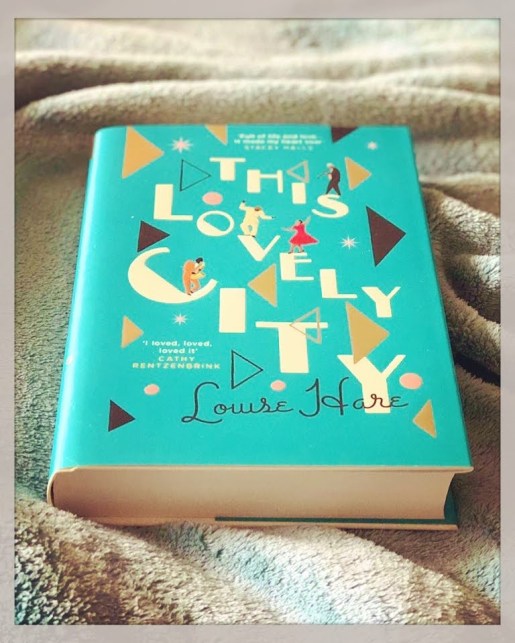
This Lovely City by Louise Hare

84d3cee4-2a2f-48c7-9f87-f1286c11f66e

This Lovely City by Louise Hare

Published by HQ Stories

Available from all Good Bookshops and Online


What They Say

The drinks are flowing.
The music is playing.
But the party can’t last.

With the Blitz over and London reeling from war, jazz musician Lawrie Matthews has answered England’s call for help. Fresh off the Empire Windrush, he’s taken a tiny room in south London lodgings, and has fallen in love with the girl next door.

Touring Soho’s music halls by night, pacing the streets as a postman by day, Lawrie has poured his heart into his new home – and it’s alive with possibility. Until, one morning, he makes a terrible discovery.

As the local community rallies, fingers of blame are pointed at those who had recently been welcomed with open arms. And, before long, the newest arrivals become the prime suspects in a tragedy which threatens to tear the city apart.

What I Say

I need to start this Blog Post with an apology to Louise.  I read This Lovely City in May, and adored it, and started a blog post straight away, but I just couldn’t find the right words to tell you all about it.  We were in the middle of lockdown, adjusting to life with all four of us – five if you include our dog, at home, all the time, and we didn’t know what was going to happen next.  Juggling everyday life, school work, new rules and not being able to go out as and when we wanted hit me hard.  The world beyond our house was also facing an unprecedented time, people were protesting throughout the world about Black Lives Matter, and my words somehow didn’t seem important enough to publish.

The thing is, that Louise’s novel is on the bookshelf in my dining room, and every time I went in there, it was sat there waiting for me in its bold and beautiful cover.  I need to tell you about this novel, about Lawrie and Evie, about why their story is so important for us all, and how we think everything has changed in our society, but in so many ways, there are so many attitudes that have not moved on from the time where Lawrie and Evie’s story is set.

Lawrie is part of the Windrush generation, who has come to our country in search of a better life for himself and his family.  He is in love with Evie, the girl next door, who lives with her mother Agnes, and they are like most young people, trying to find a way to spend some time together in a world where it is not seen as appropriate for unmarried couples to spend time together alone. Lawrie is working as a postman, but at night time, he and his friends form a jazz group and play at venues around London.  It seems that this is when Lawrie and London really come alive – Louise’s descriptions of the sights and sounds of this world which where Lawrie really can be himself are so vibrant and real that you feel you are sat in the corner watching these friends enjoy their lives.

One day, when Lawrie is on his post round, he is approached by an hysterical woman who has found the body of a baby in a nearby pond. When Lawrie is taken to the station to give his side of the story, it is clear from the moment that he enters the room, that the police are certain Lawrie killed the child. What is so unnerving and uncomfortable to read about this incident, is not only the judgements that the police unquestioningly put on Lawrie, but how casually and unconsciously their attitude and manner towards him is dripping with the racism they are so comfortable with.

With seemingly little to go on, Lawrie is released – to find that the tyres on his bike have been slashed.  This is what makes This Lovely City so difficult but so necessary to read. This is London in the 1950s. Lawrie and his friends were actively encouraged to come here by the government as part of the Windrush generation, to help Britain rebuild after the Second World War, but the shiny pamphlets and promises of a better life failed to mention the way in which they would be treated and the racist attitudes that they would encounter at every turn.

Lawrie may have been released, but as the baby who passed away was black, the police are convinced that the person who committed the crime must be too, and they step up their threats and intimidation, seemingly randomly targeting people in an attempt to illicit a confession from someone. The interesting thing in this investigation too is that Mrs Barratt, a white woman who found the child’s body is automatically discharged from the enquiry.

As the investigation continues, what is so strong in this narrative is that all this tension, suspicion and sobering sense of unease is set against the love story of Evie and Lawrie.  Her love binds him to her unquestioningly, and her determination to prove that Lawrie is innocent is the driving force throughout the novel.  Evie also faces casual racism on a daily basis, from people not taking her seriously at work, to those not wanting to sit near her on a bus. For me, these scenes were shameful to read, because they were so casual yet so ingrained in so many people.

All Lawrie and Evie want to do is to have the chance to be married, and to embrace the life that was tantalisingly promised to them by the very country that is so intent on destroying it. As the novel moves forward, it becomes clear that both Lawrie and Evie have hidden secrets from each other, frightened that revealing them could end their relationship.  Ultimately, it is only by realising that their love for each other is the most powerful and immovable force, that they can finally be honest with each other and live the life together that they deserve.

From the very moment you turn the first page, in This Lovely City, Louise Hare immerses you absolutely in London in the late 40’s and early 50’s.  The sights, sounds and world Lawrie and Evie are in are so clear and vibrant that it makes you lose yourself totally.  Both Lawrie and Evie are characters that not only are trying to find their way in this huge and sometimes cruel city, but they are also trying to find a way to be together totally honestly, when both have secrets they are desperately trying to hide from the person they love the most.

This Lovely City is a novel that will educate you, make you see how far we think we have come in terms of our understanding and condemnation of racism, but unflinchingly shows us how much there is still to do and how much further we have to go. At the heart of this unforgettable story and in every single page is the love story of Lawrie and Evie. All they want is to live together in peace, in the city they love, and their innate capacity for love and tolerance is perhaps the most important lesson we need to take from their enduring narrative.

I absolutely loved it.

Thank you very much to Joe Thomas and HQ Stories for my gifted copy in exchange for an honest review.


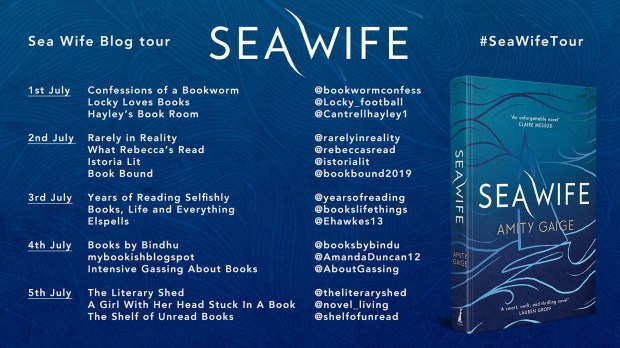
Sea Wife by Amity Gaige


Sea Wife by Amity Gaige

Published by Fleet

Available online and at All Good Bookshops


What They Say

Juliet is failing to juggle motherhood and her anemic dissertation when her husband, Michael, informs her that he wants to leave his job and buy a sailboat. The couple are novice sailors, but Michael persuades Juliet to say yes. With their two kids – Sybil, age seven, and George, age two, Juliet and Michael set off for Panama, where their forty-four-foot sailboat awaits them – a boat that Michael has christened the Juliet.

The initial result is transformative: their marriage is given a gust of energy, and even the children are affected by the beauty and wonderful vertigo of travel. The sea challenges them all – and most of all, Juliet, who suffers from postpartum depression.

Sea Wife is told in gripping dual perspectives: Juliet’s first-person narration, after the journey, as she struggles to come to terms with the dire, life-changing events that unfolded at sea; and Michael’s captain’s log – that provides a riveting, slow-motion account of those same inexorable events.

What I Say

“I had held myself together all my life. Then I became a mother, twice, and I was not fine. I was the opposite of me.”

When I heard about Sea Wife, I was really interested to read it, because for me, a life on the ocean is one that I have never contemplated nor ever experienced.  I also thought it was interesting that the title immediately categorises Juliet, the main character  in such a powerful and definitive way.

At first glance, it might seem like Juliet and Michael have it all  – a home, two children and a life that they have constructed for themselves that satisfies what everyone in their social circle expects. They are the epitome of the American Dream. Michael works for an insurance company, and Juliet, a poet, is attempting to complete her PhD.

Unfortunately, beneath the veneer, Juliet and Michael are struggling. Both with their own emotional state, and their marriage. Juliet suffers from depression and has also suffered sexual abuse as a child and now her ‘ugly angels’ torment her, and and she is plagued by the feeling that she simply is not fit to be a mother. Michael feels trapped in his job, and is increasingly realising that he needs to do something to help Juliet and to try and open communication between them before their marriage disintegrates.

Michael’s decision is to buy a boat which he renames Juliet – something he later discovers is regarded by those in the sailing world as a bad omen.  He has to then persuade Juliet that by taking a year off, and having their children Sybil and George with them, that this is just what they all need to try and find their way back to each other.

The novel is told from a dual narrative perspective – via Juliet’s memories and the Captain’s Log that Michael keeps whilst on board.  Stylistically and linguistically it also creates two distinct stories for the reader as Michael’s writing is in bold and to the right hand side of the page, and Juliet’s is more free flowing and lyrical and it seems more at times to be a flow of consciousness. As the voyage progresses, it is interesting to see how Michael becomes less analytical and logical and instead uses his journal as a way of not only tracing his relationship, but also gaining a deeper understanding of the issues and divides within their marriage.

As they undertake their voyage, it seems like Michael was right, and that in moving away from the constraints they have so strictly adhered to, that Juliet and Michael are slowly able to see the person they fell in love with.  All the time, Amity ensures that the ocean is an ever present and omnipresent force.

At times it is passively part of the backdrop, which makes Michael and Juliet feel that they are in control and have done the right thing in coming away together.  However, they are also reminded of how dispensable and unimportant they are in the world when they have to tackle the storms and ferocious unpredictability of the sea.  It is those times that their marriage is most put to the test as Juliet has no experience of sailing and she is totally reliant on Michael’s knowledge to keep them all safe.

They may be on this voyage as a family, but the limited living space and emerging tensions in their marriage mean that as time passes, Juliet and Michael finally start to see each other at their most open and honest. They realise that politically they are poles apart, that Michael has secured a loan for the boat against their house, and they start to wonder whether they really have a future when the voyage is over.

Then Michael falls seriously ill, and Juliet is forced to make a decision that alters the course of their lives forever, and it ultimately means Juliet has to face the reality of her marriage and confront her own mental health issues too.

Sea Wife is an emotionally challenging and taut novel that will make you think about the relationships with those people closest to you, and how much we take for granted in the way we seamlessly go about our daily lives together. For Michael and Juliet, they chose to embark on this seemingly idyllically journey in an attempt to salvage their fractured marriage. Amity Gaige’s intriguing and realistic portrayals of Michael and Juliet’s world in all its brutal and unfiltered reality, make us understand that we may never truly know the person closest to us until we have no choice. Sea Wife also unapologetically makes us realise, that perhaps we never really knew them at all.

Thank you very much to Grace Vincent at Fleet for my gifted copy of Sea Wife in exchange for an honest review.

Please do see what the other bloggers on the tour are saying too..

Negative Capability by Michèle Roberts

Negative Capability by Michèle Roberts

Published By Sandstone Press

Available from all Good Bookshops and Online

What They Say:

Yesterday ended in disaster. Very late at night, I decided to write down everything that had happened; the only way I could think of coping.
So here goes.
 

So begins Michele Roberts’s intimate and honest account of the year after her latest novel has been rejected by her then publisher. Written with warmth and sensitivity, she navigates the difficult road from depression and anxiety to acceptance and understanding of the value of the friendships which nurture her and make life worth living – whatever happens.


What I Say:

“I’d rediscovered, recording them, the pleasures of doing ordinary things,

the pleasures of living day to day.”

I think like many people, I had always assumed that once an author has had a book published, every book they write is edited and it is a done deal that we will see it in the Bookshops.

Negative Capability is Michèle’s Diary – a book about what happens when her latest novel is rejected by her publishers. It is obviously a painful and awful experience for her, and I can imagine that everything you had planned about that book being published suddenly slips out of your hands slowly and absolutely out of your control.

As a response to this, she writes about what it is like to be an author with no book being published on the horizon. This is where it becomes a really absorbing and revealing read, as Michèle opens her heart and life totally to the reality of having to accept that you have no plans. The Negative Capability of the title refers to the idea that instead of reacting to a negative situation, you instead allow yourself to resign to the fact that yes, this is not a good place to be, but that it will get better.

What I really loved about Michèle’s writing is the fact that it is not linear, and it slides beautifully from one moment to the next. One minute she may be talking about her gardens, the next the passing of one of her friends, but it works so well because it is and authentic and visceral experience, and I felt as if I was sat having a drink with Michèle as she talked about her life.

Memories slide from one to the next, we learn about the families she comes into contact with, the lovers she has had, her visits to France and all the social niceties there and the etiquette one is expected to follow. I also felt that it was almost Michèle’s love letter to France, a way for us to understand the deep emotional connections she has to the country and to the people she loves there.  It is also a complete treat for our senses – her pitch perfect and evocative descriptions of the places she visits and the countryside she is in, only serves to draw us closer to her.

I felt that reading Negative Capability was like sitting with a friend who is chatting with you about what they have been going through. It is conversational, clever, witty and so refreshing to read a book by someone who is absolutely candid about every aspect of their life, be it positive or negative.

It is also absolutely impossible to talk about this book without making reference to the many and glorious references to all things food related!  There are descriptions of wonderful informal and simple breakfasts and lunches, of dinner parties and get togethers, and I defy anyone not to read this book and not immediately feel hungry.  The act of eating and being with other people and enjoying the preparation and eating of meals is also a major part of this book, and it made me think about how often for me, the act of eating and being with my family is a rushed and thoughtless one.  We need to understand the importance of being with each other and the joy that sharing food and conversation can bring, as oppose to wolfing down a meal and disconnecting from each other by going to different rooms, or staying in the same one and just looking at our screens.

As we follow Michèle through her year, she offers us insights into the world of writing and her processes.  I am not a writer, just a reader, but I found it really interesting to see how Michele explains the process of writing and the way in which a book goes from a creative impulse to a finished novel on a Bookshop Shelf.  Michele is always honest about every part of it, and I think that it made me understand and appreciate the art of writing so much more.  I realised how much I took for granted about the act of writing something, that I believed it was much more of a formulaic process and that the author went from A to B, but Michèle absolutely dispels that theory.

It is difficult to review Negative Capability, because although it is a relatively short book, it encompasses so much.  Within these pages, all life and death is here.  You are absolutely and totally in Michèle’s life constantly, and feel every emotion with her.  For me, one of the most affecting parts of the book, is when she is talking about grief, after losing people close to her.  Her pain and incredulity at the fact these people are no longer here are translated to the page so sensitively, that for anyone who has lost someone, the words absolutely resonate with you.

Negative Capability is a book that defies categorisation, but it is all the more richer for it. It is a book to be savoured and lost in, and one that will absolutely make you think about many of the things you take for granted on a daily basis, and stop and appreciate everything and everyone around you even more.

Thank you so much to Kealey Rigden at FMcM Associates for my gifted copy in exchange for an honest review.

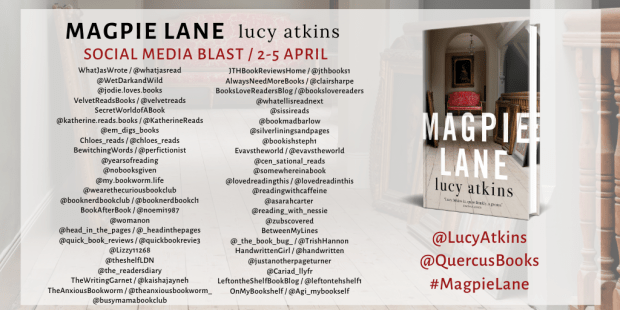
Magpie Lane by Lucy Atkins

img_8985

Magpie Lane by Lucy Atkins

Published by Quercus on 2 April 2020

What They Say

When the eight-year-old daughter of an Oxford College Master vanishes in the middle of the night, police turn to the Scottish nanny, Dee, for answers.

As Dee looks back over her time in the Master’s Lodging – an eerie and ancient house – a picture of a high achieving but dysfunctional family emerges: Nick, the fiercely intelligent and powerful father; his beautiful Danish wife Mariah, pregnant with their child; and the lost little girl, Felicity, almost mute, seeing ghosts, grieving her dead mother.

But is Dee telling the whole story? Is her growing friendship with the eccentric house historian, Linklater, any cause for concern? And most of all, why is Felicity silent?

Roaming Oxford’s secret passages and hidden graveyards, Magpie Lane explores the true meaning of family – and what it is to be denied one.

What I Say

Make no mistake, reading in these strange times has been a real challenge for me, and I am guessing lots of you at the moment. Having daily, hourly and instant news about the coronavirus is not overly condusive to wanting to pick up a novel is it really?

The thing is, Magpie Lane is one of those novels you can lose yourself in completely, whilst at the same time, feeling a slight (huge) sense of trepidation that something you can’t predict is going to happen. From the moment you turn the first page and meet Dee, Nanny to Mariah and Nick and their daughter Felicity, you realise this is going to be something very different and deliciously unnerving.

The novel starts with Dee being interviewed at a police station by Faraday and Khan, as her charge, Felicity has gone missing and they are desperately searching for clues as to why and where she could have gone. Prompted by Felicity’s parents, she has been asked to come in for questioning as she was close to her, was one of the few people that Felicity would speak to. An added complication to the eight year old’s disappearance is that she has elective mutism, and refuses to speak to anyone except her Dad, Dee and Dee’s friend Linklater – more of Mr Linklater further on in this review..

Right from the start of Magpie Lane, Dee is a very calm, together and perhaps slightly distant character, who seems to be at odds with the extrovert and opinionated Mariah. Like Dee, Mariah feels she is somewhat the outsider in her husband’s world, as he becomes the new Master of an Oxford College. She has no concept of the innate traditions and expectations of the wife of the Master, she decides to renovate the Lodge as she wants, infuriating the other College staff, who cannot abide this confident and vibrant woman who has come into their world.

Nick on the other hand, believes that this position will give him the social standing and recognition he craves. He has taken the role on after a position at the BBC has come to an end, and his drive and ambition has brought his family here to ensure that he is able to fulfill his dreams and his need to be respected and looked up to by other people. With them, they bring eight year old Felicity, who it transpires, is actually the daughter of Nick and his first wife, whose death is referred to in whispers and subtle glances between Nick and Mariah.

Felicity feels like an outsider in her own family, and her mutism and inability to connect with her parents means that she is often overlooked and disregarded. She seems at times to be almost an inconvenience to them, who needs to be looked after in order for them to furt her their own careers. This isn’t to say Nick and Mariah don’t love her – they just seem unsure as to what to do with her.

This sense of disconnection and dislocation is an important theme that runs throughout Magpie Lane. Dee has no family to speak of, and is wary of making a connection with anyone for fear of getting hurt. Mariah is not allowed to be part of her husband’s world unless she adheres to what is socially expected of her, and when she doesn’t, she is disregarded. Linklater, who is hired by Mariah and Nick to uncover the history of the Lodge is living a solitary academic life in Oxford, and seems to be happy in his own world, but at the same time seems to feel a connection to Dee, although she tries to ignore it.

So far so straightforward – why is Magpie Lane so engrossing? Well, what I haven’t told you yet is what happens when Felicity goes to sleep..

In Felicity’s bedroom in the Lodge, is a locked door which is discovered to be a locked priest’s hole. At night, Felicity is disturbed by noises that come from it, and Dee often finds her distressed and telling her about what she has heard and seen coming from it. As Felicity withdraws further into her silent world, her behaviour becomes more and more erratic, and Dee keeps her off school without telling her parents, to keep her safe from the constant bullying and upset she endures from her peers.

As readers, we are drawn into this other world, as we see what Dee and Felicity are witnessing, but Mariah and Nick only see their daughter becoming more distant, and a seemingly indispensible Nanny who is able to form a bond with their daughter that they cannot. The plot moves along at a perfect pace, balanced between Linklater’s investigations into the history of the Lodge, the consequences of it for Felicity, and the slowly disintegrating marriage of Nick and Mariah, as they struggle to cope with what they believe would be the making of them. As they try to present a united and indefeatable face to the College, Mariah discovers she is pregnant.

What worked so well for me about Magpie Lane, was that Lucy Atkins’ writing is always so tightly controlled, and is impossible to determine which way the novel was going to turn next, and I loved that. For me, as a reader, especially at a time like this, I want to lose myself completely in a book, and Magpie Lane draws you in right from the start. Lucy also writes absorbing and relatable characters that serve to bring the reader closer to the novel and become increasingly invested in their lives.

I thought it was also interesting that my allegiances changed towards the characters as the plot developed. Initially, I thought that Dee was a cold and menacing woman, whose relationship with Felicity was going to be the unsettling thread in the novel. However, as the narrative moved forward, instead I felt she was like Felicity, searching for the one thing we all strive for – a sense of belonging and true connection to other people. Similarly, Mariah is someone who initially seemed to be this force of nature, determined to have it all and to ensure she was not forced to stay in her husband’s shadow. Little by little her insecurities and real self was revealed, and we saw a woman who like many of us is just getting by at parenting, and is blindsided by the reality of caring for a child who won’t talk to her and a baby who is not a perfectly behaved insta perfect infant.

Linklater is really the catalyst for the plot to drive forward and also for Dee to start to realise that she may have found someone with whom she can be her authentic self without fear of ridicule. He, like Dee has always been slightly disconnected from the world around him, but together they seem to edge towards some sort of understanding and realisation that in each other they have found what has been missing from their lives. As they work together on the history of the Lodge, Dee sees that Felicity has found her voice, and is being listened to by people who really understand her. From that point on, leading up to Felicity’s disappearance, the novel twists and turns and not only reveals the secrets of the Lodge, but of those who live and have lived there.

Magpie Lane is a novel that is not easy to categorise, and is all the more powerful for it. For me, it was the female characters who were at the heart of the novel, and it was all the more relatable because of it. It is a brilliant and engaging novel, that not only has the traits of an unnerving mystery, but is a heartfelt and emotional novel about our need to belong, to connect with someone else, however difficult and ultimately life changing it might be.

I absolutely loved it, and I think you will too.

Thank you so much to Ella at Quercus Books for my gifted copy in exchange for an honest review and a chance to be part of the Magpie Lane Social Media Blast.

Why don’t you check out what my fellow fabulous Bookish Friends are saying too…

Virtuoso by Yelena Moskovich

6376480e-560e-40cf-bbef-0311d6cc6047

Virtuoso by Yelena Moskovich

Published By Serpent’s Tail

Available from all good Bookshops and Online

What They Say

Zorka. She had eyebrows like her name.

1980s Prague. For Jana, childhood means ration queues and the smell of boiled potatoes on the grey winter air. But just before Jana’s seventh birthday, a new family moves in to their building: a bird-eyed mamka in a fox-fur coat, a stubble-faced papka – and a raven-haired girl named Zorka.

As the first cracks begin to appear in the communist regime, Zorka teaches Jana to look beyond their building, beyond Prague, beyond Czechoslovakia … and then, Zorka just disappears. Jana, now an interpreter in Paris for a Czech medical supply company, hasn’t seen her in a decade.

As Jana and Zorka’s stories slowly circle across the surreal fluctuations of the past and present, the streets of 1980s Prague, the suburbs of 1990s Wisconsin and the lesbian bars of present-day Paris, they lead inexorably to a mysterious door on the Rue de Prague …

Written with the dramatic tension of Euripidean tragedy and the dreamlike quality of a David Lynch film, Virtuoso is an audacious, mesmerising novel of love in the post-communist diaspora.

What I Say

From the beautiful cover, through to the very last page, Virtuoso is a lyrical and ethereal novel, unlike any I have read before. I initially thought it was simply about the relationship between two girls, Zorka and Jana. I was ready to learn about their childhood in Prague, and the subsequent paths their adult lives would take.

Virtuoso is just that, but so much more too. It is a startling commentary on life under the Communist Regime in Prague, a novel about what family is to us, how we search for our identities throughout our lives, and what it means to find our place in the world.

The novel starts with a young woman discovering the body of her wife in their hotel room, and immediately you are pulled into their world as you have no idea why this woman has passed away, or indeed who any of the characters are. It serves to draw you in immediately to the plot, and I was intrigued by it. As the novel moves forward, we are observers to the lives of Jana, Zorka and Aimee, all of whom have their stories to tell, and slowly their lives start to come together as we understand how inextricably linked their lives are.

Jana is a respectful and quiet young girl, who lives a fairly unremarkable existence with her mother and father, until one day Zorka and her family move in to her neighbourhood. From the first time they meet, Jana and Zorka have an immediate connection, a sense that their meeting was pre-destined, and Jana seems to be in awe of this fiery and outspoken girl who is absolutely aware of her self and the innate power she possesses. Zorka seems to be someone who refuses to be categorized or tamed, she is determined to live her life how she wants, and Jana can only stand by and watch. What happens from that point on, is that these two women are entwined forever in a relationship neither can adequately describe.

Right from the start of the novel, you are aware of the confines and restrictions placed on women during this time. They are defined by their roles of wife and mother, whilst living in a world of unspoken subservience and fear. You do not know who to trust, and what you can say, and as mothers sit with each other and swap secrets, the playground benches are apparently the safest place to do so. This is why Zorka is such a revelation to Jana and her family. Although initially Zorka seems to be this problematic child, who pushes everyone to their limits, we as readers learn the troubling relationship she has with her mother, and this defiance is a distraction technique so her mother won’t physically assault her.

Little by little, Zorka realises the only way she can survive her childhood is to escape from it, leaving Jana behind, bewildered and shattered at the loss of this young woman who she had come to depend on. What Yelena captures so perfectly is the intensity of friendship between girls, how they mean everything to you at the time, the shared secrets, the confessions and discussions about your hopes and dreams. To have that taken away from you without explanation can be devastating, and for Jana, she now has to work out how to carry on living alone in the very place that Zorka has deserted.

Aimee is living with her father after her parents divorce and is working for his company, however she seems to be unsettled and searching for someone to love. Her memories of her life with her father come out as a stream of remembrances, but this works as it gives the reader an insight into her thoughts and dreams. Eventually she meets and falls in love with Dominique, an actress. Initially their relationship seems idyllic and gives Aimee everything she thought she wanted, but little by little, she comes to realise that Dominque has issues of her own, and she will again fall into a role of caring and supporting someone at the expense of her own hopes and desires.

The novel as it progresses, seems more fractured in terms of the narrative, and is at times almost dreamlike in its telling. There are short, distinct chapters, a nightmarish scene outside a club where Jana is brutally attacked by strange and disturbing children and the ever present blue smoke that seeps into different chapters and permeates the narrative.

Virtuoso is also an exploration of self and sexuality, and the visble and real relationships between Jana and Zorka and Aimee and Dominique are offset by a relationship carried out in the confines of a chatroom. A thread of a conversation between an American teenager called Amy and an Eastern European housewife whose username is Dominxxika_N39 who is effectively kept prisoner by her husband are presented to us without context. Their conversations reveal that Amy is a pupil known to Zorka, but Amy is determined to travel to this woman and rescue her, which as casual observers on their chat is unsettling for the reader, and we are simply bystanders who are unable to intervene to save Amy from her fate.

As the novel draws to its conclusion, it becomes more surreal and is far from a straightforward narrative that many of us are comfortable with. Did I ‘get’ all of it – no. However, it is impossible to not be drawn into Jana, Zorka and Aimee’s lives, to see how they try to define themselves and their place in the world even when the world doesn’t seem to make sense to us.

In Virtuoso, Yelena has written a brave and uncompromising novel, which has interesting and defiant women at its core. It serves only to remind us that fiction can be whatever it wants to be, as long as readers are open to recognising that not everything can be explained neatly and completely.

Thank you very much to Midas PR and to the Dylan Thomas Prize for my copy of Virtuoso in exchange for an honest review.

I’m one of 66 Bloggers taking part in the Dylan Thomas Prize Blog Tour – do follow Midas PR and The Dylan Thomas Prize to see what my fellow bloggers have to say…