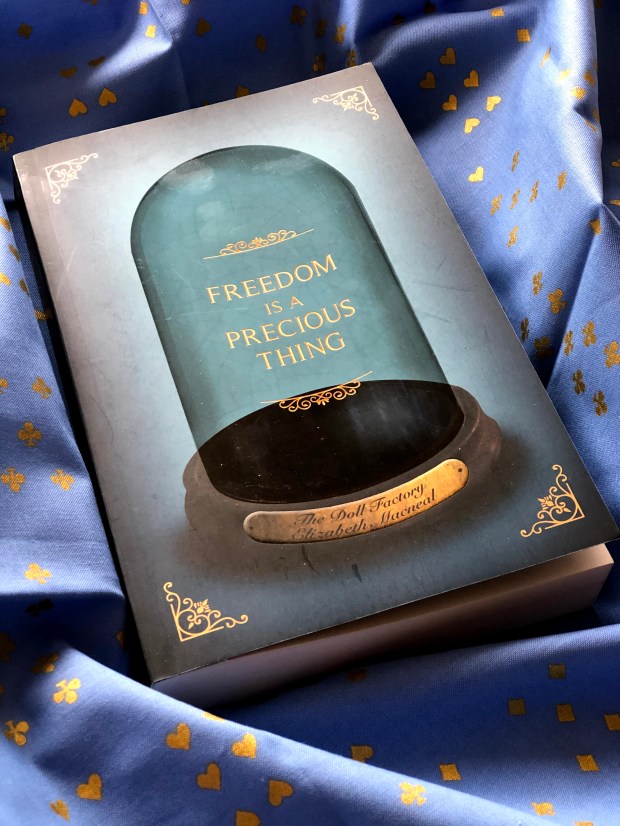
The Doll Factory By Elizabeth Macneal

img_3895


Elizabeth Macneal: The Doll Factory

Published By: Picador Books

Buy It: here


What The Blurb Says:

The Doll Factory by Elizabeth Macneal is the intoxicating story of a young woman who aspires to be an artist, and the man whose obsession may destroy her world for ever.

London. 1850. The greatest spectacle the city has ever seen is being built in Hyde Park, and among the crowd watching two people meet. For Iris, an aspiring artist, it is the encounter of a moment – forgotten seconds later, but for Silas, a collector entranced by the strange and beautiful, that meeting marks a new beginning.

When Iris is asked to model for pre-Raphaelite artist Louis Frost, she agrees on the condition that he will also teach her to paint. Suddenly her world begins to expand, to become a place of art and love.

But Silas has only thought of one thing since their meeting, and his obsession is darkening . . .


What I Say:

This year, for me, I have been determined to read more fiction which comes from those voices which may not previously have been heard.  I knew as soon as I read about The Doll Factory, and its story of a young woman who aspires to be an artist in Victorian London, that I had to read it.

From the first turn of the page, and our introduction to Silas, you are drawn into a darker world where collection and possession is the very lifeblood of the characters who weave their way through this thoroughly engrossing and immersive novel.

Silas spends his days in his curiosity shop perfecting his latest acquistions to be displayed and sold.  A young man at odds with his world and angry for people not understanding his talent, Silas is an unsavoury and menacing man who is desperate for recognition and for a connection with a woman. He is often visited by Albie, a young street urchin, who brings him the corpses of animals he needs, and is a street smart child on the look out for himself and his sister. Albie’s finds prove to be a useful way for Silas to enter the exclusive world of the notorious Pre-Raphaelite Painters, as he is able to procure a variety of props for them to use in their paintings.

The Doll Factory of the title refers to the Emporium where Iris and her sister Rose work for the awful Mrs Salter.  Iris paints the doll’s faces, while Rose sews the dolls clothing.  Both are struggling with their sense of worth and self – Iris has a clavicle which is twisted and Rose has been left with facial deformities after an illness.  Rose silently resents Iris, believing that she is in some way responsible for their current predicament. Trapped together and desperately unhappy, reliant on Mrs Salter for work, Iris yearns to be free to pursue her dreams of becoming a painter.

The ever magnificient, ever imposing London is readying itself for the spectacle of the Great Exhibition, which finally provides a chance for Silas to get the recognition he craves as he is desperate to get his latest taxidermy into the Exhibition – a double headed puppy.

It is there that Silas, thanks to Albie, finally meets Iris.  He believes that this striking woman with the bewitching red hair is is the one with whom he can ultimately connect. It is only a fleeting moment for Iris, but for Silas, it is life changing, and from that point on, Iris seeps into his consciousness and becomes the very thing Silas is desperate to possess.

When Louis, a Pre-Raphaelite Artist is looking for a model for his painting, Silas suggests Iris.  This being Victorian London, the very idea of modelling for an artist for an unmarried young woman has all sorts of ramifications and social implications.  It is simply not the done thing, and the shame that Iris would bring on her family for doing so is overwhelming.  However, Iris also knows that being given the opportunity to escape from the Doll’s Emporium for a chance to be near an artist would be life changing. She agrees to model for Louis on the condition that he teaches her to paint.

As she and Louis become closer, and cross the line from model and artist to lovers, Iris finds happiness in her new life until a revelation from Louis’ past threatens to unravel everything for them. Headstrong and passionate, Iris is unaware of Silas’ increasing obsession.  He finds alarmingly more outlandish and frightening ways of getting closer to her, with the aim of making Iris his ultimate experiment and complete possession. Albie is aware that Silas’ obsession is growing, but is powerless to do anything as Silas seeks to control him too.

The sublime skill of Elizabeth’s writing is that with every character, every plot twist, you become more and more deeply involved with this story.  Her detailed and unflinching descriptions of London and the worlds the characters inhabit, only serves to add to the tension and growing sense of unease that permeates this novel.

It is a story of outsiders, those who do not fit in with the world around them, and are searching for a way to belong.  Silas, Iris, Rose, Louis and Albie are all at odds with the society they live in, and each struggles with knowing that they are on the outside looking in. For Silas, it is finding a companion and feeling seen. For Iris, it is going against what is expected and being true to what she really wants from life.  Rose’s facial deformities and lack of husband leave her facing a life alone, on the perimeters of her world. Louis’ style of painting, as well as his views on marriage means that he is at odds with the society that he inhabits. Albie is surviving on his wits and street knowledge, and is desperate to belong, to feel part of a family.

Although it might seem that Silas is the man who wishes to possess Iris, I thought it went far deeper than that in The Doll Factory.  Iris is Louis’ model, and he in my mind also owned her in a way too. She was totally reliant on him for her new life, and without his favour and dotage, Iris always runs the risk of being the latest in a line of women who are useful until they are no longer needed, and a new muse arrives.

The Doll Factory is a novel which raises many questions about love, obsession, the perception and treatment of women, and the notion of what possession truly means. It is a novel in which you can only lose yourself and be in awe at the evocative descriptions and incredible characters who move in and out of the novel, drawing you in and keeping you there until the very last page.

Elizabeth Macneal has written an absolutely astounding debut novel. I could not turn the pages fast enough, but at the same time wanted to savour every last chapter. The Doll Factory is a novel I will telling everyone they need to read, and I am not going to forget Iris, Louis and even Silas for a very long time.

I loved it.

Thank you so much to Camilla Elworthy for my review copy in exchange for an honest review.
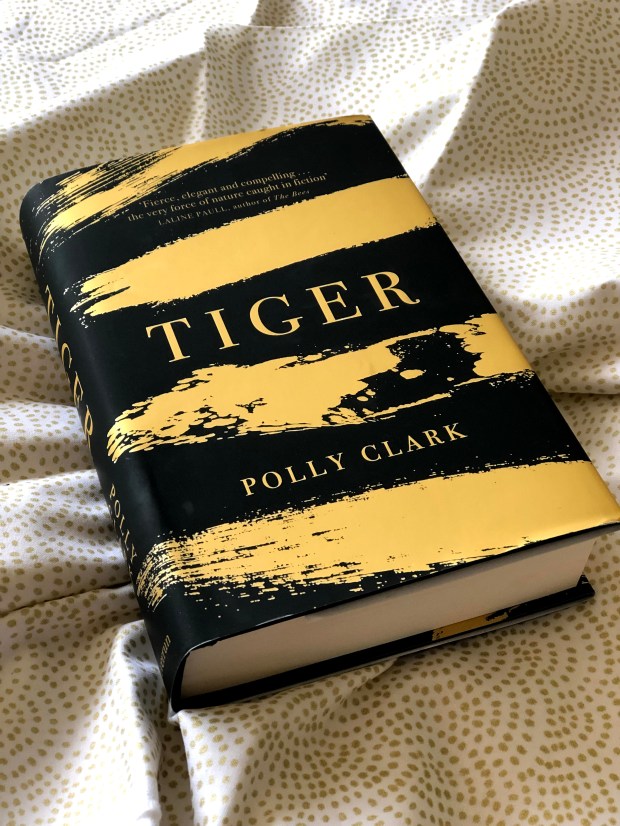
Tiger by Polly Clark

img_3969

Polly Clark: Tiger

Published By: riverrun Books

Buy It: here

What The Blurb Says:

Set across two continents, Tiger is a sweeping story of survival and redeeming love that plunges the reader into one of the world’s last wildernesses with blistering authenticity.

Frieda is a primatologist, sensitive and solitary, until a violent attack shatters her ordered world. In her new role as a zookeeper, she confronts a very different ward: an injured wild tiger.

Deep in the Siberian taiga, Tomas, a Russian conservationist, fears that the natural order has toppled. The king tiger has been killed by poachers and a spectacular tigress now patrols his vast territory as her own.

In a winter of treacherous competition, the path of the tigress and her cub crosses with an Udeghe huntress and her daughter. Vengeance must follow, and the fates of both tigers and people are transformed.

Learning of her tiger’s past offers Frieda the chance of freedom. Faced with the savage forces of nature, she must trust to her instinct and, like the tiger, find a way to live in the world.

What I Say:

For those who know me, and for those who don’t, I absolutely adored Polly Clark’s first novel Larchfield.  To be given the opportunity to read and review her second novel, Tiger, was something I just didn’t want to miss.  I have to admit from the outset, when I heard it was about Tigers and central Siberia, I was sceptical.  I am not a fan of novels about animals, and wasn’t sure how I could relate to Siberian tigers or the terrain they inhabit.

What becomes clear from reading the novel is that although the tigers are absolutely at the heart and permeate every part of this epic and majestic story, it is also about humans, and how we want to feel part of the world around us.  To matter to someone, to have that bond with another human being is everything, and that sometimes we have to go far beyond our limits and experience to do so. It also unashamedly tackles issues of addiction, motherhood, love, loss and unresolved grief and is all the richer for doing so.

Tiger is about Frieda, a primatologist who is sacked from her job at the Institute for being caught using drugs, and is given a final chance as a zookeeper at Torbet Zoo in Cornwall. It is about Tomas, a Russian conservationist working with his father, who has given up everything to protect the tigers of Siberia.  We meet Edit and her daughter Zina, who has left her husband and her life in the Undeghe tribe to survive in a cabin in the wilds of Siberia.

All these people are linked by the tigers of Siberia, and have to reassess everything they know in order to survive. When Frieda is picked to observe the new tiger, Luna, at Torbet Zoo, she believes she is starting to form a bond with her. Frieda also has to deal with a fellow employee Gabriel, the son of the owner who resents Frieda for being asked to look after the new tiger, and is a mixture of bully and protector.  At the heart of it all, Luna is still a wild animal, trapped in a cage, whose instinct to attack when she smells blood means that Frieda ends up being a victim of the very animal she was attempting to help.

For Tomas, his compassion and understanding for the animals that surround his camp, means he is finely tuned to their needs and desires, but he has to face the fact that he is lonely and has rejected his chance of a family and a way to feel loved and needed.  He has prioritised his father and the tigers, and is drifting around the landscape, rootless and unsatisfied by his endless quest to ensure the tigers are safe.

Edit has tried to be the woman that her father and husband expect, she has struggled with her feelings for her husband, and come to realise she actually doesn’t love him and likes him even less.  Frustrated by the constraints others put upon her, and desperate to ensure her daughter doesn’t follow in her footsteps, she decides to leave the safety of her village and put herself at the mercy of the wild to learn to live and find herself again.

Polly has created a barren and starkly uncompromising landscape  – where you are never sure what is going to happen next, and you are absolutely aware the sense of isolation that the characters feel. It doesn’t matter what continent they live in, their loneliness is only magnified by the magical and poetic language that weaves its way through the pages and around them all. I always felt that the humans were at the mercy of the tigers.  The intelligence and survival instincts the humans have, mean that although they know the rules of the wild, and believe that they have the upper hand, in fact, as we discover, the tigers are the true rulers of Siberia, and the humans are subjects in their kingdom.

Tiger is a novel that moves stealthly along, that seamlessly moves between characters and continents, strong and sure like the animal itself.  Polly has achieved many things in this novel.  It is an education for someone like me who knew nothing of tigers and tigresses, or Siberia or even how a zoo works, and it gives the reader much food for thought as to our place and responsibilites to the world around us.  I have to say, that the overriding lesson I took away from my reading of Tiger, is that no matter how much we try to convince ourselves, every single one of us needs to feel a connection to both the natural world around us and to someone else to truly feel alive.

Thank you so much to Katya Ellis, Ana Sampson McLaughlin and Elizabeth Masters for asking me to be part of the Tiger Social Media blast in exchange for an honest review.
Why don’t you see what everyone else is saying about Tiger too…

Things In Jars by Jess Kidd


img_2562

Things In Jars by Jess Kidd

Published by Canongate

Buy It: here


What The Blurb Says: 

London, 1863. Bridie Devine, the finest female detective of her age, is taking on her toughest case yet. Reeling from her last job and with her reputation in tatters, a remarkable puzzle has come her way. Christabel Berwick has been kidnapped. But Christabel is no ordinary child. She is not supposed to exist.

As Bridie fights to recover the stolen child she enters a world of fanatical anatomists, crooked surgeons and mercenary showmen. Anomalies are in fashion, curiosities are the thing, and fortunes are won and lost in the name of entertainment. The public love a spectacle and Christabel may well prove the most remarkable spectacle London has ever seen.

Things in Jars is an enchanting Victorian detective novel that explores what it is to be human in inhumane times.

What I Say:

Sometimes, when you least expect it, you find a novel that absorbs you so completely, that you wish there were another hundred pages.

What I did know, was that everyone who had read Things In Jars, had loved it and could not stop recommending it. When I saw that my Bookish Sister, Bookish Chat had awarded it six stars (you can read her review here), I knew that Things In Jars was going to be very special.

Bridie Devine is the heroine, a woman who bursts into the novel and out of the pages with such passion and strength, and into the 1800’s of London’s streets and alleyways with such force that we know she is absolutely in charge of her destiny.  She is working for the police – usually Inspector Rose and actually not officially, to help them solve crimes.  Bridie is still smarting from her failure to reach her last victim in time, and is wary of getting involved with police work again.  However, when she hears about the case of Christabel Berwick, the daughter of Sir Edmund Berwick, who has apparently been kidnapped, she is intrigued and cannot resist getting involved.

We, as readers, know from the very start of the novel that Christabel is not a normal child, and she seems to possess supernatural powers as well as very sharp set of teeth and a fondness for eating slugs and snails!  She is taken from her bed in the middle of the night, but as Bridie starts to investigate, it is apparent that not only do lots of people seem very interested in Christabel, but that also no one is really as innocent as they may seem.  We learn that Christabel is actually a merrow – a magical creature that has the ability to affect the emotions of a person who looks upon her, and that she can also influence the weather.  This of course means that she is a highly valuable prize, who is being touted around until her kidnappers can find the highest bidders.

The London that we are presented with in Things In Jars, is one teeming with life, a world filled with fantastical sights, disorienting sounds and powerful smells that overwhelm and envelop us constantly. London is not presented at its tourist friendly, picture perfect best. This London is one of poverty and suffering, where things that might be ignored in other novels are pushed right in front of our faces so that all we can do is look at them and feel a sense of unease and discomfort. Bridie on the other hand knows exactly how to navigate it to get what she wants.  Bridie is not alone in her endeavours to find Christabel.  She has a maid called Cora, who is a seven foot woman with facial hair and a whole lot of attitude, as well as a fighter called Ruby Doyle who is a ghost, and only Bridie can see him. As the novel progresses, Ruby and Bridie form a powerful and nearly romantic bond which delights and also frustrates them, as they know they can never truly be together.

This is one of the many things I loved about Things In Jars – the fact that what could have been an ordinary ‘whodunnit’ is elevated way beyond any usual reading experience, and it makes you sit up and take notice from the very start.  There is a sense of the magical, surreal and supernatural which weaves its way into the fabric of the story from the moment you turn the first page. As a reader you are pulled along with Bridie and her unrelenting determination to find Christabel, but Jess’ writing is so wonderful, that the magical elements seem to fit perfectly and are not at all out of place.

Along the way, Bridie and Ruby meet a plethora of interesting and unusual characters, all with a story to tell and more often than not, a score to settle. As Christabel is moved around the capital, and the kidnappers try to find a buyer, there is a sense of unease that starts to unsettle the natural order of the city.  Birds start to congregate, the Thames starts to rise, and London’s inhabitants sense that all is not well with the world and unbeknown to them, Christabel is at the heart of it all.

Although there is lots of humour in the novel, it is a very real depiction of the grim reality for many of those living in London, far away from the wealth and privilege of the monied classes.  Jess is not afraid to show the dark and often grim side of life. People and children are killed, a decapitation occurs, and we also see how awful it was for those who had to have operations in a time where there was no anaesthetics. It also shows us how difficult it was for women like Bridie, who are fiercely intelligent and refuse to be limited by society’s expectations and have to constantly battle to ensure that they are heard.  This made me love Bridie even more, and at the heart of her character lies kindness and compassion and an overwhelming desire to find Christabel in time.

Things In Jars is a novel that is breathtaking in its scope, that delves into the dark underbelly of London and captures our attention and heart from the very first page.  Bridie is a fierce and captivating character, who defies the limits that others place on her and is reassuringly comfortable with who she is and what she wants. Jess Kidd has boldly taken a familiar genre, unapologetically turned it on its head, added elements of the supernatural and magical and created a fantastic and vibrant world filled with amazing characters that quite simply that leaves us wanting more.

I loved it.

The Language Of Birds by Jill Dawson

img_3718


Jill Dawson: The Language Of Birds

Published By: Sphere

Buy It: here 

What The Blurb Says:

In the summer of 1974, Mandy River arrives in London to make a fresh start and begins working as nanny to the children of one Lady Morven. She quickly finds herself in the midst of a bitter custody battle and the house under siege: Lord Morven is having his wife watched. According to Lady Morven, her estranged husband also has a violent streak, yet she doesn’t seem the most reliable witness. Should Mandy believe her?

As Mandy tries to shield her young charges from harm, her friend Rosemary watches from the wings – an odd girl with her own painful past and a rare gift. This time, though, she misreads the signs.

Drawing on the infamous Lord Lucan affair, this compelling novel explores the roots of a shocking murder from a fresh perspective and brings to vivid life an era when women’s voices all too often went unheard.


What I Say:

At the moment, I am finding myself increasingly drawn to novels that place unheard people at the centre of them, which allow us to hear their voices and lives that might otherwise be silenced by the weight of more prominent ones.  The Language of Birds by Jill Dawson is one of those novels.

It recounts the story of Mandy River, who arrives in London in the summer of 1974 with her friend Rosemary.  Both are nannies (Rosemary is a Norland Nanny) and Mandy becomes Nanny to Lord Dickie and Lady Katharine Morven.  They have two children, a baby called Pamela and a young boy called James.

If you believe that this is simply a coming of age novel in the heydays of swinging London, filled with young women finding themselves and loving life, it is not.  That is a very small part of an intelligent and thought-provoking retelling of the infamous Lord Lucan case.  Lord Lucan is notorious for his alleged part in the murder of his nanny Sandra Rivett, and his subsequent disappearance.  His story has been told numerous times, and in all this, Sandra’s story has been lost. Until now.

Little by little, the story of Rosemary and Mandy before they came to London starts to unfold.  They meet while they are in The Poplars, a psychiatric unit, and their friendship grows as each tries to come to terms with their lives and what has brought them to this point.  Both have troubled relationships with their mothers, and have tried to be the daughters their mothers wanted, but with little success.  We discover that Mandy has had two children, one of whom lives with her parents as their son, and the other child was given up for adoption.

As the young women finally start to forge new lives for themselves, free from familial interference and guilt, Mandy is intoxicated by the life she has fallen into.  Lady Morven lends her clothes so she and Rosemary can go out nightclubbing, Mandy loves looking after Pamela and forms a close bond with James, and is instantly attracted to a young man called Neville who lives over the pub she visits.

The unnerving reality however, is that Mandy finds herself in the middle of a bitter divorce between Dickie and Katharine, both desperate for some sign of personal or parental failing which will strengthen their legal position.  Lord Morven no longer lives with his family, but has the house constantly watched, anonymous phone calls taunt them day and night, and he is determined to ensure that Katharine fails in her role as mother, so he can have sole custody of the children.

Mandy and her friend Rosemary find themselves drawn into this privileged world, as Lord Morven realises by charming those closest to Katharine, he can gain the evidence he needs to humiliate his wife and not only ruin her social standing but ensure his children are removed permanently from her care.  When Lord Morven asks them to accompany him with their charges to Scotland, Rosemary and Mandy blindly believe they will be treated as guests, as oppose to members of the staff. However, when they are there, Mandy finds herself reassessing her opinion of Lord Morven and starting to question her loyalty to Katharine.

The narrative switches between Mandy and Rosemary, and in understanding both of the women, we also see how Rosemary is haunted by the fact that as her mental health worsens, she is able to hear voices – the language of birds which taunt and torment her, and also foretell Mandy’s fate.  There is a sense of foreboding which only adds to the tension that underpins every page.

I loved the fact that this novel is filled with so many different ideas, of motherhood and what it means to be a mother.  It is a novel about class and privilege, and that just because you may have the financial means, it does not necessarily bring you happiness and fulfillment. It is also about language, and the power that it holds. Mandy cannot find the words to tell her son that he is hers, Rosemary is haunted by the language that she hears and cannot tell anyone else about, and both of the young womens’ Mothers cannot find the words to communicate with their daughters.

As the novel reaches its awful conclusion and the repercussions of the case for those who are left behind, instead of focussing on the man who is at the root of all of this, we are  look at the young woman.  As the reader, we are made to confront the reality of how an inquest like this is dealt with.  Mandy is fodder for the press, her attractiveness is a selling point that seemingly adds to the glamour of this case.  Lord Morven is portrayed as a dashing Lord with a penchant for fast cars, gambling and a plethora of aristocratic friends who are ensure he is able to evade the justice he should face.

What Jill Dawson brilliantly achieves is in The Language of Birds is to make us question ourselves and the ingrained social norm which is to see the woman as a faceless victim.  In creating a character like Mandy, and following her life, her hopes and dreams, we understand that she is a living, breathing woman. We all need to start looking beyond the sensationalist headlines and instead acknowledge that behind every victim is a life lived, a person loved and in this case, a world shattered.

I loved it.

Star Crossed by Minnie Darke

img_3176

Minnie Darke: Star Crossed

Published by: Bantam Press

Buy It: here


What The Blurb Says:

Destiny doesn’t happen by accident . . .

When Justine Carmichael (Sagittarius, aspiring journalist and sceptic) bumps into her teenage crush Nick Jordan (Aquarius, struggling actor and true believer) it could be by chance. Or it could be written in the stars.

Justine works at the Alexandria Park Star – and Nick, she now learns, relies on the magazine’s astrology column to guide him in life.

Looking for a way to get Nick’s attention, Justine has the idea of making a few small alterations to the horoscope for Aquarius before it goes to print.

After all, it’s only the stars. What could possibly go wrong?

What I Say:

If I read my horoscopes, and it says wonderful things – of course I am in awe of the wisdom of the Astrologer. If it makes no sense at all, then of course it’s a load of rubbish and a waste of paper too.  How many of us sneak a peek at what the stars have in store for us, and tell others that we behave in a certain way because of the Star Sign personality we have.  By the way, I am a Scorpio, so that’s fiercely loyal and very protective thank you, and of course I read my stars regularly.

Minnie Darke’s exqusitely different novel asks us, what would happen, if someone altered the horoscopes to make a person fall in love with them.  Justine works at the Alexandria Park Star magazine and does not believe in horoscopes at all. Nick, her childhood boyfriend and aspiring actor believes in them passionately. When they meet by chance (or is it?) one day, Justine realises that she still has feelings for Nick, but is too scared to say anything – and after all, he now has an impossibly beautiful and picture perfect girlfriend.

As Justine watches Nick move further away from her, and with access to the magazine’s horoscopes, she decides just to alter Nick’s horoscope, Aquarius, so that when he reads it, he realises that Justine is the woman for him.  The thing is, and as we all know, life is never that easy…

What follows is a brilliantly imaginative story, that looks at how we may think we are able to determine our fate, but that maybe letting the stars determine them is far more fun.  Each chapter of Star Crossed is a different star sign, where we learn a little about astrology, but also, it gives us a glimpse into the lives of other people who have read the same horoscope as Nick, and how that impacts the choices they make too.  What we also see is that the same statement can be read in a thousand different ways according to who is reading it and what they are going through at the time.

What is also a clever plot device, and you probably guessed it from the title, that Nick is starring in a production of Romeo and Juliet – the original Star Crossed lovers, and it is a theme that runs throughout the whole novel too. Justine helps Nick to learn his lines and interviews the young actress who plays Juliet, and Nick inadvertently crashes another production where he has to stand in as Romeo.

This is one of the many things I loved about Star Crossed. It is just so different to anything I have picked up recently, and it is a joyous celebration of the power of love and that you may try and fight it, but apparently our fate is determined by a higher power whether we like it or not.  The story moves along quickly and at a cracking pace, and Minnie’s plot is a thing of beauty as it starts stories, ends them, you wonder why this character has been introduced, but as the novel gains momentum towards the end, it all finally makes sense. I loved how each story also brings new characters into the novel, but it never felt forced or superfluous to the main plot.

At the heart of Star Crossed is the story of Nick and Justine, and how really, they were always meant to be together, but they just didn’t know it. They are two really likeable characters, flawed, unsure and relatable, and I defy you not to read Star Crossed and shout at them to just get together and start the rest of their lives (I may have done this once or twice!). That is why this novel is so unique – as fate conspires to keep them apart, we understand that they need to go through all this heartache and missed opportunities to truly acknowledge what has been right in front of them from the first time they met

Star Crossed is just the novel I needed to read at the moment.  Sometimes I just want to read a novel that brings me joy, doesn’t upset me, and that in the end, shows that love conquers all (the fabulous dog Brown Houdini-Malarky was a brilliant addition to the plot too!).  Minnie Darke has written a truly wonderful novel, which is filled with characters I loved, a belief in the power of love, and is just simply heart warming to read. It would also be absolutely perfect for a film adaptation- just in case by any strange luck there are any film-makers reading this blog…

I really loved this novel, and I hope you do too.

Thank you so much to Hannah Bright at Transworld for my gifted copy of Star Crossed, and for asking me to be part of the Blog Tour.

You’ve read what I thought, now follow the rest of the other Bloggers to find out what they thought…


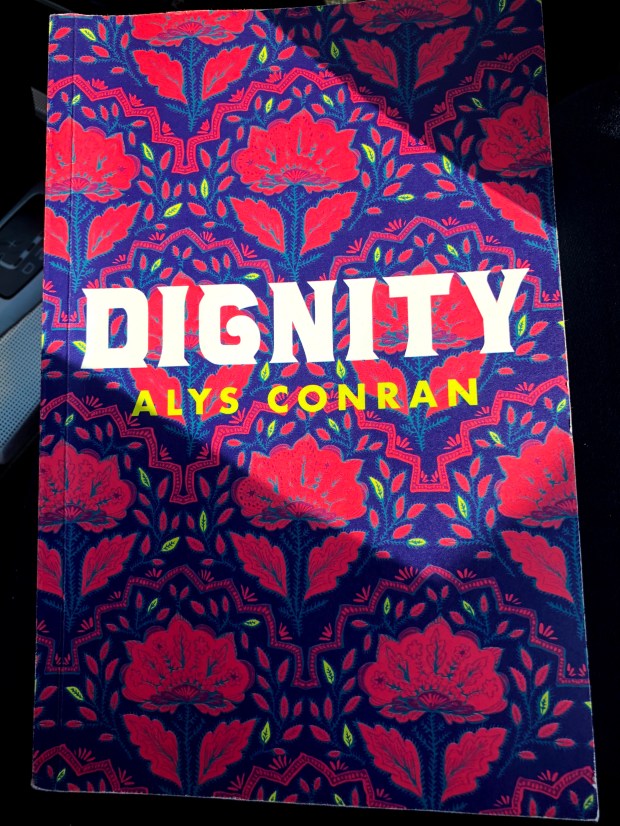
Dignity by Alys Conran

img_3579


Alys Conran: Dignity

Published By: W & N Books

Buy It: here


What The Blurb Says:

‘An Indian household can no more be governed peacefully without dignity and prestige, than an Indian Empire’ The Complete Indian Housekeeper and Cook, Flora Annie Steel & Grace Gardiner

Magda is a former scientist with a bad temper and a sharp tongue, living alone in a huge house by the sea. Confined to a wheelchair, her once spotless home crumbling around her, she gets through carers at a rate of knots.

Until Susheela arrives, bursting through the doors of Magda’s house, carrying life with her: grief for her mother’s recent death; worry for her father; longing for a beautiful and troubled young man.

The two women strike up an unlikely friendship: Magda’s old-fashioned, no-nonsense attitude turns out to be an unexpected source of strength for Susheela; and Susheela’s Bengali heritage brings back memories of Magda’s childhood in colonial India and resurrects the tragic figure of her mother, Evelyn, and her struggle to fit within the suffocating structure of the Raj’s ruling class.

But as Magda digs deeper into her past, she unlocks a shocking legacy of blood that threatens to destroy the careful order she has imposed on her life – and that might just be the key to give the three women, Evelyn, Magda and Susheela, a place they can finally call home.


What I Say:

So, this is my blog, my space to be honest about what I read and why. I was sent my copy of Dignity by Virginia from W & N  books, I thought it was beautiful, but I put it onto my reading pile to pick up later on this year.

On March 20th, my Mum passed away.  It wasn’t unexpected, it was after a long battle with lung cancer.  One of the many things my Mum and I had in common was our deep love of reading and books.  She is the reason I cannot leave the house without a book in my bag, and there is not a day goes by that I don’t read something.  As I finally took the plunge and started book blogging, she was there every step of the way, loving the fact her daughter was talking about books and often told me how proud she was.  Mum loved seeing the books I was lucky enough to get sent, and I would always show her my bookpost.

When I showed her Dignity, she told me how beautiful she thought it was, and to read it next and let her know whether she would like it too.  I started reading it on Monday 18th March, and the reason I am so specific is because two days later, Mum passed away.  In the days after she had gone, I had to do all the things a grieving daughter has to do. I had to carry on, being the Mum, daughter, wife and sister that I needed to be until I could come back from seeing my Dad and sister and finally process what had happened.

When I was able to sit down, Dignity was there, right next to the pile of stuff I had brought back from my Mum and Dad’s house and I just picked it up and started to read. The thing was, then I couldn’t put it down again.

Dignity is the story of three women, Magda, Susheela and Evelyn.  It is a novel about love, of trying to find that elusive home that we all strive to belong to, and of finding a family.

Magda is a cantankerous old woman, confined to her decaying house and reliant on the care and support from the women who are paid to look after her.  Susheela is one of the young women who takes on this task, in spite of Magda’s constant attempts to belittle her and break her spirit.  Magda was born and raised in India until she was sent away by Evelyn, her Mother, and Benedict her Father, to a cold and desolate boarding school.

We meet Evelyn as she is being sent to India to marry Benedict.  She is perfectly packaged and preened, naive about many things, and reliant on the books she has taken with her on the voyage to try and make sense of the world she is about to enter.  Although slightly wary, you get the sense that Evelyn is going to relish this next stage of her life, and she sees her new life as a time of adventure and promise.  Indeed when she arrives, she is overwhelmed and in awe of the sights, smells and sounds of the world around her. 

Unfortunately, this is short lived, as she realises that being a wife in India comes with certain conditions, ways of behaving, and treating the servants who work for you as if they are there purely to cater to your every whim.  Little by little, Evelyn realises the world she was ready to embrace is slowly closing in around her. Her husband Benedict only sees her as a trophy to show off, to prove his virility and to establish his position in polite Indian society.  Evelyn’s hopes and dreams are ignored and quashed, as she realises her worth is purely measured in her ability to produce an heir and to conduct herself in a manner deemed appropriate by those around her. 

Even when she gives birth to Magda, her longed for child, she is not permitted to be the mother she truly wants to be, as almost immediately an Indian woman called Aashi is hired to be Magda’s wet nurse. Evelyn is slowly removed from Magda’s life and is told that when Magda reaches an appropriate age, she will be sent ‘home’ to the United Kingdom, while Evelyn and Benedict stay in India. Unfortunately, a life changing event happens, and Magda is sent home alone, forever apart from her parents.

Magda is a different kind of prisoner, trapped with her memories and dreams of her former life in the decaying family home at Victoria Road. Initially she seems resentful of the ever changing world around her and mired in outdated attitudes and beliefs especially towards Susheela. We know that Magda is fiercely intelligent and strives for independence, but now she has no one, and is seeing out her days in a cluttered and neglected home, a stoic reminder of her past glories. Magda reluctantly accepts Susheela’s help, but finds herself drawn to this bright young woman who has many issues of her own. Together, they form a unique and tender bond which changes both of their lives in ways they never would have dreamed possible.

Susheela is trying to balance so many things, she is trying to deal with her father who is grieving for his wife, while she grieves for her Mum and they are in danger of losing their home. Her boyfriend Ewan loves her but is fighting his own demons after serving in the Army, and on top of all this, Susheela has to deal with Magda. She may be the youngest of the women in the story, but her fierce determination to find her place in the world is just as engaging.

What elevates Dignity for me is not only the beautiful storytelling, and the sense of depth you get with each character, but that these women are bound together. This is not a novel of hopelessness, it is a novel of hope. Evelyn, Magda and Susheela are all looking for a sense of belonging, of being loved and being able to love too. They are all searching for a place to call home.

The writing is so engaging and smart, and you really feel that you are there with each character. The description of life in India, was a revelation for me- it brought home to me how much things have changed, and how much they haven’t. The novel draws you in from the first page, and as you fall deeper in, the changing narrative and evocative descriptions only serve to keep you willing the women to fulfill their dreams.

In Dignity, Alys Conran has written a novel that will captivate you from the first page, and will not let go of you until you turn the last. It is about love, loss, motherhood and home, and of a time past and a world where everyone is searching for their place in it.

Without a doubt, Dignity will be one of my books of 2019. I absolutely loved it, and I know that my Mum who understood the importance of home and belonging and would have truly loved it too.

What Not by Rose Macaulay

img_3056

Rose Macaulay: What Not

Published By: Handheld Press

Buy It: here


What The Blurb Says:

What Not is Rose Macaulay’s speculative novel of post-First World War eugenics and newspaper manipulation that anticipated Aldous Huxley’s Brave New World by 14 years. Published in 1918, it was hastily withdrawn due to a number of potentially libellous pages, and was reissued in 1919. But by then it was quickly overshadowed by Macaulay’s next two novels, and never gained the attention it deserved. What Not is a lost classic of feminist wit and protest at social engineering, now republished with the suppressed pages reinstated. Kitty Grammont and Nicholas Chester are in love, but Kitty is certified as an A for breeding purposes, while politically ambitious Chester has been uncertificated, and may not marry. But why? There’s nothing apparently wrong with him, he is admired in his field, and is charming and decisive. Although Kitty wields power as a senior civil servant in the Ministry of Brains, which makes these classifications, she does not have the freedom to marry who she wants. They ignore the restrictions, and carry on a discreet affair. But it isn’t discreet enough for the media: the popular press, determined to smash the brutal regime of the Ministry of Brains, has found out about Kitty and Chester, and scents an opportunity for a scandalous exposure. The introduction is by Sarah Lonsdale, senior lecturer in journalism at City University London.

What I Say:

“Humanity; the simple things; love, birth, family, life.  They’re the simple things, but, after all, the deep and grand things.  No laws will ever supersede them”.

I had heard a lot about Rose Macaulay’s novel, What Not, as Handheld Press had decided to reprint it, and the notion of a novel that anticipated Brave New World from a female writer was one I definitely wanted to read.

The sobering thing about this novel, that in today’s uncertain and inflammatory times, the premise behind this novel seems to be not as far fetched as we may hope to believe.  The country is returning to normality after the First World War, and that is what struck me about the opening pages of this novel.  Everything is just as it was, people are commuting to work, reading magazines, chatting and lives are carrying on, but it is only as we read on that we realise things are far from usual. From the minute you read of aero buses and street aeroplanes, you know that this is not the Great Britain we know.

The Government has decided the way forward for the country is to use social engineering to ensure that they control the population. People are certificated according to their intelligence, and a new Ministry – The Ministry of Brains has been established.  It has passed an act called the Mental Progress Act, where every citizen is categorized according to intelligence. The idea is that you must have children with someone of an appropriate intelligence level, and you are punished if you do not.  This is further complicated by the fact that if anyone in your family has mental disabilities, you are categorised as Uncertificated, and are forbidden to marry or have children.

This was something that was extremely chilling for me to read, as my eldest son has learning difficulties, and the implication that laws like this could exist are just devastating.  It was a sobering and frightening thought that anyone could deem this an acceptable law to live by, and it added a personal level of involvement in this novel for me.

Our main protagonist, Kitty Grammont, works for the Ministry of Brains, and she lives in a house in the village of Little Chantreys with her brother Anthony, his partner Miss Pansy Ponsoby and their child who is called the Cheeper. Her father is a vicar, and he is seeing the devastating consequences of the Mental Progress Act, as he knows that more and more babies are being abandoned for fear of punishment from the authorities for not fulfilling the relevant criteria.

Throughout What Not, you get the unnerving sense that the world has already survived a horrific war, and although it is over, there is still a sense of unease and foreboding.  The State is desperately trying to ensure their citizens have stability in their world, but they need to limit and control every aspect.  Knowing as we do that the world will see a Second World War, I wondered how the Ministry of Brains would react to another situation that was out of their control and what more extreme measures they would strive to put into place afterwards.

This is not an easy novel to read. The unflinching narrative is set against the seemingly idyllic notion of Britain’s victory and the unchanging English countryside, however the subject matter- that of social engineering, seems to be always present in the background of the story, and the notion of the state controlling everything is the reality for Kitty and the British people.

When she meets and is attracted to Nicholas Chester, the Minister of Brains, Kitty believes she has met the man of her dreams.  The brutal reality is that Nicholas is Uncategorized as he has siblings with a mental disability, so, following the legislation he oversees, he is unable to marry or have children.

This then becomes the crux of the novel.  What happens when the one person you love is the one person the state forbids you to?  Chester and Kitty are undeniably attracted to each other and after attempting to conduct their relationship in private, they are confronted with a hostile press and unsettled population who are starting to fight back against the Ministry of Brains – whatever the consequences for Chester and Kitty.

What Not is a biting satirical novel, that succeeds in its premise by drawing us in.  It is rooted in reality, and that is what for me, made its tone even more sinister.  In today’s political uncertainty, especially in a week where even Parliament seems to have no say over its destiny, a state attempting to control its population by extreme measures while ignoring basic human emotions such as love, suddenly doesn’t seem so far fetched.

Thank you so much to  Kate at Handheld Press for my gifted copy.

What Not was published by Handheld Press on 25 March.


“All You Do Is Read A Book and Tweet About It..”

So, in today’s adventures from Book Blogging Land, I wanted to share with you a little conversation I had with someone (Not A Book Blogger), who, when I told them I wrote about books in my spare time, said the line which I have now immortalised as the title for this Blog Post…

In the last few days, I have been thinking a lot about what I do as a Book Blogger, and I guess what I wanted to share with you all is what happens when I decide to Blog about a book. I hope it helps you if you are new to blogging and don’t know where to start, or if you are just interested in knowing what it involves!

This is only my way of doing things, everyone is different, and there is no right or wrong way to do this (am getting that in there nice and early!)

  • First of all, I choose a book I want to talk about – it could be one from the library, one from my shelves or if I’m lucky, one I have been sent.
  • I have This Book, but I want to make it look attractive, so I spend time taking pictures of This Book, trying different layouts, styles and backgrounds. Finally I have it, cropped, filtered, edited and ready to upload..
  • The next step is to post This Book on my social media feed, hashtagging the title, making sure I tag the author, publisher, date of publication where relevant, where or who I got it from. I only use Twitter and Instagram, but I always make sure I post on both platforms, and do ALL the numerous hashtags on Instagram so that it’s seen by as many people as possible!
  • Then finally I read This Book – while making notes and using post it notes to highlight memorable quotes (I’m 48 years old – I often forget my childrens names or call them by the dog’s name so don’t judge me..!)
  • Hooray, now I’ve read This Book, if I’ve enjoyed it (yes, unapologetically I am a blogger who only posts positive reviews), I tweet and post on Instagram about it – again making sure I tag and hashtag everyone and everything until I can’t tag no more!
  • It’s now time to settle down and spend quite a few hours writing my blog post, and re-writing, and tweaking and checking and finally posting it. This is inbetween dealing with a husband, two teenagers and a bonkers Springer Spaniel.
  • Now I just have to get back on to my social media and tell everyone that I have written a blog post so that they can check it out and comment on it (so now I have to check and respond to all the comments on my Twitter and Instagram feeds as well as anyone who has taken the time to leave a comment on my blog).
  • Time for a cup of coffee.
  • Oooh, I think I need to read another book…
  • It starts all over again – and I love every minute of it…

There you go – some people may do much more than I do, some a lot less, and some just the same.

Do you know what? The only question you need to ask yourself is – do you enjoy doing it? If you do, then that’s all that matters…

Love

Clare xx