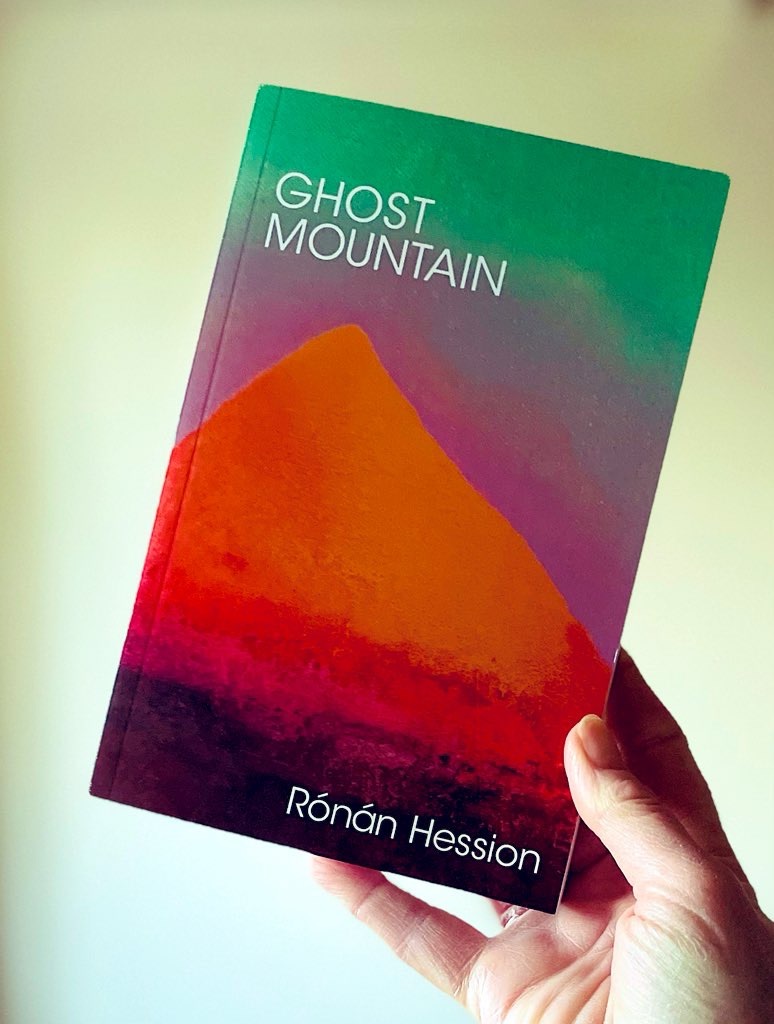
Ghost Mountain by Rónán Hession

Ghost Mountain by Rónán Hession

Published by Bluemoose Books on 23 May

What They Say

Ghost Mountain, is a simple fable-like novel about a mountain that appears suddenly, and the way in which its manifestation ripples through the lives of characters in the surrounding community. It looks at the uncertain fragile sense of self we hold inside ourselves, and our human compulsion to project it into the uncertain world around us, whether we’re ready or not. It is also about the presence of absence, and how it shadows us in our lives. Mountains are at once unmistakably present yet never truly fathomable.

What I Say

I don’t think it’s any secret that I have loved each of Rónán’s previous novels, Leonard and Hungry Paul and Panenka, and knew one thing for sure that Ghost Mountain would be very different to both of them.

Rónán’s skill as a writer is that he constantly surprises you with the way in which he uses the written word and weaves worlds that are like ours but seem slightly magical. I don’t think you can easily categorise his writing, and that is what makes it even more special, and why I love reading his novels.

In Ghost Mountain, the seemingly simple premise of a mountain that just appears one morning, and the reactions of those who know about it becomes so much more. This is a novel about the human condition, of connection and co-existence. It is the story of how our lives can often seemingly be destined to move in one way, but that a decision or action in a single moment can change your world and those of people who you have never met.

When the Ghost Mountain appears in the nameless location, it is discovered by a local woman called Elaine, whose interaction with it ends in tragedy, and her not wanting to articulate to anyone what she has found. As other people discover it, the story spreads, and the mountain is swathed in visitors and tourists, all drawn to the place which has appeared for no reason, bringing with it routines and behaviours and as in society creating a right and wrong way to behave while there.

We meet local couple Ruth and Ocho, married but it seems more because it works rather than for any passionate reason. Both react to the appearance of Ghost Mountain in different ways – Ruth is bewitched by it, and wants to spend time there, while Ocho is highly sceptical of it, and retreats to his parent’s house, a place of safety, mundanity and comfort.

We meet the Clerk of Maps, an unnamed official who sees this ironically as the chance to make a name for himself, and realises he now has professional worth in a world where he was previously ignored. There is also the landowner who has inherited the land Ghost Mountain stands on, finds himself in possession of land he cannot sell, and a tenant who refuses to engage with him.

I loved the character of Dominic – the renowned local drunk with a penchant for making his feelings known by attaching notes to bricks and lobbing them through the relevant windows. When he throws one through Elaine’s window with a promise to pay back for the damage a small amount each week over a period of time, these two people who have stepped back from the world find a connection that draws them together and their lives change.

This for me is the very heart of Ghost Mountain, and what Rónán achieves brilliantly. He shows us how we are all connected, and often want to feel that human connection with someone or a group of people. All the characters in this novel in some way cross paths with everyone else, be it by being in a relationship, meeting because one character knows another, or even by standing behind them in a queue in a butcher’s shop.

Moments of tenderness and joy are set against shocking events that as a reader stop you in your tracks, and Rónán’s understated and thoughtful prose adds to the impact of them. There is a section about a mother’s love and the grief that comes when you lose them that just stopped me in my tracks, and Rónán’s absolute understanding of that life changing experience is present in every single one of those words.

Society is complicated, layered and often wonderful, but it can also be brutal and exclusive. It will alienate those who don’t fit the expected roles or aesthetics, leaving a group of people who live their lives trying to work out how to fit in. The ever present Ghost Mountain serves as a catalyst for this community, prompting some to question what they have accepted for so long, others to take the first step to a new life, and for some to realise that their time in this world is only temporary and to accept that too.

Ghost Mountain is an unforgettable and erudite novel about love, society and inexplicable mountains. It will make you stop and think about what you have read long after you have finished it, and realise that life is fleeting and complicated and often challenging, but that it is up to us to determine the path we take.

I absolutely loved it.

Thank you so much to Kevin and Bluemoose Books for my proof copy.

Chouette by Claire Oshetsky

Chouette By Claire Oshetsky

Published by Virago Press on 4th November

Available from West End Lane Books and All Good Bookshops

What They Say

A fierce and darkly joyful fable about mothering an unusual child from an electric new voice.

Tiny is pregnant. Her husband is delighted. ‘It’s not yours,’ she tells him. ‘This baby will be an owl-baby.’ Tiny’s always been an outsider, and she knows her child will be different.

When Chouette is born, Tiny’s husband and family are devastated by her condition and strange appearance. Doctors tell them to expect the worst. Chouette won’t learn to walk; she never speaks; she lashes out when frightened and causes chaos in public. Tiny’s husband wants to make her better: ‘Don’t you want our daughter to have a normal life?’ But Tiny thinks Chouette is perfect the way she is.

As Tiny and her husband fight over what’s right for their child, Chouette herself is growing. In her fierce self-possession, her untameable will, she teaches Tiny to break free of expectations – no matter what it takes.

Savage, startling, possessed of a biting humour and wild love, Chouette is a dark modern fable about mothering an unusual child. It will grip you in its talons and never let go.

What I Say

When I heard about Chouette, I wasn’t sure what to expect. The premise that a woman is carrying an owl-baby that she has conceived after sleeping with an owl just seems to be so incredibly eccentric that it couldn’t possibly work.

The thing is, it absolutely does. Chouette may be like nothing you have read before, but this is a novel about parenting a child who does not conform to what the world expects, and as a Mum of a child with special needs, it could not have been more pertinent and emotional.

When Tiny discovers that she is pregnant, she is stunned. She doesn’t want a baby, but is insistent that this is an owl-baby, not as she calls the other babies, a dog-baby. Her husband doesn’t understand what she means and is concerned for her mental health. Yet as the pregnancy progresses, Tiny becomes bonded to the owl-baby she is convinced she is carrying, and is determined to love it.

As Chouette grows in Tiny’s womb, she starts to understand the intense ferocity of maternal love, and irrespective of her husband and his family, she is driven by a need to ensure that she keeps her baby safe. Having always felt to be an outsider herself, she doesn’t feel that she fits in with her husband’s family, and Chouette’s behaviour during pregnancy only serves to distance her from her husband who feels unable to connect with his wife. When Chouette is born and taken to the special babycare unit, her husband is away, and her in-laws rush to her side, but Tiny decides to take her daughter home in spite of the medical advice to the contrary. Tiny is literally blinded by love, and knows already that although her daughter is very physically and intellectually different to other babies, she is hers, and only she can understand what Chouette needs.

While up to this point the novel has seemed to have a strange and mythical tone, as you are never really quite sure what is real, what is imagined, and whether Tiny’s insistence as to the identity of Chouette’s father is representative of an altered mental state or is in fact a reality, suddenly one thing becomes very clear.

Chouette is not like other children.

The way in which Tiny and her husband and his family react to her is an interesting and at times startling one. Tiny sees Chouette as a child to be cherished and loved, that her need to be fed differently and her lack of social skills and non-conformity is something to be sympathetic to, while her husband sees her as something to be ‘cured’.

Her husband refuses to rest until Chouette is like all the other children, so he decides to consult as many experts as he can, to undertake whatever therapy they recommend so that his daughter who looks and acts so differently can be moulded to fit in and not stand out in a crowd. While he wants to ‘fix’ Chouette however he can, Tiny can’t understand why the world can’t accept her daughter as she is. This for me is the crux of the novel. Oshetsky has to make this difference so extreme in a way, so the reader can see how polarised Tiny and her husband are.

So often, people who either have no experience of children who are different, or for whom the thought of having a child that does not fit in is overwhelming, will seek to find a way in which they can make that child fit into the world around them.

All too often, and I am absolutely speaking from experience here, your child is regarded as either a problem that needs to be solved, or an issue that they don’t know how to deal with, because they have no clue what to do with them. It is far easier to attempt to fit them into a convenient societal box, or give up when they can’t be fixed as oppose to looking at the child and working out a bespoke plan to try and give that child the best life possible. We have been stared at, avoided, commented on and made to feel unwelcome numerous times. Children like Chouette are not things to be mended or moulded, they are individuals who deserve love and understanding in order that they are able to fulfill their potential.

The reason this novel works so well for me aside from the emotional connection I feel to the subject matter, is the sense that you never really know what is real, what is mystical, what is imagined and what is the truth. Claire Oshetsky has created a world so like our own, but is always slightly removed and the prose and events in this novel seem to have a sense of other worldliness about them. Tiny’s understanding of how important nature and the environment is to Chouette for her well being is balanced by her husband’s insistence on science and theory, and culminates in him making a devastating choice as to how Chouette should be cured. His decision sets off a chain of events that no one could have foreseen, and Tiny is forced to make some life changing decisions.

The prose is all encompassing and filled with a real sense of the power of nature and its inablity to be contained. Tiny and Chouette are always right at the heart of the novel, and the way in which they are portrayed serve only to make the reader want them to live the life they want. Tiny’s husband, and indeed all the other characters aside from Tiny and Chouette are portrayed as almost annoyances, in that their self serving interference only makes the reader want Chouette to find her own way even more deeply.

If you are looking for a straightforward narrative novel, then Chouette is probably not your kind of book. If however, you want to read a story that blurs and pushes the boundary of the everyday and the magical, and also exquisitely details the frustrations, heartache and joy of having a child that is different to others, then Chouette should absolutely be on your reading pile.

I absolutely loved it.

Thank you so much to Celeste at Virago for my gifted finished copy.

You can buy your copy of Chouette at West End Lane Books here.