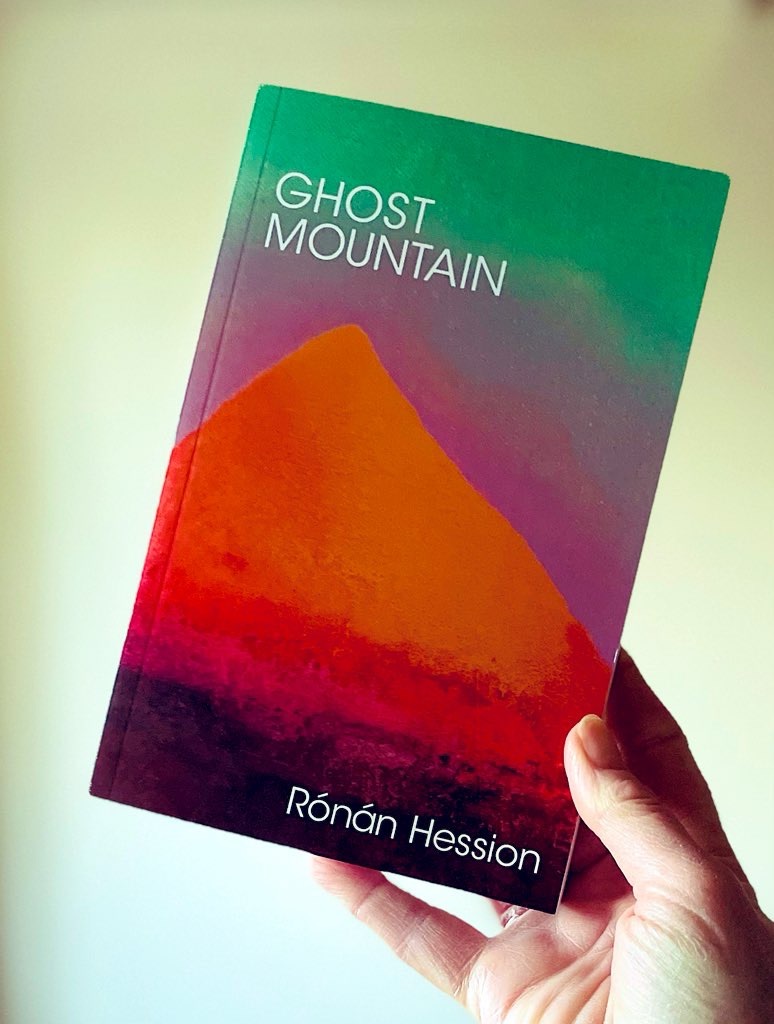
Ghost Mountain by Rónán Hession

Ghost Mountain by Rónán Hession

Published by Bluemoose Books on 23 May

What They Say

Ghost Mountain, is a simple fable-like novel about a mountain that appears suddenly, and the way in which its manifestation ripples through the lives of characters in the surrounding community. It looks at the uncertain fragile sense of self we hold inside ourselves, and our human compulsion to project it into the uncertain world around us, whether we’re ready or not. It is also about the presence of absence, and how it shadows us in our lives. Mountains are at once unmistakably present yet never truly fathomable.

What I Say

I don’t think it’s any secret that I have loved each of Rónán’s previous novels, Leonard and Hungry Paul and Panenka, and knew one thing for sure that Ghost Mountain would be very different to both of them.

Rónán’s skill as a writer is that he constantly surprises you with the way in which he uses the written word and weaves worlds that are like ours but seem slightly magical. I don’t think you can easily categorise his writing, and that is what makes it even more special, and why I love reading his novels.

In Ghost Mountain, the seemingly simple premise of a mountain that just appears one morning, and the reactions of those who know about it becomes so much more. This is a novel about the human condition, of connection and co-existence. It is the story of how our lives can often seemingly be destined to move in one way, but that a decision or action in a single moment can change your world and those of people who you have never met.

When the Ghost Mountain appears in the nameless location, it is discovered by a local woman called Elaine, whose interaction with it ends in tragedy, and her not wanting to articulate to anyone what she has found. As other people discover it, the story spreads, and the mountain is swathed in visitors and tourists, all drawn to the place which has appeared for no reason, bringing with it routines and behaviours and as in society creating a right and wrong way to behave while there.

We meet local couple Ruth and Ocho, married but it seems more because it works rather than for any passionate reason. Both react to the appearance of Ghost Mountain in different ways – Ruth is bewitched by it, and wants to spend time there, while Ocho is highly sceptical of it, and retreats to his parent’s house, a place of safety, mundanity and comfort.

We meet the Clerk of Maps, an unnamed official who sees this ironically as the chance to make a name for himself, and realises he now has professional worth in a world where he was previously ignored. There is also the landowner who has inherited the land Ghost Mountain stands on, finds himself in possession of land he cannot sell, and a tenant who refuses to engage with him.

I loved the character of Dominic – the renowned local drunk with a penchant for making his feelings known by attaching notes to bricks and lobbing them through the relevant windows. When he throws one through Elaine’s window with a promise to pay back for the damage a small amount each week over a period of time, these two people who have stepped back from the world find a connection that draws them together and their lives change.

This for me is the very heart of Ghost Mountain, and what Rónán achieves brilliantly. He shows us how we are all connected, and often want to feel that human connection with someone or a group of people. All the characters in this novel in some way cross paths with everyone else, be it by being in a relationship, meeting because one character knows another, or even by standing behind them in a queue in a butcher’s shop.

Moments of tenderness and joy are set against shocking events that as a reader stop you in your tracks, and Rónán’s understated and thoughtful prose adds to the impact of them. There is a section about a mother’s love and the grief that comes when you lose them that just stopped me in my tracks, and Rónán’s absolute understanding of that life changing experience is present in every single one of those words.

Society is complicated, layered and often wonderful, but it can also be brutal and exclusive. It will alienate those who don’t fit the expected roles or aesthetics, leaving a group of people who live their lives trying to work out how to fit in. The ever present Ghost Mountain serves as a catalyst for this community, prompting some to question what they have accepted for so long, others to take the first step to a new life, and for some to realise that their time in this world is only temporary and to accept that too.

Ghost Mountain is an unforgettable and erudite novel about love, society and inexplicable mountains. It will make you stop and think about what you have read long after you have finished it, and realise that life is fleeting and complicated and often challenging, but that it is up to us to determine the path we take.

I absolutely loved it.

Thank you so much to Kevin and Bluemoose Books for my proof copy.

brother do you love me by Manni Coe and Reuben Coe

brother do you love me by Manni Coe and Reuben Coe

Published by Little Toller

Available from Little Toller Website and All Good Bookshops

What They Say

Reuben, aged 38, was living in a home for adults with learning disabilities. He hadn’t established an independent life in the care system and was still struggling to accept that he had Down’s syndrome. Depressed and in a fog of anti-depressants, he hadn’t spoken for over a year. The only way he expressed himself was by writing poems or drawing felt-tip scenes from his favourite West End musicals and Hollywood films. Increasingly isolated, cut off from everyone and everything he loved, Reuben sent a text message: ‘brother. do. you. love. me.’ When Manni received this desperate message from his youngest brother, he knew everything had to change. He immediately left his life in Spain and returned to England, moving Reuben out of the care home and into an old farm cottage in the countryside. In the stillness of winter, they began an extraordinary journey of repair, rediscovering the depths of their brotherhood, one gradual step at a time. Combining Manni’s tender words with Reuben’s powerful illustrations, their story of hope and resilience questions how we care for those we love, and demands that, through troubled times, we learn how to take better care of each other.

What I Say

I have really struggled with writing a review of brother do you love me. The reason being is that I want to share endless paragraphs and pages and chapters with you, to show you how brilliant Manni’s writing is, and how perfectly Reuben’s words and illustrations show us what their relationship means to them. This is a memoir that is quite unlike any I have read, and it moved me deeply.

Manni was living in Spain as a tour guide, and his brother Reuben who has Down’s Syndrome was living in a residential home. Reuben sent Manni a text message that read ‘brother.do.you.love.me’. As soon as he read that message, Manni knew that his brother needed him, and that Reuben had to be out of that care home as soon as possible. When Reuben moved in with Manni in a cottage in the UK, Manni was shocked to see how far his brother had regressed physically and emotionally, and was desperate to get his brother back.

This is a memoir not only of the incredible bond that Manni and Reuben have, and how their love for each other transcends the frustrating limitations that the professionals tried to constrain their world with, but is also a book about the realities of caring for a family member when you know exactly what they need even if those in positions of power disagree.

Their situation is further complicated by the fact that Manni’s partner Jack is in Spain, and the rest of their family are spread throughout the world, so even though everyone is involved and supporting them, Manni is the one dealing with all the day to day decisions and being the support for Reuben on his own. What echoes throughout the book is the fact that on one hand, for Manni, having your brother who is also your best friend, living with you is the best thing, but at the same time caring for Reuben and trying to help him regain his confidence as well as dealing with all the people and teams who are involved is also incredibly exhausting and isolating. I know from my own experience that you spend so much of your time convincing the people making the decisions that honestly, yes, you really do know your family member so much better than the snapshot they have gleaned from all the forms and phone calls you have been forced to repeat time and time again.

One of the elements of the book which I think will resonate with many people, is the way in which Manni describes the realities of the social care system in the U.K. It is one stretched to its limits, with those people who use it often become little more than a set of initials moving from team to team as decisions are made sometimes with the family involved, and sometimes not. One of the worst things (and I am speaking from personal experience) is how often you find someone who absolutely understands the person you are caring for, and what they need to thrive, only to have them move on or leave, and you are left either without no one, or a new person that you have to explain everything to – never quite sure if you have said the right thing, or told them enough, or too much.

As Manni tells their story, he weaves his family’s narrative in effortlessly, as we learn everything about their family, from their childhood in Leeds, to the rift that happens when Manni tells his religious family that he is gay, to their reconciliation – and always at the heart of the story is the love and determination that the family and their friends have to ensure that Reuben is happy and living the life that he wants. In doing this, Manni also subtly shows us the difference between the Reuben of those times, and all the things they did together, and the Reuben who is now a very different man. Manni perfectly articulates not only the all consuming love you feel for the person you care for, but also the ingrained hope and desire you have for them to be accepted by the world and for them to live the life they want, rather than the life that others feel they deserve.

The book is also filled with the art that Reuben has produced, which adds an intensely personal and emotional element to the book, and Reuben also talks about having Down’s Syndrome and what that means to him. We learn how he feels about the world around him, as well his own hopes and dreams for his future. I think it’s one of the most important parts of this book, that Reuben’s voice and identity are so clear and we learn so much about him and his personality, and his relationships with his family and friends.

I wanted to finish my review by saying thank you to Manni and Reuben, who helped me think about my own situation and my own relationship with my son, who has a range of special needs, and I am his full time carer.

I know am guilty of doing too much for him, for sometimes treating him like a child at times even though he is twenty two, and for thinking I know how he feels, and not really trying to make him do any more than I think he can cope with. Hearing how Manni and Reuben talk together, and Reuben talking about himself and his identity have really helped me reassess how I relate to my son, and has opened up a whole new world for us, and for that, I can’t thank them enough.

I don’t often say this, but please try and read this book however you can. #BrotherDoYouLoveMe is not only an incredible testament to the love that Manni and Reuben have for each other, but is also a book that absolutely captures the realities of caring for a family member, and how important it is to ensure that what they want and deserve is always at the front and centre of every decision that is made.

I absolutely loved it.

One Day I Shall Astonish The World by Nina Stibbe

Published by Penguin Viking on April 21st 2022

Available from West End Lane Books

and all Good Bookshops

What They Say

Susan and Norma have been best friends for years, at first thrust together by force of circumstance (a job at The Pin Cushion, a haberdashery shop in 1990s Leicestershire) and then by force of character (neither being particularly inclined to make friends with anyone else). But now, thirty years later, faced with a husband seeking immortality and Norma out of reach on a wave of professional glory, Susan begins to wonder whether she has made the right choices about life, love, work, and, most importantly, friendship. 

Nina Stibbe’s new novel is the story of the wonderful and sometimes surprising path of friendship: from its conspiratorial beginnings, along its irritating wrong turns, to its final gratifying destination.

What I Say

Before I tell you about Nina’s novel, and what I think of it, I have a confession to make. I usually write my reviews by referring to the notes I have taken as I write it,

I didn’t write a single note about One Day I Shall Astonish The World because I was too absorbed, and didn’t want to put it down! I was sat outside on my patio on Easter Sunday (possibly with an Easter egg!) reading it, laughing out loud and reading numerous passages to Mr Years of Reading.

It’s a brilliantly funny, incisive and emotional novel that absolutely understands not only the complexities of female friendships, but also the realities of life for so many women that it’s impossible not to be genuinely moved by it.

Susan and Norma are lifelong friends, who first meet when Susan starts working in The Pin Cushion, the haberdashery shop that Norma’s family owns. Norma breezes into Susan’s life and wants to learn about literature from her so that she can apply for courses and leave her life at The Pin Cushion behind.

While Norma forges ahead with an academic career, Susan has stayed in Brankham, married Ray – the marketing manager of the local golf club and and has dropped out of her degree course to be a full time Mum to their daughter, Honey. Norma seems scornful of the life choices that Susan has made, and yet makes her own romantic choices based on the opportunities the men afford her. She marries her first husband, Hugo Pack-Allen, the man who has invested in The Pin Cushion, and Susan cannot understand what the attraction is. Unfortunately, after they Norma and Hugo are married, certain proclivities come to light that reveals Hugo to be someone who is not what Norma thought, and a twist of fate means that she finds herself alone a lot sooner than she thought.

As Norma sets on a path of carving out a career in academia for herself, Susan is feeling increasingly trapped at home. She is knows she is ever more isolated from Ray, and when they discover Ray has a daughter called Grace from a previous relationship, Susan starts to question exactly what she is getting from the life that seems to be whizzing past her without her making any mark in the world.

It’s also important to say that Norma and Susan’s relationship is an interesting one. They are in each other’s lives, but there always seems to be an ebb and flow in the relationship, and they seem to take a delight in the passive aggressive towards each other. Yet that is what made me love them even more. The fact that they quite frankly wind each other up and sometimes seem to take delight in the other woman’s misfortune is what adds another dimension for me. I loved the fact that their friendship wasn’t saccharine sweet and cosy confidences – because friendship isn’t always like that.

The turning point is when Susan decides to apply for a role at the local University – first in the Estates Office and eventually she ends up working for the Vice Chancellor. As someone who worked in a University, I can tell you that Nina has absolutely nailed what it is like to work in a place like that! On the one hand it is steeped in tradition with a dedicated group of people determined to ensure the University never changes, on the other is the outside ever changing world and the voices of those who know that in order to thrive, it has to understand the very students it needs to come through it’s doors.

Susan feels herself increasingly drawn towards the enigmatic VC and finds herself romantically imagining a life with him, Norma is suddenly again putting herself front and centre into Susan’s life. She decides she wants the VC for herself – while also keeping other relationships on the back burner just in case! Norma soon marries the VC and Susan wonders if she ever really had a friend in her at all.

As we follow both women through their lives from 1990 right up to the onset of the Covid-19 Pandemic, we see how their worlds weave in and out of each others, and how whether they like it or not, in the absence of other female friends, they have this really deep, but not always comfortable bond that always brings them back together.

One Day I Shall Astonish The World is an incredibly funny and touching novel about women, friendship and the lives we somehow find ourselves in. For me, one of the many brilliant things about Nina’s writing is that she has that perfect balance of humour and emotion. She intuitively understands her characters and it is testament to her writing that each and every one of them is unforgettable and relatable, and that is why you can’t put this book down.

If I had to tell you just one reason why I loved One Day I Shall Astonish The World, I would say that in a world which at the moment for me seems unsettling and confusing, this book brought me such utter joy, that to be able to lose myself completely in it was just what I needed until I really did have to put it down. That for me is the sign of a brilliant writer, and Nina Stibbe is undoubtedly that.

I absolutely loved it, and this is without doubt one of my favourite books of this year.

Thank you so much to Ella Harold and Penguin Viking for my gifted Proof copy.

You can buy your copy from West End Lane Books here.