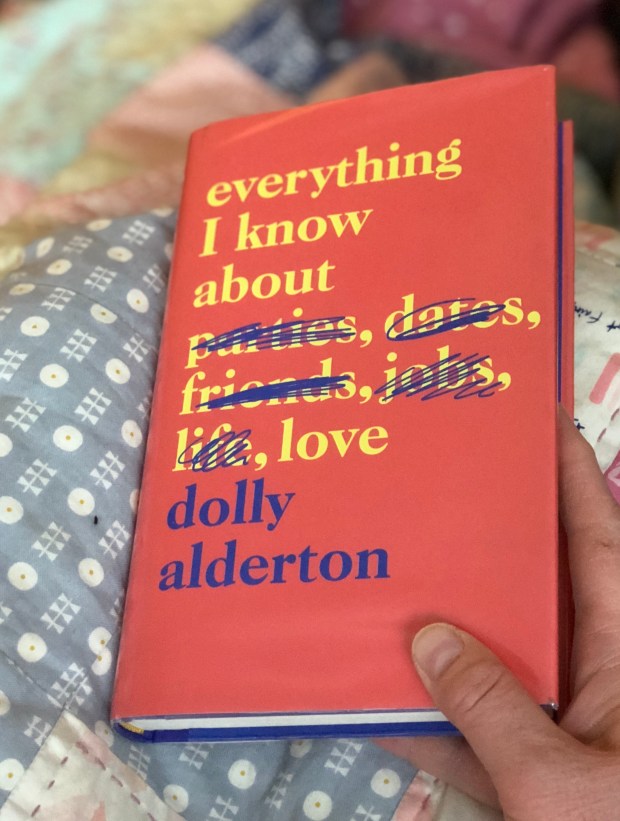
everything I know about love by Dolly Alderton

IMG_0257.jpg

Dolly Alderton: Everything I Know About Love

Published By: Fig Tree

Buy It: here

What They Say:

When it comes to the trials and triumphs of becoming a grown up, journalist and former Sunday Times dating columnist Dolly Alderton has seen and tried it all. In her memoir, she vividly recounts falling in love, wrestling with self-sabotage, finding a job, throwing a socially disastrous Rod-Stewart themed house party, getting drunk, getting dumped, realising that Ivan from the corner shop is the only man you’ve ever been able to rely on, and finding that your mates are always there at the end of every messy night out. It’s a book about bad dates, good friends and – above all else – about recognising that you and you alone are enough.

Glittering with wit and insight, heart and humour, Dolly Alderton’s powerful début weaves together personal stories, satirical observations, a series of lists, recipes, and other vignettes that will strike a chord of recognition with women of every age – while making you laugh until you fall over. Everything I know About Love is about the struggles of early adulthood in all its grubby, hopeful uncertainty.


What I Say:

“Because I am enough.  My heart is enough. 

The stories and the sentences twisting around my mind are enough.”

Let me say from the start, because I am always upfront about my reviews, that I don’t know why I chose to pick up this book other than I had heard lots about it on Twitter, and it was on the ‘New Books’ Shelf in my local library.

I didn’t think that I was in any way the target demographic.  I am a 47 year old Mum of two, who has been married to the same man since 1996, and have been with Mr Reynolds since 1992. Even writing that down surprises me!  Dolly is 29 and as she explains in her book, has not been in a relationship for longer than two years.

So, I thought, we have nothing in common.  I was sure I would read a couple of pages and disregard it as another self-indulgent memoir that was only on my radar due to the power of social media.

If I tell you that I started this book at six thirty this morning, and finished it by midday,  then you can probably guess that I completely misjudged everything about this book.

Dolly Alderton, if by any chance you ever read this blog post.  I humbly apologise to you and have only one thing to say to you.  Thank you – this book resonated with me on every level.

Everything I Know About Love is Dolly’s memoir, explaining what she has learned through her experiences and what knowledge from different points in her life she can share with us.  What makes this book stand out, and I think relatable for every woman, is that this is not some gloating, Instaperfect look at a privileged life that we really couldn’t care about.

Dolly’s writing and her narrative tone reminded me very much of Jilly Cooper’s style, but this is meant as a huge compliment as I love the deftness of touch and humour that both women have in their writing.  The addition of recipes and the asides such as the excruciating baby shower and hen do emails, serve to lift this book way above the usual memoirs with a horrifying realisation that we have all been party to something like this.

Dolly, and her wonderful friends that we meet – (I guarantee you will especially love  Farly, Dolly’s best friend) are normal human beings.  They make mistakes, they drink too much, they sometimes make bad life choices, worry about paying their bills and get themselves into situations that made me wince a few times, but ultimately they embrace life.   Dolly and her friends love each other without question.

As many of us now realise, your family are not always those related to you by blood, they are the ones who are there to listen to your latest relationship disaster, to make sure you have food in your fridge, to be there when life seems to be overwhelming and to sometimes say nothing at all.

Dolly is unflinchingly honest in her memoir.  No topic is off-limits, she is brutally frank as she tells us of her love of alcohol, her online dating disasters and her route to therapy as she struggled to find her way in today’s increasingly pressured society.  Make no mistake, she is not looking for our pity or attention, instead she is saying to us, it is ok for us not to be perfect.  Just because someone might seem to have it all, and appear to be leading the life we wished we had, it doesn’t mean they are any happier than we are.

Everything I Know About Love is the book I wish I had when I was in my twenties.  I too tried to navigate my way through the complexities of being a young woman, but my time was in the early nineties.  I had done the expected thing of A levels and then Leeds University, but nothing prepared me for real life afterwards.

I realised then, and more so now that like Dolly, my friends were truly everything, and together we believed we were invincible and would have done anything for each other. Dolly’s book is a love letter to female friendship, to understanding that you may be in and out of each other’s lives as time goes on, but that you will always be bound by the love, laughter and tears you have shared.

Everything I Know About Love is a beautifully written, razor-sharp and stunning memoir.  I will be pressing a copy in to my nieces’ hands as soon as they are old enough, and will tell them that they should appreciate the women around them, relish the friendships that will endure, and know that they are always enough.

I loved it.


You Don’t Know Me: Imran Mahmood


img_0059251459823.jpg

Imran Mahmood: You Don’t Know Me

Published By: Michael Joseph

Buy It: here

What the Blurb Says:

It’s easy to judge between right and wrong – isn’t it?

Not until you hear a convincing truth.

Now it’s up to you to decide…

An unnamed defendant stands accused of murder. Just before the Closing Speeches, the young man sacks his lawyer, and decides to give his own defence speech.

He tells us that his barrister told him to leave some things out. Sometimes, the truth can be too difficult to explain, or believe. But he thinks that if he’s going to go down for life, he might as well go down telling the truth.

There are eight pieces of evidence against him. As he talks us through them one by one, his life is in our hands. We, the reader – member of the jury – must keep an open mind till we hear the end of his story. His defence raises many questions… but at the end of the speeches, only one matters:

Did he do it?

What I Say:

“Maybe it don’t matter who tells the story because there is no way of making a person understand what it is to be you”.

You Don’t Know Me is one of those books that had been on my radar for a while (it was a Radio 2 Book Club Choice), so half-term seemed a perfect time to sit and really take my time to read it. Unfortunately, it is not one of those books you want to slowly savour – it is a book you want to read and read until you can’t keep your eyes open, turning the pages until you find out what has happened. It is a fast paced, twisting turning novel that doesn’t stop pulling you along until the very last page – and then leaves you hanging on the precipice!

You Don’t Know Me tells the story of an unamed man who is on trial for murder. He decides to fire his barrister just before the closing arguments, and takes the decision to tell the jury his side of the story.

His story fills in the blanks for us – the everyday mundane and irrelevant, the things we don’t really need to know, but also the things that mean we are seeing a fully formed person in front of us as oppose to a representation skewed by legal arguments and cross-examination. – we listen to him talking to the jury and telling them everything that his barrister can’t possibly know.

He gives us not only a blow-by-blow account of how he ended up being tried for murder, but also a glimpse into the day-to-day reality of living in a world where the gang culture is everything. I have no experience of anything like this, and You Don’t Know Me was a huge learning curve. I had no idea how organised and structured this world is, how children are beguiled by the sense of belonging and having a family that always has your back, and that they can work their way up through the ‘ranks’ to become a pivotal member of the gang.

Belonging to, and being an active member of a gang is everything to many young people. It gives them not only a sense of identity, but a shared life experience and a belief that they are ultimately untouchable.

The narrator who has no legal experience meanders and goes off point, swears and apologises immediately and has to stop and explain the different terms and slang he uses to us. This serves to only make the monologue much more authentic and natural. We, the reader become the thirteenth member of the jury, and are drawn in to his story and start to realise that we are starting to make judgements and assumptions based on the evidence he is presenting us with.

We learn how he met his girlfriend Kira, and how their relationship seemed to be going well, she loves books, he loves working on his cars, they settle into a routine that seems to work. However, Kira’s brother, Spooks is in prison, scared for his own safety, and his fear means that he trades his sister’s wellbeing to ensure he is not touched in prison. Kira is forced to work the streets by a gang. Bereft at having lost his girlfriend, the defendant searches the streets until he finds her and takes her home, realising that she will never be the same again, shattered by what she has been forced to do with almost a weary acceptance as she wants her brother to be safe.

From this point on, You Don’t Know Me turns up the tension even further, as Kira and the defendant, along with Curt, his best friend, play a dangerous game with the gangs that surround them. A young man called JC, who is working for the Olders gang taunts the defendant that he knows Kira is back with him, and from that point on, a devastating chain of events is set into motion which means that our narrator is left alone to face a charge of murder.

The events that overtake the defendant, Kira, Curt and his family put them into situations that Imran describes so convincingly, you can feel their desperation and their desire to return back to the mundane and everyday that they longed to escape from. They realise that the grass is not always greener, and that they are completely subsumed in the gang culture that they are trying to escape.

You Don’t Know Me is a truly remarkable novel – the narrator holds the whole book together as he gives his impassioned closing speech to us, the jury. However, the freshness and the pace of Imran’s writing never flags, and you feel that you are sat in court watching this young man uncomfortably standing in front of us, trying to recall any tiny piece of information that could help prove his innocence. We are constantly forced to confront our preconceptions and beliefs as a young man asks us to look behind the case notes and judge him simply as a human being.

He stands in front of us, fallible, flawed and imperfect, but pleading with us to believe him. That is the crux of You Don’t Know Me, as Imran Mahmood presents us with no narrative other than that of the defendant, as you, the reader are finally asked – so, who do you believe?

I loved it.

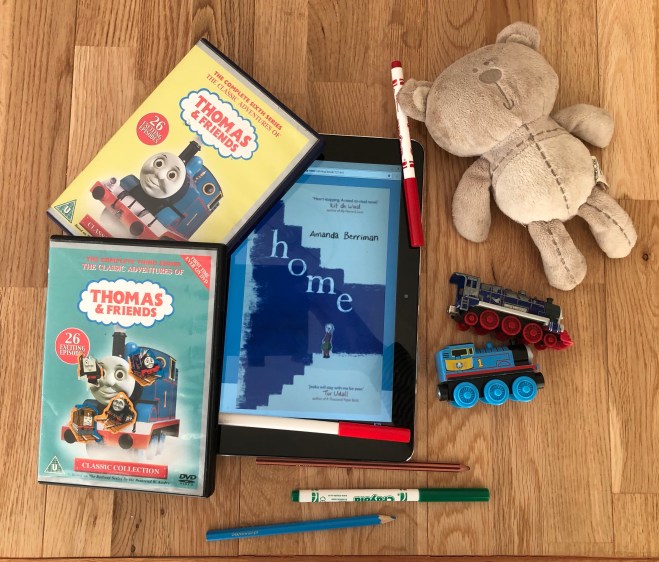
Home by Amanda Berriman

IMG_0008.jpg

Amanda Berriman: Home

Published By: Doubleday

Buy It: here

What The Blurb Says:

Jesika is four and a half.

She lives in a flat with her mother and baby brother and she knows a lot. She knows their flat is high up and the stairs are smelly. She knows she shouldn’t draw on the peeling wallpaper or touch the broken window. And she knows she loves her mummy and baby brother Toby.

She does not know that their landlord is threatening to evict them and that Toby’s cough is going to get much worse. Or that Paige, her new best friend, has a secret that will explode their world.

Thank you to Netgalley for providing me with an e-book preview copy of Home in return for an honest review.

What I Say:

From the very first sentence, you know Home is going to be different to any novel you have read before. Our narrator is a four and a half-year old girl called Jesika, and we are seeing the world through her eyes, misunderstandings and innocent narrative. The written language with the spelling mistakes and misheard words, means that this is a unique viewpoint and an intriguing narrator that we are party to.

As I realised that I was reading the thoughts and feelings of a four-year old, I was lulled into a false sense of security that the Home of the title was going to be a warm and friendly place and an Instaperfect existence.

Jesika is making her four-year old way in the world. Her naivety and lack of experience means that she tells us about her day-to-day life in a very matter of fact way, whilst we as grown ups are able to fill in the blanks of her understanding with the knowledge and experience we have gained. We can understand the things that Jesika is unable to comprehend, and it makes it very uncomfortable reading as we gradually realise what Jesika can see happening.

What works so consistently well in Home is how as the reader it makes you remember what it was like to be four years old.  How your parents and home life was your world.  That they were everything to you, and all you wanted was for them to know how much you love them. Without them you feel rootless. How you love it when you laugh together, and you can make them laugh, but the thing you hate the most is when your parent is shouting and you don’t know why and you would do anything to make it stop.

Home is not by any means an easy read. It brings us face to face with the uncomfortable reality that life in Britain for a young single mother and her family on the breadline is far from idyllic. Jesika, her mother Tina, and her baby brother Toby live in a flat which is full of mold, a boiler that doesn’t work and a landlord who cares nothing for them or the state of the flat he has rented them.

The disrepair of the flat causes Tina and more especially Toby to be constantly unwell, and unable to work, Tina and her two children are living day-to-day, hand to mouth. Her husband has left her to return to his native Poland, and she is alone, navigating life, dealing with an inquisitive four-year old and a young toddler who constantly make demands on her. Tina gets through the grind and stresses of every day purely because she has no choice. She, like so many people in the United Kingdom today is caught in a benefits system which cannot operate outside the parameters of a heavily bureaucratic script. It does not see a young woman who desperately needs help, it sees her as a statistic to be counted and a case to be closed.

For Jesika, her session at preschool is everything. For a brief period of time, she can simply be a four-year old and live in the moment and forget everything else.  She is desperate for a friend, and when she meets Paige, she realises that she has finally found someone to play with.  Even though Paige blows hot and cold with the friendship, and at times is downright hostile to Jesika, Jesika sees nothing but the good in someone, and longs to make a connection.  When it transpires that Paige’s Mum and Uncle are Tina’s former school friends, it seems that Jesika finally has a new world of friendships to explore.

This is where Home starts to lead us into much darker territory.  As the events unfold, we are drawn into a story which is extremely harrowing for us as adults to read, but we are also aware that an innocent four year old child is the one going through this. Amanda Berriman’s superb writing means that we are totally consumed by Jesika’s story, and we feel that we have to read this, to be present alongside Jesika to ensure that everything will be okay for her in the end.

A particularly poignant section in the novel for me, is when Tina and Toby are admitted to hospital, and faced with no family to help, Tina has to make the decision for her daughter to be taken into temporary foster care.  It was absolutely heartbreaking to read, the sense of powerlessness that Tina felt and the bewilderment that Jesika has as the person she loves the most is choosing tho send her away.

Jesika may be an unusual narrator, but she is also a brave and fearless one, who wants to protect those around her and keep her family intact. Her reluctance to tell Tina what is happening to her and Paige for fear of what could happen to them is heartbreaking to read, as you understand how overwhelming this must be for a four year old to deal with.

Home does not shy away from making us face many difficult issues, but it is also a novel filled with love and a sense of community.  For so many of us today, we don’t have our family on our doorstep. Today, more than ever, we understand that family is not necessarily blood relations, but it is often our friends who understand what we are going through and by supporting us with time, love and little gestures, it can make all the difference to how we view the world around us.

I wish this novel could be pushed into the hands of all the professionals who work with families like Tina, Jesika and Toby.  Home would help them truly understand what life is like for so many people through no fault of their own.

The resounding message I took from this astounding novel is one we can all relate to. Jesika simply wants to live happily with her Mum and Toby in a place she can truly call Home.

I loved it.

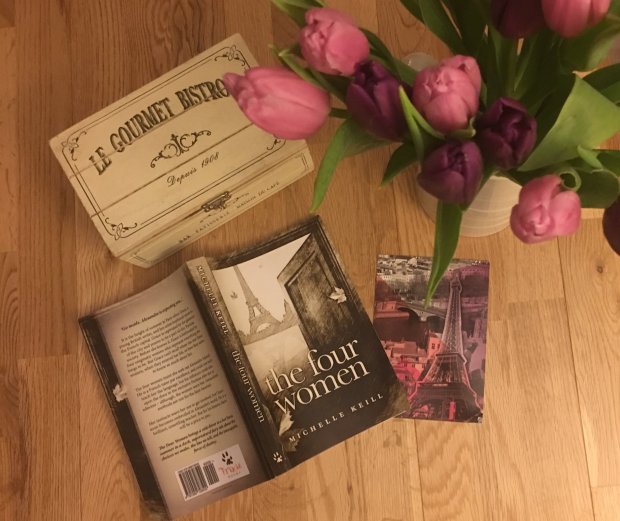
The Four Women by Michelle Keill

IMG_7211.jpg


Michelle Keill: The Four Women

Published By: Trixie Books

Buy It: here


What The Blurb Says:

‘Go inside, Alexandre is expecting you…’

It is the height of summer in Paris when Grace, a young British writer, and her artist boyfriend move to the French capital. Grace is captivated by the glamour of the city and yearns to be part of chic Parisian society. Before she knows it, Grace is befriended by four enigmatic women who represent everything she longs to be. But Grace can’t recall where she met these women, when they entered her life, or how they seem to know so much about her.

The four women insist she seek out Alexandre Martel. He is a French tutor par excellence, and could not only teach her the language, but his influence could also open the door to the exclusive Parisian elite she so admires – although, the women warn her, Alexandre’s methods are not for the faint-hearted.

Her instincts warn her not to get involved, but Grace soon becomes embroiled in Alexandre’s world. He is a brilliant, unsettling teacher. But for his lessons there will be a price to pay…

The Four Women brings a cold shiver to a hot Paris summer in a dark, supernatural fairy tale about the choices we make, the lies we tell, and the inescapable force of destiny.

What I Say:

I was given a free copy of The Four Women by Michelle Keill in exchange for an honest review.

As regular readers of my blog know, I am always honest about the books I review, and when Michelle asked me if I would like to review her novel I have to admit I was slightly nervous.  What if I didn’t enjoy the book, or found it difficult to review?

Fortunately, this was not the case!  The Four Women is a unique novel which brings to the fore a number of interwoven themes, such as love, passion, relationships and confidence, in an intriguing and layered read.

I stared at the name on the card.  Alexandre Martel.  The name I will never forget.”

Grace and Mats have decided to stay in Paris for as Mats follows his passion of painting, and Grace attempts to write a novel.  Although Grace enjoys being in Paris, she finds not being able to speak the language a source of frustration and longs to feel the same sense of belonging that Mats so obviously does.  Mats finds Paris a source of inspiration, and his output of paintings becomes prolific, whilst Grace cannot put a word on the page.  Almost from the start, the reader can sense there is some sort of disconnect between Grace and Mats, and that the different experiences they are having in Paris, is serving to pull them further apart.

One day, while Grace is in a restaurant, she notices four women who start talking to her and seem to pity her for her inability to master their language.  The way that they were introduced added to the air of mystery, I felt that Michelle’s writing immediately added a sense of unease – they seemed to appear out of nowhere, and the slightly distanced air they have makes them seem other worldly almost.

They encourage Grace to approach the mysterious Alexandre Martel, a French teacher who is renowned for his unconventional teaching methods and the exclusivity of his lessons.  If you receive lessons from Martel, you are immediately given access to the exclusive Parisian social circle that so many people long to be part of.

Mats tells Grace that he has been commissioned by a benefactor, Madame Dumas to paint for her, but he refuses to tell Grace the details, and asks that she does not look at his work. As Grace says;

It was his first secret, and my last promise”.  

As Grace finally finds the courage to go and find Martel, she is faced with an imposing and unwelcoming building, that adds only to the mystery surrounding him.   The first lesson she attends is far from conventional.  Martel’s method of learning French is to dance with Grace, spinning her round the room as he speaks to her.  In that moment, she feels almost as if she is having an out-of-body experience, and she is aware of the presence of the Four Women in the room with them.  It is as if she is starting to lose her grip on reality.  From that moment, Martel has a connection with Grace, and that whether she knows it or not, he will start to consume her day-to-day life.

The really interesting idea is that Martel, Dumas and the Four Women are inextricably linked, and that is something that is both a central theme and is present throughout the whole book.  When Grace voices her reservations to the ever-present Four Women, they hint that her refusal to work with Martel could lead to Mats losing his commission.

Mats and Grace are trying to maintain their relationship as Martel and the Four Women are in the background of their life in Paris.  The Four Women always seem to be around wherever they are, and Grace’s thoughts are filled with the mysterious French teacher whose methods and behaviour are affecting her in more ways than she can admit to.  She loves Mats, and wants a future with him, but is aware that she is under the spell of Martel, and that he has forced her to confront something within herself that she does not want to.  The Four Women seem to act as Grace’s conscience, articulating the thoughts that she does not want to face.  They know that Martel has a hold on her, and it feels as if they are circling Mats and Grace, ready for the inevitable collapse of their relationship.

In the meantime, Grace’s neighbour, Brigitte, tells her that she is sure she has heard crying in their apartment, and Grace is obviously concerned for Mats’ welfare and whether the commission is as innocent as he would have her believe.

Alexandre invites Grace and Mats to his party, which is an honour not afforded to many, and something that they are far from comfortable with, but feel that they should be seen to be there.

Ironically, although Grace senses that she and Mats are far from secure in their relationship, it is at this point that Mats decides to propose.  As they arrive at the party, Mats feels unable to go in with Grace, and although she initially refuses to go without him, Mats persuades her that it is the right thing to do.  He walks away from her and we know that it is forever.

The party feels claustrophobic and has a sense of foreboding as soon as Grace enters, and the Four Women have also played a cruel trick on Grace by convincing her that she has to wear a green dress, when of course the dress code is black dresses for the women.  She already feels self-conscious and out-of-place but inexplicably she has to keep walking through the rooms to find Martel.

When Grace does find him, it unleashes a dramatic chain of events which Grace could never have predicted, and spins the novel in another direction that I never saw coming, but serves to cleverly slot all the events of the book into place.  Grace has been drawn into a world which has left her battered and bruised, but the overriding feeling is that she is not Martel’s first victim and she certainly won’t be the last.

The Four Women is a sharp, crisp and unsettling novel, which pulled me in from the first chapter, and made me want to find out the disturbing connection behind the Four Women and Alexandre Martel.  It is a credit to Michelle’s clever writing that I could not predict what was going to happen, and that I really enjoyed reading The Four Women to find out.


Little Fires Everywhere by Celeste Ng

IMG_7083.jpg

Celeste Ng: Little Fires Everywhere

Published By: Little, Brown

Buy It: here

What The Blurb Says:

Everyone in Shaker Heights was talking about it that summer: how Isabelle, the last of the Richardson children, had finally gone around the bend and burned the house down.

In the placid, progressive suburb of Shaker Heights everything is meticulously planned – from the layout of the winding roads, to the colours of the houses, to the successful lives its residents will go on to lead. And no one embodies this spirit more than Elena Richardson, whose guiding principle is playing by the rules.

Mia Warren, an enigmatic artist and single mother, arrives in this idyllic bubble with her teenage daughter Pearl, and rents a house from the Richardsons. Soon Mia and Pearl become more than just tenants: all four Richardson children are drawn to the alluring mother-daughter pair. But Mia carries with her a mysterious past, and a disregard for the rules that threatens to upend this carefully ordered community.

When the Richardsons’ friends attempt to adopt a Chinese-American baby, a custody battle erupts that dramatically divides the town and puts Mia and Mrs. Richardson on opposing sides. Suspicious of Mia and her motives, Mrs. Richardson becomes determined to uncover the secrets in Mia’s past. But her obsession will come at unexpected and devastating costs to her own family – and Mia’s.

What I Say:

” …sometimes you need to scorch everything to the ground and start over.  “

Little Fires Everywhere was never a planned blog post. Quite often, I read a lot of books ‘behind’ my blog. I just want to read books without the pressure of trying to write down pertinent points and punchy quotes to put into a post.

However, sometimes, a novel comes along that knocks you sideways, and the only way you can get over not being able to read it anymore is to tell everyone else how wonderful it is!

From the first chapter, where the family house of the Richardsons is burnt to the ground, seemingly by their youngest daughter, Little Fires Everywhere drew me in and kept me there.

It is at first glance a book about two families – the Richardson and the Warrens.

The Richardsons, who live in the quaintly named Shaker Heights have it all. Two successful parents, a brood of children who are over achieving in every nauseating Round Robin Christmas Newsletter way possible, and an ordered, chocolate box existence that most of us can only dream of.

Mia Warren, a free-spirited, nomadic artist and her daughter Pearl, arrive in Shaker Heights to take up the rental of the Richardsons’ second house.  From that moment on, the two families become intertwined in a way that neither could have foreseen – perhaps the first little fire of the title has been lit.

Elena Richardson is initially welcoming to Mia, seeing her as a charitable cause to take under her wing.  Pearl becomes great friends with the Richardson children and relishes the stability and apparent normality that she longs to have in her own home.  There is no doubt that she loves her mother and has accepted that they move when and where her mother decides, but it is evident that Pearl longs for something more traditional, a secure base for her to develop and mature.

Similarly, Elena’s youngest daughter, Izzy, seems at odds with her family.  Constantly restless, she seems confined by the rigidity and conventionality of Shaker Heights, and her family’s reputation and place in it.  Izzy strikes up a close friendship with Mia, and as Pearl becomes more a part of the Richardsons family, Izzy falls into Pearl’s place with an ease that surprises even herself.

The stifling conformity of Shaker Heights is threatened when Elena’s friends, the McCulloughs have to go to court to keep their baby Mirabelle or May Ling Chow, that they wish to adopt.  Mirabelle was found abandoned outside a fire station, and given to the McCulloughs who were looking to adopt.  Bebe, May Ling’s biological mother and a friend of Mia, wants to take her baby home. This shocking turn of events reveals that Shaker Heights is not used to having to confront something this inflammatory in their perfect world and no one seems quite sure how to handle it.

Should Mirabelle stay with the McCulloughs who can offer her everything she needs in this privileged, monied life, or should she be handed back to her biological mother who can give May Ling the cultural and emotional roots she needs?

We see the emotions, background and daily realities of both the birth and adoptive mothers, and feel enormous empathy for both.  At the heart of it all, Celeste portrays them purely and simply as women fighting for the child they feel is rightly theirs.

“To a parent, your child wasn’t just a person: your child was a place, a kind of Narnia, a vast eternal place where the present you were living and the past you remembered and the future you longed for all existed at once.”

The volatile custody battle is perhaps the next spark of the little fires everywhere –  an incendiary moment that sets Elena against Mia, and Izzy against Elena as they face each other on opposite sides of the custody battle.  Elena feels increasingly frustrated that she cannot ultimately control the outcome of the trial, and sets about trying to find out as much as she can about Mia.  It becomes her mission to ensure that Mia is humiliated and shamed into leaving Shaker Heights. As Elena investigates Mia’s past, revelation after revelation comes tumbling out, which show us why Mia is who she is today, and why she and Pearl live the lifestyle they do.  It also means that Elena has to confront some unpleasant realities about her family and her own behaviour too, which is something she perhaps had never really faced.

Little Fires Everywhere is an epic contemporary novel about so many different things.  It is about family, race, motherhood and the choices we are forced to make in times of crisis.  Every character in the novel has important decisions to make which have far-reaching impact and will change the world they inhabit forever.

Celeste never forces an opinion on us, she presents us with the characters and their dilemmas, and as we live through them with them, we learn more and more about why they do what they do, and we are made to understand that things in life are not always black and white for any of us.

Little Fires Everywhere is a brilliant and thought-provoking novel to be savoured, read slowly and recommended to everyone.

I loved it.

The Woman In The Window by A.J. Finn


IMG_7119.jpg

A.J. Finn: The Woman In The Window

Published By: HarperCollins (25 Jan 2018)

Buy It: here


What The Blurb Says:

What did she see?

It’s been ten long months since Anna Fox last left her home. Ten months during which she has haunted the rooms of her old New York house like a ghost, lost in her memories, too terrified to step outside.

Anna’s lifeline to the real world is her window, where she sits day after day, watching her neighbours. When the Russells move in, Anna is instantly drawn to them. A picture-perfect family of three, they are an echo of the life that was once hers.

But one evening, a frenzied scream rips across the silence, and Anna witnesses something no one was supposed to see. Now she must do everything she can to uncover the truth about what really happened. But even if she does, will anyone believe her? And can she even trust herself?

What I Say:

First of all, thank you to NetGalley and HarperCollins who provided me with a free E-Arc in exchange for an honest review.

I knew that this book was one of the most anticipated reads of this year, and had heard lots about it both on social media and in the press.  I was so delighted to be approved to receive a review copy, but it was also a lot of pressure because I was worried that it would not live up to its promise, and my whole ethos is only talking about books that I love.

Let me start by saying this.  Believe the hype, and miss this novel at your peril.

Yes, it is a psychological thriller, but it picks up the genre, shakes it, twists it on its head and breathes a whole new lease of life back into it!

It is also a difficult book to review because giving away too many plot points would completely ruin your enjoyment!  It is packed full of twists and turns, none of which I guarantee that you will either see coming, or be able to work out what is happening.

We meet Dr Anna Fox, a child psychologist, and is currently in the grip of agoraphobia.  An incident has resulted in her being separated from her husband and daughter, and an increasing dependence on alcohol and the medication she takes to cope with her agoraphobia means that her grip on reality is at best hazy, and at worse, she is unable to remember what she has done.

Confined to her home, Anna spends her days playing chess, watching movies, and keeping a close eye on the comings and goings of the neighbours in her street. She has few visitors, and finds comfort in helping others on an internet forum dedicated to fellow agoraphobia sufferers.

Anna becomes fascinated by the Russell family who move in across from her house, almost envying the life they lead as she rattles around her home existing from medication to medication and drink to drink.  A.J. Finn creates a world for Anna which feels increasingly unsettling and uncomfortable, and almost claustrophobic in its scope, but at the same time, it gives Anna the safety and control she needs to function – albeit fuelled by her dependence on alcohol and mediation.

This is what gives The Woman In The Window a new dimension.  We are presented with an increasingly unreliable narrator, living in a self induced haze – can we really believe anything she tells us? When Anna is finally brave enough to push herself and meet someone to have an evening of relaxed fun and a good old chat, it leads to one of the biggest shocks in the book, that starts a whole chain of events which relentlessly spin out of control, propelling Anna front and centre.  The cocoon that she has carefully constructed, in order to protect herself from the outside world, is pulled apart by neighbours, the police and even those few people Anna has to let in to her world in order to function.  No one believes her version of events – and why should they?

The pace of the novel is unrelenting- the phrase ‘page turner’ is often overused in book marketing, but The Woman In The Window genuinely is one.  Once the story gets going, it just does not let up.  You are never sure whether what you are reading is what actually happened, or whether you are seeing Anna’s version of the world around her.  One thing is for sure, this is one of the few novels I have read recently that genuinely had me mystified as I tried to work out what was happening!

As it hurtles towards its climax, you read revelation after revelation, and little by little, the fractured pieces of Anna’s past slot into place as she attempts to make sense of the chaotic world she has been pulled into.

The Woman In The Window is a wonderfully filmic novel, brilliantly written at a breakneck speed.  It is also a chilling and a deft examination of what it means to be deemed as unreliable and unbelievable when you are trying to prove to people that you are the one person who really knows the truth.

A J Finn has written a superb novel that had me hooked from the start, and I loved it.

A New Year’s Eve Thank You…

wp-image--1107900328

I know at this time of year, many people, newspapers and magazines put together their lists:

The Best Books of 2017, Books I loved, Books I Hated, Books You Should Have Read, Books You Shouldn’t Have Read and Books that Everyone Pretends They Have Read when They Couldn’t Get Past the First Page – you know what I mean.

2017 was the year where I finally plucked up the courage to start to blog about how much I love reading and books.

More importantly, it was the year I finally fell in love with reading again.

Quite simply, life had got in the way, and the draw of my mobile phone was too much.

I had forgotten how much I love reading.  I also decided that instead of trying to bravely battle through a book I wasn’t enjoying, I would put it down and move on to the next one- and that is how this blog, My Years of Reading Selfishly came about.

Too often today, we see people pulling each other down, looking down on them for the choices they make or the opinions they voice.

My final blog post of 2017 is my Thank You to all the people who have inspired me, supported me and helped me love books again.

The Authors

This list is in no particular order, other than from the start of my reading in 2017 to the end.

Each of these books stood out in 2017 as they were simply fantastic reads.

They challenged me, often pushed me out of my reading comfort zone, and more importantly were books I fell in love with and told everyone else about.

These authors helped me realise that there was still a whole new world of literature waiting for me to explore, and that there were so many amazing new genres and styles for me to discover as I began to read again.

Often when I tweeted how much I had enjoyed reading the books, the author in question replied, always kindly, and I absolutely believe that it is so important to let people know when you have enjoyed their book, so they know that all their stresses, deadlines and edits are not in vain!

To each and every one of you below, thank you for your amazing books this year – please don’t ever underestimate how appreciated you are by your readers.  More importantly, please don’t stop writing!

So, thank you to:

Kate Eberlen (@KateEberlen) – Miss You

Ali Land (@byAliLand) – Good Me, Bad Me

Gail Honeyman (@GailHoneyman) – Eleanor Oliphant is Completely Fine

Susie Steiner (@SusieSteiner1) – Missing, Presumed

Julie Buntin (@juliebuntin) – Marlena

Sam Hepburn (@Sam_Osman_Books) – Her Perfect Life

Flynn Berry (@flynnberry_) – Under The Harrow

Clare Mackintosh (@claremackint0sh) – I See You

Rowan Coleman (@rowancoleman)  – The Summer of Impossible Things

Julie Cohen (@julie_cohen) – Together

Laura Barnett (@laura_jbarnett) – Greatest Hits

Katherine Heiny (@katherine_heiny) – Standard Deviation

Maggie O’Farrell – I Am, I Am, I Am

Sarah Hilary (@sarah_hilary) – Someone Else’s Skin

Laura Purcell (@spookypurcell) – The Silent Companions

Fiona Barton (@figbarton) – The Child

Jon McGregor (@jon_mcgregor) – Reservoir 13

Laura Wilson (@LWilsonCrime) – The Other Woman

Sarah Stovell (@Sarahlovescrime) – Exquisite

John Boyne (@john_boyne) – The Heart’s Invisible Furies

Alice Hoffman (@ahoffmanwriter) – The Rules of Magic

Elizabeth Day (@elizabday) – The Party

Rebecca F John (@RebeccaWriter) – The Haunting of Henry Twist

Fiona Mozley (@FJMoz) – Elmet


My Instagram and Twitter Friends

It’s a truly scary thing when you decide to take the plunge and start talking about your love of books on social media.  Initially I worried whether I was smart enough, funny enough or even coherent enough to communicate what I loved about reading.

However, as soon I started blogging, posting on Twitter and Instagram, I realised that there were so many other people who felt the same.

When I posted, people talked to me and started conversations – a whole new world opened up for me, and as a 47-year-old stay at home mum, I felt that my opinions finally counted for something!

I had found a way of connecting with other like-minded people who offered nothing except support, laughter and a thousand other reading suggestions – Heaven!

I have been really lucky to connect with lots of fantastic people – so thank you to all you amazing book lovers on Twitter and Instagram.

I am really honoured to know you and here’s to even more reading and book chatting in 2018!

Friends and Family

They know me best, and those who absolutely know me understand how much reading and my blog means to me.

From a ‘what if’ chat with some of my best friends over coffee, cake and maybe a little wine, the idea of Years of Reading Selfishly grew, and they have been my biggest supporters – especially when I didn’t think anyone would be bothered what I thought about books!  Thank you for all your advice and for pushing me to do it – you were right!

Finally, to my Husband and two boys, who have always completely supported me as I started out on this new chapter, and not said anything as yet another pile of books makes its way into our home, or as I swore because I couldn’t understand my blog scribbles -thank you!

You mean the world to me, and I would be lost without you.


I wish you all a very Happy 2018, and here’s to even more Years of Reading Selfishly!

Love,

Clare

xxxx


Elmet by Fiona Mozley

IMG_6959.jpg

Fiona Mozley: Elmet

Published by: J M Originals

Buy It: Here


What The Blurb Says:

Daniel is heading north. He is looking for someone. The simplicity of his early life with Daddy and Cathy has turned menacing and fearful. They lived apart in the house that Daddy built for them in the woods with his bare hands. They foraged and hunted.

Cathy was more like their father: fierce and full of simmering anger. Daniel was more like their mother: gentle and kind. Sometimes, their father disappeared, and would return with a rage in his eyes. But when he was at home, he was at peace. He told them that the little copse in Elmet was theirs alone. But that wasn’t true. Local men, greedy and watchful, began to circle like vultures. All the while, the terrible violence in Daddy grew.

Brutal and beautiful in equal measure, Elmet is a compelling portrayal of a family living on the fringes of contemporary society, as well as a gripping exploration of the disturbing actions people are capable of when pushed to their limits.

What I Say:

“I still smell embers.  The charred outline of a sinuous wreck.  I hear those voices again..”

Elmet had been on my ‘Must Read’ Pile for a long time.  I was entranced by the premise, of a family living outside society, whilst living within their own rural idyll.  After having read it in a weekend, I am asking myself why it took me so long to pick it up and read it!

Quite simply, Elmet is one of those books that once you start reading, you start bargaining with yourself – ‘Just one more chapter, one more page, five more minutes’, because it is absolutely impossible to put down.

Beautifully written,  it has the juxtaposition of the family  – Daddy, Cathy and Daniel, living contentedly in a house they have built, pitched against the underlying menace of the brutality their father can inflict on others when pushed to protect those he loves, and a world that doesn’t understand the choices they have made.

The family spend their days looking after the land where they live, farming and maintaining their property and generally existing in peace.  Daddy makes money for the family by taking part in fights, a violent side of him they are aware of but do not see, as he attempts to keep the two sides of his life separate.

Cathy is not constrained by what society expects of her – she lives her life as she wishes, free from the ties of school life, choosing her own path at a pace that suits her and always has that element of unpredictability and wildness at her core.

Danny on the other hand, quieter and more reticent than Cathy, takes on the majority of the domestic tasks, and seems to find his happiness in providing for and caring for his sister and Daddy.

Fiona’s detailed description of the rural idyll that the family find themselves in, almost lulls the reader into a sense of calm and peace.  Although it is a hard life, it seems a simple, uncomplicated one, and I have to admit I was at times jealous of them, and their ability to live without the constant need to be part of the overwhelming society we live in.

This false sense of security is testament to Fiona’s talent as a writer, as the arrival of the Price family into the landscape immediately creates a sense of unease and foreboding.  You know that things are never going to be the same again, and with that, comes the realisation that the Prices will be the catalyst to destroy the life the family have so carefully created.

Mr Price arrives with his two sons, claiming that he is the landlord and that they are his tenants. Daddy is aware that Price has the police and the council in his pocket, and that he is facing a huge battle against this powerful family to maintain the status quo he has fought so hard to create.

Cathy and Danny are now faced with people intruding on their landscape, but instead of fearing them, they find them intriguing, a side of life from which they have been shielded.

..though I loved watching birds and beetles, watching human beings was the thing

I loved the best.”

Realising that their peace is threatened, Daddy comes up with a plan to exact revenge on Price, and persuades Cathy and Danny to infiltrate the teams that Price uses to farm the lands, and to get the workers to come forward and tell their stories.  In doing so, there is a new community that forms, a group of people who have been treated badly by Price, and Cathy, Danny and Daddy find themselves part of that.

What I also found really interesting was the way in which Danny explores his sexuality.  He is free from the confines of a narrow-minded world, where he can truly express himself.  He has no knowledge or constraints on how he should behave and I thought that was really liberating and a clever way to make us realise how defined we are by what society expects.

As Danny says,

Nor did I have any understanding that there were parts of the body

that held a different worth”.

The tension in the novel starts to build as Price realises that his hold on his world is being threatened.  The final chapters are unflinchingly brutal and are at times difficult to read, but this is never gratuitous violence.  The actions of the characters caught in this world are reactions to the fact that their existences are being threatened, that what they thought they knew will be forever changed.

Fiona Mozley has written a quietly brilliant masterpiece which deserves every piece of praise which has rightly been heaped on it.

Elmet is a superb, thought provoking novel, filled with both the beauty and unrelenting harshness of the natural world. It shows us if we are determined, how easily we can live contentedly outside the confines of society, and that it is those that wish us to conform who are the biggest threat to our happiness.

I loved it.


The Other Woman by Laura Wilson

IMG_6805.jpg


Laura Wilson: The Other Woman

Published By: Quercus

Buy It Here: here


What The Blurb Says:

Shortly after Christmas, a message arrives at Sophie’s house, scrawled across her own round robin newsletter: HE’S GOING TO LEAVE YOU. LET’S SEE HOW SMUG YOU ARE THEN, YOU STUPID BITCH. Perhaps she should ignore it, but she ignored the last one. And the one before that. Now it’s time to take action.

But when a simple plan to identify and confront the other woman goes drastically and violently wrong, Sophie must go to extreme lengths to keep her life and her family together – while never letting on her devastating secret.

What I Say:

Trying to decide what to read next can sometimes be overwhelming.  Should you read a book you have had on your shelves for ages, or maybe look online to find out what everyone else is reading.  Sometimes, it is just as simple that your next read jumps off the shelf and into your hands.

The Other Woman was one of those books.

Sophie Hamilton, and her husband Leo, live the lives that most of us can only dream about.  They have a gorgeous house, wonderfully perfect children, a yacht and successful careers.

Sophie sends out an annual Round Robin family newsletter, only this time one is returned with the message:

He’s going to leave you. Let’s see how smug you are then, you stupid bitch.”

I have to say, initially I didn’t warm to Sophie – her life seemed just a little too perfect and she was one of those Instaperfect People who annoy you, but you can’t help but scroll through all their photos!

The very fact that she had a round robin newsletter was enough to make me wonder whether I could warm to her and read this book!  However, this makes Laura’s novel even more beguiling, as in a strange sort of way, I revelled in the fact that Sophie found herself in a situation that was so out of her comfort zone.

What also confused me was that Sophie hid the letter from her husband, Leo.  Why didn’t she show him straight away?  Why not be upfront about it?  Sophie knows that if she shows him, she opens up a whole Pandora’s box of ‘What If’s?”.

If she is right, he could choose to leave her to be with the Other Woman and the comfortable and enviable lifestyle she leads will come crashing down around her ears.  If she is wrong, Leo could be so upset with her that he could leave her anyway and she will be in the same predicament.

Plagued by doubts, Sophie sets out to search Leo’s office to try to find some trace of evidence.  She finds a tissue with some lipstick on it, but the lipstick is not hers…

To add further suspicion, Sophie’s cleaning lady finds a camisole in the family’s washing that doesn’t belong to anyone.  Leo has a flat in London, so Sophie heads there to see if she can find anything else, and is unable to get in as the locks have been changed.

This is why Laura’s novel is so good, because the evidence starts to stack up against Leo so early on.  You are convinced that the Other Woman exists, and that Sophie’s desire to uncover Leo’s betrayal is something that we all would do when faced with the prospect of losing the comfort and safety of our home life. Sophie’s dilemma is also more acute because we learn about her unsettled childhood and perhaps her desire to maintain the status quo is a consequence of an unstable upbringing.

As a reader, you really feel Sophie’s sense of bewilderment and sense of disbelief that something like this could possibly happen to her.  However, don’t think for one minute that Sophie is to be pitied.  She continues living her life as normally as possible, all the time wondering what the hell her husband has been up to.  As she says;

“A perfectly ordinary Saturday morning.  Except it wasn’t”.

When Sophie makes a second visit to Leo’s flat, a woman emerges, but it is someone who she knows.  Her worst fears have been realised, threatening the life she holds dear and the social standing she desperately wants to cling onto.

“Pain, like a block of ice, lodged in her chest.  The world slowed, stopped.”

Faced with the prospect of losing everything, Sophie cleverly manipulates the woman she believes to be guilty into coming to meet her.  Sophie is clearly the woman with everything to lose, but with a sense of power over her rival, she aims to overwhelm her with her staunch belief in her right to continue to hold onto her husband.

What happens next?  As a blogger loyal to her authors, as always, I will simply say, you need to read this book!

I guarantee that you will never be able to guess the chain of events that spiral away from Sophie.  She desperately attempts to protect the hilariously awful secret she now has to keep to ensure that everything she holds dear stays the same.

The utter brilliance of this novel is that we see Sophie go into auto pilot, navigating her way through the mundane trivialities of every day life, cooking dinners, dealing with the children and the husband and the dog, all the time knowing exactly what has happened.

As the novel progresses, we watch in horror as Sophie’s life starts to unfurl in front of her, but there was also a part of me that recognised myself!  Faced with the dilemmas that Sophie has, I think I would have reacted in much the same way!

The awful truth is that irrespective of what has happened,  daily life still goes on, and Sophie has to keep up the facade of fabulousness she has so carefully crafted to ensure that no one suspects anything, even though she might have fallen apart inside.

However, just when you think that you understand everything, Laura plants a massive twist that will knock you sideways and adds a whole other layer to The Other Woman.  It at once makes lots of events click into place, but at the same time, like Sophie, realise how many catastrophic choices have been made because of it.

The Other Woman is a fast-paced, clever and refreshingly different novel.  It is also at times hilarious, as Sophie struggles to cope to maintain her precious facade.  The brilliant twists and turns keeps you on your toes and the genuine horror of the situation pushes you out of your reading comfort zone and you are with Sophie every step of the way.  Her nightmare becomes yours, as you do not know what life is going to throw at her next!

I loved it.


The Silent Companions by Laura Purcell

IMG_6748.jpg

Laura Purcell: The Silent Companions

Published By: Raven Books

Buy It: here

What the Blurb Says:

Newly married, newly widowed Elsie is sent to see out her pregnancy at her late husband’s crumbling country estate, The Bridge.

With her new servants resentful and the local villagers actively hostile, Elsie only has her husband’s awkward cousin for company. Or so she thinks. For inside her new home lies a locked room, and beyond that door lies a two-hundred-year-old diary and a deeply unsettling painted wooden figure – a Silent Companion – that bears a striking resemblance to Elsie herself…

What I Say:

The first thing I have to say is, can we all take a few minutes to admire this gorgeous cover?

I have to admit, that it stopped me in my tracks when I saw it, and the keyhole you see on the front, opens to reveal the full portrait of a young woman, who simply stares back at you which is immediately slightly unnerving and sets the tone for the whole novel.

I have not read any type of gothic novel since my days at University, (a long time ago thank you!), however the premise of the novel, added to the numerous positive reviews I had heard of meant that it just had to be read.

I am going to say from the outset, that I really did love this novel.  It also scared the hell out of me and made me sleep with the lights on for a week afterwards, but that is all credit to Laura’s incredible writing, and the way in which she weaves a genuinely unsettling story that is not sensationalist or a mindless gory tale.

The novel works so well because everything is told in such an understated way, the genuine shocks and ‘What the hell?’ moments (of which there are many, believe me), work so well because there is no ten page build up.  It is as simple as a single line, such as

“The companion no longer looked out across the grounds.  She stared, dead and unblinking, right into Elsie’s soul”.

The Silent Companions is the story of Elsie Bainbridge, who we first meet in a mental asylum.  Obviously traumatised by what she has gone through, she is unable to effectively communicate.  With the help of her doctor, Dr. Shepherd, she starts to tell her story in series of flashbacks.  The story alternates between Elsie’s time at The Bridge, which is her late husband’s estate and St Joseph’s Hospital.  Anne Bainbridge, married to Joseph, and an ancestor of Elsie’s husband,  provides another narrative, as we learn about her experiences at The Bridge in 1635, as well as through her diary.

Elsie, is the young widow who has to go back to her late husband’s estate, accompanied by Sarah, a cousin of her husband.  We learn that Elsie has risen through the social ranks as a former match girl, and inherited everything on her husband’s death. She does not fit in with her former friends, and is viewed with suspicion by the class she has married in to, as they regard her as a gold digger.  Added to this is the fact she is pregnant, and is facing the prospect of raising their child alone in a remote and unwelcoming home.  Her only comfort seems to come from the fact that her brother Jolyon is able to stay with her for a while, reassuring and looking after her.

The unsettling events at The Bridge happen almost as soon as Elsie has crossed the threshold.  At night she hears a strange hissing sound, but is unable to get into the garret where the noise seems to be coming from.  When she does get in, she finds a beautiful nursery, which she mentions to Mrs Holt, the housekeeper, who takes her back to reveal a dust-covered and decrepit room, at the same time telling Elsie that no one has been to the house to open the garret door.  We also see the wooden silent companions for the first time – a boy and a girl, made even more realistic as they have life-like faces painted on them.

This event is typical of the novel, and one that makes it genuinely scary  – all the small incidents start to build to an unnerving crescendo which constantly unsettles and disorient you as a reader and serves to show you how scared and alone Elsie must feel.

Elsie’s ancestor Anne, bought the wooden silent companions from a mysterious shop, in order to impress the King and Queen who are coming to The Bridge.  She finds herself inexplicably drawn to them and says;

They were calling to me, watching me, baiting me to take them”

As Anne prepares for the visit, we learn that she has a daughter called Hetta, who was born with a deformed tongue, and is mute.  This inability to communicate, adds an unsettling air, as Anne and Joseph sense that Hetta is something much more than an innocent child.  Hetta seems to find solace in gardening and Anne arranges her for her to have some space in the garden which brings her some joy.

Not wanting to upset their potential social standing in front of the King and Queen, Joseph forbids Hetta to be presented to them.  Feeling guilty, Anne hires Hetta’s gypsy friend Merripen to help with the stables, only for the Queen’s horse to be found slaughtered and Merripen nowhere to be seen.  The Bainbridges are in disgrace, exiled from court and Merripen is on the run.  In a shocking turn of events, Anne eventually realises that the evil in the house is her own daughter, and that she is powerless to stop her.

Elsie and her staff are now seeing lots of different wooden companions all around the house, including one of her late husband, Rupert.  From reading Anne’s diaries, she and Sarah have deduced that the boy silent companion is Merripen, and the girl is Hetta.  Elsie is more and more convinced of the evil powers of the companions and decides to burn all of them, but Sarah rushes down to save Hetta from the fire.

Suffice it to say, that from then on, The Bridge becomes a living hell for Elsie and Sarah, as the companions have no intention of going quietly, and they will not rest until they have The Bridge back to themselves for good.  A series of horrific events leads to Elsie losing her baby, and she is trapped in a grotesque world she cannot escape from.  As the novel moves forwards and twists and turns to its conclusion. Elsie and everyone she is in contact suffers unspeakable horrors at the hands of the companions.   In a final bid for some sort of resolution, Elsie begs Sarah to get help from the police, and as she leaves, the silent companions move in to overpower Elsie.  A final devastating fire leaves Elsie alone, implicated in numerous murders and with no sign of Sarah.

Dr Shepherd tells Elsie she is to be sent to a prison for the clinically insane and that her only hope is for Sarah to come and corroborate her story of the silent companions and the events at The Bridge.

At the eleventh hour, Sarah comes forward.

If you want to know what happens next, as always, I am not going to tell you.

The stark isolation, both social and geographical that Elsie faces, coupled with the unnerving sense of foreboding and the bleak gothic landscape, creates a narrative where anything can happen, as indeed it does.

The Silent Companions deserves to be read and savoured, and believe me, in one of the best final scenes in a novel,  you will understand why I want you to read it too.

My review really doesn’t do Laura’s novel justice.  It is a genuinely original, scary and unique piece of writing, that will stay with you for a long time after you  have closed the book.

The Silent Companions is like nothing I have ever read, and I loved it.