
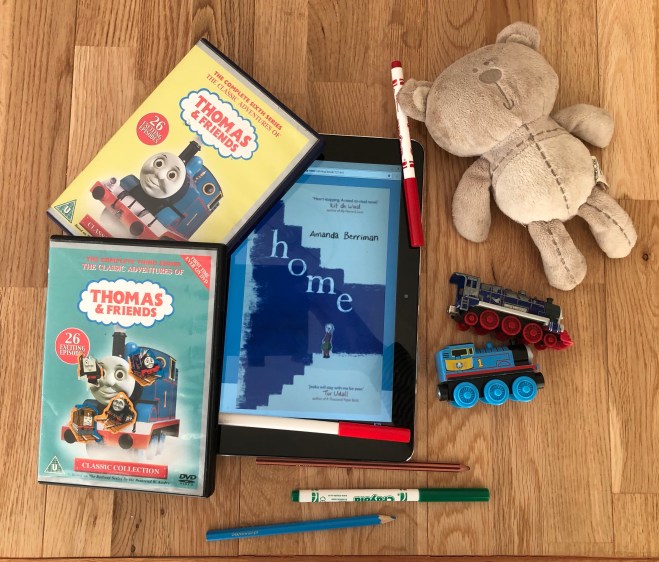
Home by Amanda Berriman

IMG_0008.jpg

Amanda Berriman: Home

Published By: Doubleday

Buy It: here

What The Blurb Says:

Jesika is four and a half.

She lives in a flat with her mother and baby brother and she knows a lot. She knows their flat is high up and the stairs are smelly. She knows she shouldn’t draw on the peeling wallpaper or touch the broken window. And she knows she loves her mummy and baby brother Toby.

She does not know that their landlord is threatening to evict them and that Toby’s cough is going to get much worse. Or that Paige, her new best friend, has a secret that will explode their world.

Thank you to Netgalley for providing me with an e-book preview copy of Home in return for an honest review.

What I Say:

From the very first sentence, you know Home is going to be different to any novel you have read before. Our narrator is a four and a half-year old girl called Jesika, and we are seeing the world through her eyes, misunderstandings and innocent narrative. The written language with the spelling mistakes and misheard words, means that this is a unique viewpoint and an intriguing narrator that we are party to.

As I realised that I was reading the thoughts and feelings of a four-year old, I was lulled into a false sense of security that the Home of the title was going to be a warm and friendly place and an Instaperfect existence.

Jesika is making her four-year old way in the world. Her naivety and lack of experience means that she tells us about her day-to-day life in a very matter of fact way, whilst we as grown ups are able to fill in the blanks of her understanding with the knowledge and experience we have gained. We can understand the things that Jesika is unable to comprehend, and it makes it very uncomfortable reading as we gradually realise what Jesika can see happening.

What works so consistently well in Home is how as the reader it makes you remember what it was like to be four years old.  How your parents and home life was your world.  That they were everything to you, and all you wanted was for them to know how much you love them. Without them you feel rootless. How you love it when you laugh together, and you can make them laugh, but the thing you hate the most is when your parent is shouting and you don’t know why and you would do anything to make it stop.

Home is not by any means an easy read. It brings us face to face with the uncomfortable reality that life in Britain for a young single mother and her family on the breadline is far from idyllic. Jesika, her mother Tina, and her baby brother Toby live in a flat which is full of mold, a boiler that doesn’t work and a landlord who cares nothing for them or the state of the flat he has rented them.

The disrepair of the flat causes Tina and more especially Toby to be constantly unwell, and unable to work, Tina and her two children are living day-to-day, hand to mouth. Her husband has left her to return to his native Poland, and she is alone, navigating life, dealing with an inquisitive four-year old and a young toddler who constantly make demands on her. Tina gets through the grind and stresses of every day purely because she has no choice. She, like so many people in the United Kingdom today is caught in a benefits system which cannot operate outside the parameters of a heavily bureaucratic script. It does not see a young woman who desperately needs help, it sees her as a statistic to be counted and a case to be closed.

For Jesika, her session at preschool is everything. For a brief period of time, she can simply be a four-year old and live in the moment and forget everything else.  She is desperate for a friend, and when she meets Paige, she realises that she has finally found someone to play with.  Even though Paige blows hot and cold with the friendship, and at times is downright hostile to Jesika, Jesika sees nothing but the good in someone, and longs to make a connection.  When it transpires that Paige’s Mum and Uncle are Tina’s former school friends, it seems that Jesika finally has a new world of friendships to explore.

This is where Home starts to lead us into much darker territory.  As the events unfold, we are drawn into a story which is extremely harrowing for us as adults to read, but we are also aware that an innocent four year old child is the one going through this. Amanda Berriman’s superb writing means that we are totally consumed by Jesika’s story, and we feel that we have to read this, to be present alongside Jesika to ensure that everything will be okay for her in the end.

A particularly poignant section in the novel for me, is when Tina and Toby are admitted to hospital, and faced with no family to help, Tina has to make the decision for her daughter to be taken into temporary foster care.  It was absolutely heartbreaking to read, the sense of powerlessness that Tina felt and the bewilderment that Jesika has as the person she loves the most is choosing tho send her away.

Jesika may be an unusual narrator, but she is also a brave and fearless one, who wants to protect those around her and keep her family intact. Her reluctance to tell Tina what is happening to her and Paige for fear of what could happen to them is heartbreaking to read, as you understand how overwhelming this must be for a four year old to deal with.

Home does not shy away from making us face many difficult issues, but it is also a novel filled with love and a sense of community.  For so many of us today, we don’t have our family on our doorstep. Today, more than ever, we understand that family is not necessarily blood relations, but it is often our friends who understand what we are going through and by supporting us with time, love and little gestures, it can make all the difference to how we view the world around us.

I wish this novel could be pushed into the hands of all the professionals who work with families like Tina, Jesika and Toby.  Home would help them truly understand what life is like for so many people through no fault of their own.

The resounding message I took from this astounding novel is one we can all relate to. Jesika simply wants to live happily with her Mum and Toby in a place she can truly call Home.

I loved it.
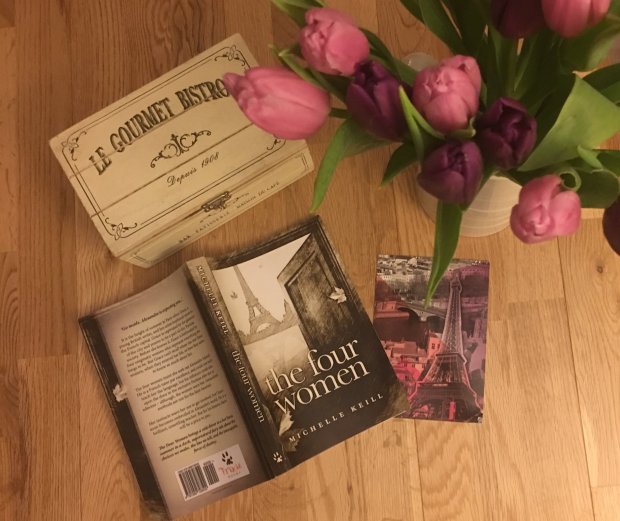
The Four Women by Michelle Keill

IMG_7211.jpg


Michelle Keill: The Four Women

Published By: Trixie Books

Buy It: here


What The Blurb Says:

‘Go inside, Alexandre is expecting you…’

It is the height of summer in Paris when Grace, a young British writer, and her artist boyfriend move to the French capital. Grace is captivated by the glamour of the city and yearns to be part of chic Parisian society. Before she knows it, Grace is befriended by four enigmatic women who represent everything she longs to be. But Grace can’t recall where she met these women, when they entered her life, or how they seem to know so much about her.

The four women insist she seek out Alexandre Martel. He is a French tutor par excellence, and could not only teach her the language, but his influence could also open the door to the exclusive Parisian elite she so admires – although, the women warn her, Alexandre’s methods are not for the faint-hearted.

Her instincts warn her not to get involved, but Grace soon becomes embroiled in Alexandre’s world. He is a brilliant, unsettling teacher. But for his lessons there will be a price to pay…

The Four Women brings a cold shiver to a hot Paris summer in a dark, supernatural fairy tale about the choices we make, the lies we tell, and the inescapable force of destiny.

What I Say:

I was given a free copy of The Four Women by Michelle Keill in exchange for an honest review.

As regular readers of my blog know, I am always honest about the books I review, and when Michelle asked me if I would like to review her novel I have to admit I was slightly nervous.  What if I didn’t enjoy the book, or found it difficult to review?

Fortunately, this was not the case!  The Four Women is a unique novel which brings to the fore a number of interwoven themes, such as love, passion, relationships and confidence, in an intriguing and layered read.

I stared at the name on the card.  Alexandre Martel.  The name I will never forget.”

Grace and Mats have decided to stay in Paris for as Mats follows his passion of painting, and Grace attempts to write a novel.  Although Grace enjoys being in Paris, she finds not being able to speak the language a source of frustration and longs to feel the same sense of belonging that Mats so obviously does.  Mats finds Paris a source of inspiration, and his output of paintings becomes prolific, whilst Grace cannot put a word on the page.  Almost from the start, the reader can sense there is some sort of disconnect between Grace and Mats, and that the different experiences they are having in Paris, is serving to pull them further apart.

One day, while Grace is in a restaurant, she notices four women who start talking to her and seem to pity her for her inability to master their language.  The way that they were introduced added to the air of mystery, I felt that Michelle’s writing immediately added a sense of unease – they seemed to appear out of nowhere, and the slightly distanced air they have makes them seem other worldly almost.

They encourage Grace to approach the mysterious Alexandre Martel, a French teacher who is renowned for his unconventional teaching methods and the exclusivity of his lessons.  If you receive lessons from Martel, you are immediately given access to the exclusive Parisian social circle that so many people long to be part of.

Mats tells Grace that he has been commissioned by a benefactor, Madame Dumas to paint for her, but he refuses to tell Grace the details, and asks that she does not look at his work. As Grace says;

It was his first secret, and my last promise”.  

As Grace finally finds the courage to go and find Martel, she is faced with an imposing and unwelcoming building, that adds only to the mystery surrounding him.   The first lesson she attends is far from conventional.  Martel’s method of learning French is to dance with Grace, spinning her round the room as he speaks to her.  In that moment, she feels almost as if she is having an out-of-body experience, and she is aware of the presence of the Four Women in the room with them.  It is as if she is starting to lose her grip on reality.  From that moment, Martel has a connection with Grace, and that whether she knows it or not, he will start to consume her day-to-day life.

The really interesting idea is that Martel, Dumas and the Four Women are inextricably linked, and that is something that is both a central theme and is present throughout the whole book.  When Grace voices her reservations to the ever-present Four Women, they hint that her refusal to work with Martel could lead to Mats losing his commission.

Mats and Grace are trying to maintain their relationship as Martel and the Four Women are in the background of their life in Paris.  The Four Women always seem to be around wherever they are, and Grace’s thoughts are filled with the mysterious French teacher whose methods and behaviour are affecting her in more ways than she can admit to.  She loves Mats, and wants a future with him, but is aware that she is under the spell of Martel, and that he has forced her to confront something within herself that she does not want to.  The Four Women seem to act as Grace’s conscience, articulating the thoughts that she does not want to face.  They know that Martel has a hold on her, and it feels as if they are circling Mats and Grace, ready for the inevitable collapse of their relationship.

In the meantime, Grace’s neighbour, Brigitte, tells her that she is sure she has heard crying in their apartment, and Grace is obviously concerned for Mats’ welfare and whether the commission is as innocent as he would have her believe.

Alexandre invites Grace and Mats to his party, which is an honour not afforded to many, and something that they are far from comfortable with, but feel that they should be seen to be there.

Ironically, although Grace senses that she and Mats are far from secure in their relationship, it is at this point that Mats decides to propose.  As they arrive at the party, Mats feels unable to go in with Grace, and although she initially refuses to go without him, Mats persuades her that it is the right thing to do.  He walks away from her and we know that it is forever.

The party feels claustrophobic and has a sense of foreboding as soon as Grace enters, and the Four Women have also played a cruel trick on Grace by convincing her that she has to wear a green dress, when of course the dress code is black dresses for the women.  She already feels self-conscious and out-of-place but inexplicably she has to keep walking through the rooms to find Martel.

When Grace does find him, it unleashes a dramatic chain of events which Grace could never have predicted, and spins the novel in another direction that I never saw coming, but serves to cleverly slot all the events of the book into place.  Grace has been drawn into a world which has left her battered and bruised, but the overriding feeling is that she is not Martel’s first victim and she certainly won’t be the last.

The Four Women is a sharp, crisp and unsettling novel, which pulled me in from the first chapter, and made me want to find out the disturbing connection behind the Four Women and Alexandre Martel.  It is a credit to Michelle’s clever writing that I could not predict what was going to happen, and that I really enjoyed reading The Four Women to find out.


Little Fires Everywhere by Celeste Ng

IMG_7083.jpg

Celeste Ng: Little Fires Everywhere

Published By: Little, Brown

Buy It: here

What The Blurb Says:

Everyone in Shaker Heights was talking about it that summer: how Isabelle, the last of the Richardson children, had finally gone around the bend and burned the house down.

In the placid, progressive suburb of Shaker Heights everything is meticulously planned – from the layout of the winding roads, to the colours of the houses, to the successful lives its residents will go on to lead. And no one embodies this spirit more than Elena Richardson, whose guiding principle is playing by the rules.

Mia Warren, an enigmatic artist and single mother, arrives in this idyllic bubble with her teenage daughter Pearl, and rents a house from the Richardsons. Soon Mia and Pearl become more than just tenants: all four Richardson children are drawn to the alluring mother-daughter pair. But Mia carries with her a mysterious past, and a disregard for the rules that threatens to upend this carefully ordered community.

When the Richardsons’ friends attempt to adopt a Chinese-American baby, a custody battle erupts that dramatically divides the town and puts Mia and Mrs. Richardson on opposing sides. Suspicious of Mia and her motives, Mrs. Richardson becomes determined to uncover the secrets in Mia’s past. But her obsession will come at unexpected and devastating costs to her own family – and Mia’s.

What I Say:

” …sometimes you need to scorch everything to the ground and start over.  “

Little Fires Everywhere was never a planned blog post. Quite often, I read a lot of books ‘behind’ my blog. I just want to read books without the pressure of trying to write down pertinent points and punchy quotes to put into a post.

However, sometimes, a novel comes along that knocks you sideways, and the only way you can get over not being able to read it anymore is to tell everyone else how wonderful it is!

From the first chapter, where the family house of the Richardsons is burnt to the ground, seemingly by their youngest daughter, Little Fires Everywhere drew me in and kept me there.

It is at first glance a book about two families – the Richardson and the Warrens.

The Richardsons, who live in the quaintly named Shaker Heights have it all. Two successful parents, a brood of children who are over achieving in every nauseating Round Robin Christmas Newsletter way possible, and an ordered, chocolate box existence that most of us can only dream of.

Mia Warren, a free-spirited, nomadic artist and her daughter Pearl, arrive in Shaker Heights to take up the rental of the Richardsons’ second house.  From that moment on, the two families become intertwined in a way that neither could have foreseen – perhaps the first little fire of the title has been lit.

Elena Richardson is initially welcoming to Mia, seeing her as a charitable cause to take under her wing.  Pearl becomes great friends with the Richardson children and relishes the stability and apparent normality that she longs to have in her own home.  There is no doubt that she loves her mother and has accepted that they move when and where her mother decides, but it is evident that Pearl longs for something more traditional, a secure base for her to develop and mature.

Similarly, Elena’s youngest daughter, Izzy, seems at odds with her family.  Constantly restless, she seems confined by the rigidity and conventionality of Shaker Heights, and her family’s reputation and place in it.  Izzy strikes up a close friendship with Mia, and as Pearl becomes more a part of the Richardsons family, Izzy falls into Pearl’s place with an ease that surprises even herself.

The stifling conformity of Shaker Heights is threatened when Elena’s friends, the McCulloughs have to go to court to keep their baby Mirabelle or May Ling Chow, that they wish to adopt.  Mirabelle was found abandoned outside a fire station, and given to the McCulloughs who were looking to adopt.  Bebe, May Ling’s biological mother and a friend of Mia, wants to take her baby home. This shocking turn of events reveals that Shaker Heights is not used to having to confront something this inflammatory in their perfect world and no one seems quite sure how to handle it.

Should Mirabelle stay with the McCulloughs who can offer her everything she needs in this privileged, monied life, or should she be handed back to her biological mother who can give May Ling the cultural and emotional roots she needs?

We see the emotions, background and daily realities of both the birth and adoptive mothers, and feel enormous empathy for both.  At the heart of it all, Celeste portrays them purely and simply as women fighting for the child they feel is rightly theirs.

“To a parent, your child wasn’t just a person: your child was a place, a kind of Narnia, a vast eternal place where the present you were living and the past you remembered and the future you longed for all existed at once.”

The volatile custody battle is perhaps the next spark of the little fires everywhere –  an incendiary moment that sets Elena against Mia, and Izzy against Elena as they face each other on opposite sides of the custody battle.  Elena feels increasingly frustrated that she cannot ultimately control the outcome of the trial, and sets about trying to find out as much as she can about Mia.  It becomes her mission to ensure that Mia is humiliated and shamed into leaving Shaker Heights. As Elena investigates Mia’s past, revelation after revelation comes tumbling out, which show us why Mia is who she is today, and why she and Pearl live the lifestyle they do.  It also means that Elena has to confront some unpleasant realities about her family and her own behaviour too, which is something she perhaps had never really faced.

Little Fires Everywhere is an epic contemporary novel about so many different things.  It is about family, race, motherhood and the choices we are forced to make in times of crisis.  Every character in the novel has important decisions to make which have far-reaching impact and will change the world they inhabit forever.

Celeste never forces an opinion on us, she presents us with the characters and their dilemmas, and as we live through them with them, we learn more and more about why they do what they do, and we are made to understand that things in life are not always black and white for any of us.

Little Fires Everywhere is a brilliant and thought-provoking novel to be savoured, read slowly and recommended to everyone.

I loved it.

The Woman In The Window by A.J. Finn


IMG_7119.jpg

A.J. Finn: The Woman In The Window

Published By: HarperCollins (25 Jan 2018)

Buy It: here


What The Blurb Says:

What did she see?

It’s been ten long months since Anna Fox last left her home. Ten months during which she has haunted the rooms of her old New York house like a ghost, lost in her memories, too terrified to step outside.

Anna’s lifeline to the real world is her window, where she sits day after day, watching her neighbours. When the Russells move in, Anna is instantly drawn to them. A picture-perfect family of three, they are an echo of the life that was once hers.

But one evening, a frenzied scream rips across the silence, and Anna witnesses something no one was supposed to see. Now she must do everything she can to uncover the truth about what really happened. But even if she does, will anyone believe her? And can she even trust herself?

What I Say:

First of all, thank you to NetGalley and HarperCollins who provided me with a free E-Arc in exchange for an honest review.

I knew that this book was one of the most anticipated reads of this year, and had heard lots about it both on social media and in the press.  I was so delighted to be approved to receive a review copy, but it was also a lot of pressure because I was worried that it would not live up to its promise, and my whole ethos is only talking about books that I love.

Let me start by saying this.  Believe the hype, and miss this novel at your peril.

Yes, it is a psychological thriller, but it picks up the genre, shakes it, twists it on its head and breathes a whole new lease of life back into it!

It is also a difficult book to review because giving away too many plot points would completely ruin your enjoyment!  It is packed full of twists and turns, none of which I guarantee that you will either see coming, or be able to work out what is happening.

We meet Dr Anna Fox, a child psychologist, and is currently in the grip of agoraphobia.  An incident has resulted in her being separated from her husband and daughter, and an increasing dependence on alcohol and the medication she takes to cope with her agoraphobia means that her grip on reality is at best hazy, and at worse, she is unable to remember what she has done.

Confined to her home, Anna spends her days playing chess, watching movies, and keeping a close eye on the comings and goings of the neighbours in her street. She has few visitors, and finds comfort in helping others on an internet forum dedicated to fellow agoraphobia sufferers.

Anna becomes fascinated by the Russell family who move in across from her house, almost envying the life they lead as she rattles around her home existing from medication to medication and drink to drink.  A.J. Finn creates a world for Anna which feels increasingly unsettling and uncomfortable, and almost claustrophobic in its scope, but at the same time, it gives Anna the safety and control she needs to function – albeit fuelled by her dependence on alcohol and mediation.

This is what gives The Woman In The Window a new dimension.  We are presented with an increasingly unreliable narrator, living in a self induced haze – can we really believe anything she tells us? When Anna is finally brave enough to push herself and meet someone to have an evening of relaxed fun and a good old chat, it leads to one of the biggest shocks in the book, that starts a whole chain of events which relentlessly spin out of control, propelling Anna front and centre.  The cocoon that she has carefully constructed, in order to protect herself from the outside world, is pulled apart by neighbours, the police and even those few people Anna has to let in to her world in order to function.  No one believes her version of events – and why should they?

The pace of the novel is unrelenting- the phrase ‘page turner’ is often overused in book marketing, but The Woman In The Window genuinely is one.  Once the story gets going, it just does not let up.  You are never sure whether what you are reading is what actually happened, or whether you are seeing Anna’s version of the world around her.  One thing is for sure, this is one of the few novels I have read recently that genuinely had me mystified as I tried to work out what was happening!

As it hurtles towards its climax, you read revelation after revelation, and little by little, the fractured pieces of Anna’s past slot into place as she attempts to make sense of the chaotic world she has been pulled into.

The Woman In The Window is a wonderfully filmic novel, brilliantly written at a breakneck speed.  It is also a chilling and a deft examination of what it means to be deemed as unreliable and unbelievable when you are trying to prove to people that you are the one person who really knows the truth.

A J Finn has written a superb novel that had me hooked from the start, and I loved it.