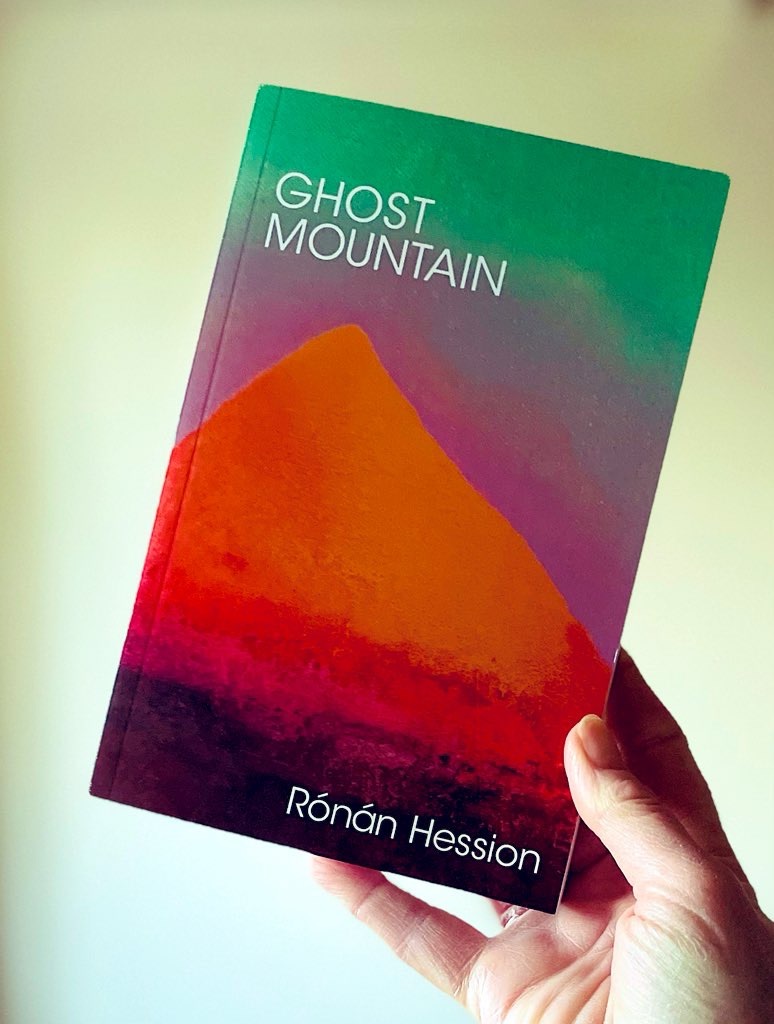
Ghost Mountain by Rónán Hession

Ghost Mountain by Rónán Hession

Published by Bluemoose Books on 23 May

What They Say

Ghost Mountain, is a simple fable-like novel about a mountain that appears suddenly, and the way in which its manifestation ripples through the lives of characters in the surrounding community. It looks at the uncertain fragile sense of self we hold inside ourselves, and our human compulsion to project it into the uncertain world around us, whether we’re ready or not. It is also about the presence of absence, and how it shadows us in our lives. Mountains are at once unmistakably present yet never truly fathomable.

What I Say

I don’t think it’s any secret that I have loved each of Rónán’s previous novels, Leonard and Hungry Paul and Panenka, and knew one thing for sure that Ghost Mountain would be very different to both of them.

Rónán’s skill as a writer is that he constantly surprises you with the way in which he uses the written word and weaves worlds that are like ours but seem slightly magical. I don’t think you can easily categorise his writing, and that is what makes it even more special, and why I love reading his novels.

In Ghost Mountain, the seemingly simple premise of a mountain that just appears one morning, and the reactions of those who know about it becomes so much more. This is a novel about the human condition, of connection and co-existence. It is the story of how our lives can often seemingly be destined to move in one way, but that a decision or action in a single moment can change your world and those of people who you have never met.

When the Ghost Mountain appears in the nameless location, it is discovered by a local woman called Elaine, whose interaction with it ends in tragedy, and her not wanting to articulate to anyone what she has found. As other people discover it, the story spreads, and the mountain is swathed in visitors and tourists, all drawn to the place which has appeared for no reason, bringing with it routines and behaviours and as in society creating a right and wrong way to behave while there.

We meet local couple Ruth and Ocho, married but it seems more because it works rather than for any passionate reason. Both react to the appearance of Ghost Mountain in different ways – Ruth is bewitched by it, and wants to spend time there, while Ocho is highly sceptical of it, and retreats to his parent’s house, a place of safety, mundanity and comfort.

We meet the Clerk of Maps, an unnamed official who sees this ironically as the chance to make a name for himself, and realises he now has professional worth in a world where he was previously ignored. There is also the landowner who has inherited the land Ghost Mountain stands on, finds himself in possession of land he cannot sell, and a tenant who refuses to engage with him.

I loved the character of Dominic – the renowned local drunk with a penchant for making his feelings known by attaching notes to bricks and lobbing them through the relevant windows. When he throws one through Elaine’s window with a promise to pay back for the damage a small amount each week over a period of time, these two people who have stepped back from the world find a connection that draws them together and their lives change.

This for me is the very heart of Ghost Mountain, and what Rónán achieves brilliantly. He shows us how we are all connected, and often want to feel that human connection with someone or a group of people. All the characters in this novel in some way cross paths with everyone else, be it by being in a relationship, meeting because one character knows another, or even by standing behind them in a queue in a butcher’s shop.

Moments of tenderness and joy are set against shocking events that as a reader stop you in your tracks, and Rónán’s understated and thoughtful prose adds to the impact of them. There is a section about a mother’s love and the grief that comes when you lose them that just stopped me in my tracks, and Rónán’s absolute understanding of that life changing experience is present in every single one of those words.

Society is complicated, layered and often wonderful, but it can also be brutal and exclusive. It will alienate those who don’t fit the expected roles or aesthetics, leaving a group of people who live their lives trying to work out how to fit in. The ever present Ghost Mountain serves as a catalyst for this community, prompting some to question what they have accepted for so long, others to take the first step to a new life, and for some to realise that their time in this world is only temporary and to accept that too.

Ghost Mountain is an unforgettable and erudite novel about love, society and inexplicable mountains. It will make you stop and think about what you have read long after you have finished it, and realise that life is fleeting and complicated and often challenging, but that it is up to us to determine the path we take.

I absolutely loved it.

Thank you so much to Kevin and Bluemoose Books for my proof copy.

The List of Suspicious Things by Jennie Godfrey

The List of Suspicious Things by Jennie Godfrey

Published by Hutchinson Heinemann on February 15th

What They Say

Maggie Thatcher is prime minister, drainpipe jeans are in, and Miv is convinced that her dad wants to move their family Down South.

Because of the murders.

Leaving Yorkshire and her best friend Sharon simply isn’t an option, no matter the dangers lurking round their way; or the strangeness at home that started the day Miv’s mum stopped talking.
Perhaps if she could solve the case of the disappearing women, they could stay after all?

So, Miv and Sharon decide to make a list: a list of all the suspicious people and things down their street. People they know. People they don’t.

But their search for the truth reveals more secrets in their neighbourhood, within their families – and between each other – than they ever thought possible.

What if the real mystery Miv needs to solve is the one that lies much closer to home?

What I Say

It is always brilliant to be able to review books by authors that you have met and become friends with on social media, which is quite ironic, considering that in The List of Suspicious Things we are firmly in a world way before anyone even knew what a mobile phone or Twitter is!

I had been chatting to Jennie for while – usually about all the fabulous books we have been reading, and sharing recent recommendations of books we loved. When I was offered a copy of Jennie’s debut novel to read and review, honestly, I was more than a little nervous – it is a Radio 2 Book Club pick, and already there have been so many wonderful reviews, that there is always the worry that I might not love it.

Once I started reading The List of Suspicious Things, I just knew that I was reading something really special.

Miv, and her best friend Sharon are growing up in the late 70s. Margaret Thatcher is Prime Minister, and The Yorkshire Ripper dominates every news story and headline. Miv lives with her Mum and Dad and Aunty Jean. Her Mum keeps herself to herself, often in her bedroom and then disappears from their house for periods of time, with no one really explaining to Miv what is happening.

Miv’s Dad seems unsettled and not himself, and decides that maybe the best thing for the family is to move down South away from The Yorkshire Ripper and all the uncertainty and unrest around them. Miv is devastated and doesn’t want to move away, so the solution to her is perfectly clear – if she can discover who The Yorkshire Ripper is, she can stay here, with her best friend Sharon and nothing has to change.

Sharon agrees to help, and as Miv pours over the newspapers and listens to news about The Yorkshire Ripper, she decides that she and Sharon have to investigate anyone who fits any part of the profile. This is a brilliant way to change the narrative, because this opens up Miv and Sharon’s world for us to meet the people in their community who make their list, but also shows us that what we have always known is true – that appearances can be deceptive, and you never really know what goes on behind closed doors.

As Miv and Sharon investigate the people and things they have hunches about, we are introduced to a range of characters – amongst them there is Omar who runs the local shop and his son Ishtiaq, Helen and Gary Andrews who seem to be a happily married couple, and Arthur, who is Helen’s Dad and dealing with the death of his wife.

Jennie’s writing harks back to a time when all our lives were contained in the small world of the streets and places and people we knew so well, and we were reliant on who had seen and heard what to find out what was happening. Yet it has to be said that this is not a cosy, uncomplicated and innocent novel, mired in nostalgia and a rose tinted view of life.

The List of Suspicious Things is also a novel that unflinchingly shows a world where there is racism, domestic violence, mental health issues and marital affairs. This is a world presented to us through the eyes of children, who see and hear these things, but do not fully understand the intricacies and realities of what they are party to. Their innocence and seeming naivety presents us with a different view of the world, whereas we as readers, and the adults in the story bring our own experiences and knowledge of the realities of what the children are actually going through.

This is such a layered and nuanced novel that deals with so many things in one book, all executed effortlessly. Undoubtedly the main focus of the novel is the project that Miv and Sharon are undertaking, as to whether they can find the true identity of The Yorkshire Ripper, but this is not singularly why this is such an unforgettable book.

What makes this book so compelling for me to read is the portrayal of family life and the wider community, in all its shapes and forms. I felt that Jennie absolutely understood all her characters and their voices are clear and distinct. You get a real sense of place and time without it being something that detracts from the plot, and it makes the book feel anchored and authentic. Miv is such a brilliant protagonist, fearless and questioning and also aware that her family life is not like other people’s. Her relationship with her Mum is genuinely heartbreaking. – she knows what it should look like, and there are little moments in the book that shows us how much Miv understands that whatever happens her Mum is still there, trying to find a way back to being the Mum Miv needs. Miv is undoubtedly the pivotal character in this novel, and it is her relationships with the people around her that makes this such a compelling story.

In becoming part of Miv and Sharon’s world, we are also looking back at a time that some of us can remember clearly – that sense of growing up in a world where human connection was part of our everyday lives, with no phones or social media to colour our opinions. Our world at that time went as far as the streets around us, the neighbours we knew and the conversations we heard. The List of Suspicious Things is an unforgettable book that perfectly articulates what it meant to be a child at that time, and in doing so may make us realise how far we have come, but also how much we have lost in terms of having that close community around us.

Do Miv and Sharon find out who The Yorkshire Ripper was? Of course I am not going to tell you, you need to read it. One thing is certain though, that I promise after reading The List Of Suspicious Things, Miv and Sharon will always have a place in your heart.

I absolutely loved it.

Thank you so much to Hutchinson Heinemann for my proof copy.

73 Dove Street by Julie Owen Moylan

73 Dove Street by Julie Owen Moylan

Published by Penguin Michael Joseph

What They Say


When Edie Budd arrives at a shabby West London boarding house in October 1958, carrying nothing except a broken suitcase and an envelope full of cash, it’s clear she’s hiding a terrible secret.

And she’s not the only one; the other women of 73 Dove Street have secrets of their own . . .

Tommie, who lives on the second floor, waits on the eccentric Mrs Vee by day. After dark, she harbours an addiction to seedy Soho nightlife – and a man she can’t quit.

Phyllis, 73 Dove Street’s formidable landlady, has set fire to her husband’s belongings after discovering a heart-breaking betrayal – yet her fierce bravado hides a past she doesn’t want to talk about.

At first, the three women keep to themselves.

But as Edie’s past catches up with her, Tommie becomes caught in her web of lies – forcing her to make a decision that will change everything . . .

What I Say

Sometimes in life there are things you can control and things you can’t. When Amanda (@bookishchat) and I read That Green Eyed Girl back in 2022 we knew straight away that we wanted to feature Julie and her brilliant novel on our joint bookish channel Two Fond of Books, because we knew how many people would love it.

We were right, and as soon as we heard that Julie had a second novel coming out called 73 Dove Street, it was without question that we wanted to ask Julie back to Two Fond so we could celebrate the publication and shout about it as much as we could.

What we didn’t anticipate was that personal circumstances would throw us both a huge curve ball, and we would have to take the difficult decision to end Two Fond of Books before we could have the chance to celebrate Julie and 73 Dove Street.

The last few months have been challenging for me to say the least, for reasons that are not important here, but I always knew that I wanted to read 73 Dove Street when I could really stop and savour every page.

I am so glad I picked it up, and so glad I waited til now to read it, because it is a novel that you will be absolutely and totally immersed in from the very first page.

When Edie first arrives at 73 Dove Street clutching her battered cardboard suitcase, it is very clear to us that she is running from something and someone, and that she needs a place to stay so she can disappear for a while. As Edie’s dual narrative unfurls, we see how Edie’s relationship with her husband Frank goes from a seemingly loving one to a world where Frank controls every aspect of her life, and starts to physically and emotionally abuse her.

As Phyllis, the landlady of 73 Dove Street is dealing with her own marital breakdown after her husband Terry cheated on her with one of the tenants, letting Edie have the attic room works for her, and Edie’s appearance is a timely solution to her need for a new lodger. Phyllis is aware of how she is getting older, and becoming invisible to the world, and as her world slowly unravels, we start to understand how the devastating events of the past have shaped her world and her place in it.

Tommie who lives there already seems to be confident and assured – working for Mrs Vee in her huge Bayswater House by day, and at night living life to the fullest. Yet we also see how Tommie is attracted to a man who simply sees her as a commodity to be picked up and put down as he wants – and she can’t see how he will never want anything more from her.

Let’s get two things straight from the start. Julie Owen Moylan has written a novel that puts you right into the heart of 1950’s London. The sights, sounds, description and domestic detail that permeate every page of this story bring this world so vividly to life, and it feels utterly authentic.

The other thing is is that Julie totally understands women and what it meant to be a women at that time. In another writer’s hands, Edie, Tommie and Phyllis could have been paper thin stereotypes, but Julie’s pitch perfect characterisations mean that these women resonate so deeply with us as readers because they are authentic, vulnerable and flawed.

73 Dove Street is a nuanced and intelligent novel, which for me shows how much Julie absolutely understands her characters and also the people who are reading her words. Julie is not afraid to show that life is often not straightforward and that neat and tidy solutions to life’s problems are not always what happens, however much we would like them to be.

Each of the women has undoubtedly been through things in their lives, and what makes them resonate with us is that in 2023 we still recognise that these issues are still prevalent today. Edie, Tommie and Phyllis are women who may be dealing with significantly different things in their lives, but they are united by two things. The painful and difficult awareness of where they are in their lives and how they got there, and the eventual realisation that it is within them to be the catalyst they need to be to make sure that the next part of their lives is going to be entirely in their control. They just have to understand that they need to have the courage to embrace and acknowledge it.

I absolutely loved it.

Thank you so much to Livvi Thomas and Penguin Michael Joseph for my proof copy.

The Stargazers by Harriet Evans

The Stargazers by Harriet Evans

Published by Headline on 14th September

Available from All Good Bookshops

What They Say

‘Don’t you think there should be a name for people like us?’ he said. ‘Who look up and who dream of more, who dream of escaping? Who never lose faith, no matter how hard it becomes?’

‘Stargazers,’ I said. ‘That’s what we are’

It’s the 1970s, and Sarah has spent a lifetime trying to bury memories of her childhood: the constant fear, the horror of her school days, and Fane, the vast, crumbling house that was the sole obsession of her mother, Iris, a woman as beautiful as she was cruel. Sarah’s solace has been her cello and the music that allowed her to dream, transporting her from the bleakness of those early years to her new life with her husband Daniel in their safe, if slightly chaotic, Hampstead home and with a concert career that has brought her fame and restored a sense of self.

The past, though, has a habit of creeping into the present, and as long as Sarah tries to escape, it seems the pull of her mother, Fane Hall and the secrets hidden there cannot be suppressed, threatening to unravel the fragile happiness she enjoys now. Sarah will need to travel back to Fane to confront her childhood, and search for the true meaning of home.

Deliciously absorbing and rich with character and atmosphere, The Stargazers is the story of a house, a family, and finding the strength inside yourself to carry on.

What I Say

I deliberately made sure that I started The Stargazers on a Friday, and gave myself a whole weekend to read it, because I knew from the start that this would be one of those novels that you can absolutely lose yourself in, and I wanted to savour every page.

This is a complex and thoughtful novel, in which Harriet deftly and pointedly deals with the idea of family and belonging, of what it means to be a mother when you have no idea what that is meant to look like, and learning to realise and accept that family is not always a picture perfect concept.

The novel opens with a young married couple, Daniel and Sarah, moving into an old house on The Row near Hampstead Heath. Daniel is effusive and optimistic about their new life, whereas Sarah seems more cautious and wary of the immense project this house will be for them.

As Daniel immediately ingratiates himself with his neighbours, Sarah feels more isolated, worried that her husband is more concerned with being with other people than their marriage.

Right from the start we become aware that Sarah has not had an easy life, and there are little clues that lead us to understand that to get to this point she has already endured a lot. The novel opens up into a dual timeline, focussing on her childhood with her sister Victoria and her mother Iris in the 1950’s, and her life with Daniel in the 1970’s.

Young Sarah and Victoria live with their mother Iris in a flat in Kensington, but make no mistake, this is not some safe and wonderful childhood, peppered with fond memories and a sense of comfort and calm. Iris is filled with anger and hate, seeing the children as an annoyance and a distraction and is openly abusive and neglectful towards them.

Iris is driven by the fact that she believes that they were wrongly forced to leave Fane Hall, her family home, by her Uncle Clive who is the Earl. Sarah and Victoria lived with their mother there as young children. When their grandfather died Uncle Clive inherited Fane Hall, because as a woman, Iris couldn’t. The family waits for Clive to come back to claim his estate, and Iris believes that once Uncle Clive arrives, they will all be able to live in Fane Hall as one happy family, Uncle Clive has very different ideas. When he and his wife Dotty arrive, Iris and her daughters are shunted off to a shabby flat in Kensington, and Iris is hellbent on ensuring she gets the house back – whatever the cost.

Then one day, she simply decides she is going to get Fane Hall back, and moves the girls and herself in to one of the wings. The house is in a terrible state, falling into disrepair and a far cry from its heyday, and similarly Uncle Clive is an angry and desolate old man, furious that Iris has moved back, determined to gain control of Fane Hall again.

It is only when Sarah meets a local boy nicknamed Bird Boy that she truly feels happy. Together they spend time looking after an injured barn owl called Stella that Sarah rescues, and looking up at the sky to see the stars and planets above them, that provides the peace and escape from her awful home situation that Sarah craves. From the very first moment they meet, they have an implicit understanding of each other, and their connection means they can be honest with each other – something they both can’t be in their everyday lives.

As the two adults battle for control of Fane Hall, Sarah and Victoria are forgotten and then sent off to a dilapidated boarding school where Victoria thrives, and Sarah doesn’t – until she discovers the cello, which gives her focus and distraction from her everyday life. Yet when the school bullies become involved in her cello lessons – including Victoria, Sarah’s world will change forever in ways she could never have imagined.

As we the narrative moves on, adult Sarah feels trapped by motherhood, feeling that she doesn’t know what she should be doing and is overwhelmed by it. Resentful that Daniel seems unaffected and living his life as he always has, Sarah’s love for playing the cello becomes something she can only dream of as she spends her days caught up in making sure that her two daughters and everyone else is looked after, while her own needs and desires are subsumed under the mountain of domestic chaos that is all around her.

It is only when Sarah and Daniel face an unimaginable event, that Sarah finally sees how much of a mother she is, and that her relationship with her own mother and sister has not defined her, but has in fact made her the woman she is today. With a new sense of understanding, Sarah is finally able to articulate what she needs to feel happy, and find the strength and confidence to live the life she deserves.

The Stargazers is such an emotionally rich and satisfying novel, that never feels stretched, and Harriet’s tender and masterful prose shows how connected she really is to both the characters and the ever present Fane Hall, which is not the backdrop to this story, but is instead the very beating heart of this book. This should have been the place to make Sarah and Victoria feel safe, their mother’s determination to own it means that for them their mother and Fane Hall embody everything they want to forget.

Iris is an unforgettable and unlikeable character, whose real motives for getting Fane Hall back are slowly revealed through the narrative. Although her treatment of her daughters can never be condoned, as Harriet skilfully peels back the history of this woman, as a reader you can start to understand exactly what motivates her. Her actions and intent speak for themselves, but at the same time as a reader you see a frustrated and angry woman whose whole existence is determined by getting back her house, as oppose to paying any attention to the daughters who are bewildered by the behaviour of the woman who is their mother.

Harriet absolutely understands her characters, and I loved how they were vulnerable, flawed, and all searching for the very thing that eludes them – a sense of family and home. It is only when Vic and Sarah have that distance from their mother and each other that they finally come to terms with what family means to them, and how they can navigate their own worlds in the best way they can.

I absolutely loved it.

Thank you so much to Rosie Margesson and Headline for my proof copy in exchange for an honest review.

The Whispers by Ashley Audrain

The Whispers by Ashley Audrain

Published by Michael Joseph on 20th July

Available from all Good Bookshops

What They Say

The whispers started long before the accident on Harlow Street . . .
Was it at the party, when Whitney screamed blue murder at her son?
Or after neighbour Blair started prowling Whitney’s house, uninvited?
Or once Rebecca and Ben’s childlessness finally puts a crack in their marriage?
But on the terrible night of the accident, the whispers grow louder, more insistent.
Neighbours gather round. Questions are asked. Secrets are spilled. And the gloss on everything begins to rub off. Everyone is drawn into the darkness.
Because there’s no smoke without fire.
No friendship without envy.
And no lie that does not conceal a devastating truth . .

What I Say

You might have already read Ashley’s first novel, The Push – which quickly found its place as one of my favourite books.

When I was asked if I would like a proof of The Whispers, of course I said yes, but there is always that slight concern that it won’t be so brilliant, and then how do you review it?

Readers, let me tell you, I think The Whispers is even better.

This is a novel which puts motherhood and relationships front and centre. What does it mean to be a mother? What does society expect from mothers? Does it mean losing ourselves as we strive to make sure that our children’s needs are always the most important, and what if you don’t fit the template that everyone expects you to?

With Whitney, Blair and Rebecca, we see three very different women living in the same street, all dealing with motherhood and their relationships in very different ways.

Whitney feels overwhelmed by motherhood, and instead spends as much time as she can out of the house at her business, leaving the parenting to her husband and anyone else, revealing how dull and boring she finds it, resentful of all the mundanity and routine it brings.

Her best friend Blair is the complete opposite, her world is her daughter, and her own wants and needs have been subsumed by her daughter and husband. Yet Blair is not fulfilled either, is desperately lonely, and yearns for something that is her own. Blair slowly starts to suspect that her husband is having an affair – with Whitney.

Rebecca is an ER Doctor, and in spite of trying, is unable to carry a child to full term. Although originally she wanted to stop trying, she now wants to have a child with her husband. As they try to conceive, the gap between them becomes wider, and Rebecca feels that her marriage is failing.

Whitney undoubtedly seems to have the world and her neighbours in her picket fence perfect suburb of Harlow Street at her beck and call. Until one day at a party held in her home, they hear her screaming at her son, Xavier. A few months later, Xavier is in a coma, having apparently fallen from his bedroom window, and as she rushes to his bedside, seemingly bereft, his accident shows us exactly who Whitney really is. and little by little, the seemingly perfect facade of Harlow Street slowly cracks to show us exactly what secrets the residents are hiding.

As the events leading up to Xavier’s fall start to become clearer, and the women’s lives start to unravel before us, you understand that each of these women have one thing in common – that they have put the needs of others first, and that although on the surface they seem content, very slowly you understand that each of them is burying the anger and resentment that they feel, because to show it outwardly would deem them as socially unacceptable.

Ashley Audrain’s incisive and intelligent writing reflects this. If all these women were perfect examples of motherhood – then we wouldn’t engage with them, and the story would feel vacuous. It is the very fact that these women articulate what so many of us express privately is what makes us feel a connection with them. They are not perfect, they are vulnerable and at times bewildered by a world that judges them for their ability to conform to standards that are old fashioned and unforgiving.

The power of this novel also comes from the way in which the plot moves along at a rapid pace, but never feels forced or contrived. Ashley knows that in order for us to engage with and care about the characters, that there has to be a distinct line between scintillating plot twists and truthful character portrayals, and in The Whispers, she achieves this perfectly.

The Whispers is a brilliantly constructed and effortlessly plotted novel that once you start reading you cannot put it down. Ashley absolutely understands not only the dynamics and pressures of families, but also the complicated and sometimes limiting roles we find ourselves in as partners and parents. As the novel draws to its conclusion, Blair and Rebecca find the confidence to determine what they want from their lives, putting themselves first. We also sense that Whitney will finally get the chance to be the mother she realises she wants to be, but be prepared, because life is never that straightforward is it?

I absolutely loved it.

Thank you so much to Jen Breslin for my proof copy.

Other Women by Emma Flint

Other Women by Emma Flint

Published by Picador Books on 23 February 2023

Available from West End Lane Books and All Good Bookshops

What They Say

Mesmerising, haunting and utterly remarkable, this is a devastating story of fantasy, obsession inspired by a murder that took place almost a hundred years ago.

In a lonely cottage on a deserted stretch of shore, a moment of tragedy between lovers becomes a horrific murder. And two women who should never have met are connected for ever.

Six years after the end of the Great War, a nation is still in mourning. Thousands of husbands, fathers, sons and sweethearts were lost in Europe; millions more came back wounded and permanently damaged.

Beatrice Cade is an orphan, unmarried and childless – and given the dearth of men, likely to remain that way. London is full of women like her: not wives, not widows, not mothers. There is no name for these invisible women, and no place for their grief.

Determined to carve out a richer and more fulfilling way to live as a single woman, Bea takes a room in a Bloomsbury ladies’ club and a job in the City. Then a fleeting encounter changes everything. Bea’s emerging independence is destroyed when she falls in love for the first time.

Kate Ryan is an ordinary wife and mother who has managed to build an enviable life with her handsome husband and her daughter. To anyone looking in from the outside, they seem like a normal, happy family – until two policemen knock on her door one morning and threaten to destroy the facade Kate has created.

What I Say

A very long time ago, when Years of Reading wasn’t even an idea rattling around my head, I picked up a novel called Little Deaths by Emma Flint. I was completely captivated by this novel of a woman called Ruth Malone, and whether or not she was implicated in the disappearance of her children. You know when you love a novel so much you can’t wait to read what the author writes next? Well, I have been waiting since then to read Emma’s next novel, and let me tell you, I think Other Women is even better.

Using a real life case as its inspiration, Other Women tells the story of Beatrice Cade and Kate Ryan. Beatrice is an older single woman, with no immediate family, living in London, with a room in Bloomsbury, and a job as a book keeper in the City. Existing but not really embracing life, she wants to find love and to have a family, but this is the world after the First World War, still reeling from cataclysmic events and processing the incredible loss so many people have had to endure as a result of so many men losing their lives.

Beatrice feels slightly out of place in her office, with the younger women so much more confident in themselves and what they want, and while she dutifully carries out her job, and tries to engage more with the women she lives with, it all just feels slightly forced, and you feel her discomfort as she tries to fit in.

When Tom Ryan comes to work in her office, she is totally and utterly captivated by him, and dares to think that he might feel the same way soon. Their tentative friendship slowly blooms into a relationship, and for the first time, Beatrice allows herself to believe that she might actually be able to get the domestic dream she has wanted for so long.

Their relationship is conducted privately, away from prying eyes and the possibility of being seen by anyone who shouldn’t see them. While to Beatrice this seems romantic and passionate, slowly it becomes clear that there is a very good reason as to why Tom doesn’t want anyone to know about their relationship.

Kate Ryan has always been the dutiful wife that Tom wants. She has created an idyllic home life for him and their daughter Judith, but Kate is not naive, and knows that Tom has had relationships with other women through their marriage. Kate is also very aware of the implications of not staying married, and that divorce is not an option. Their life may seem perfect from the outside, but only Kate and Tom know exactly what happens when they shut the door at night.

As Tom finds himself further involved with Beatrice, who is utterly besotted with him, and Kate realising that Tom is pulling away from her again, a desperate chain of events unfurl that leaves Kate reeling, as her carefully constructed world starts to implode. Tom has done something that she cannot believe or comprehend, but as the puzzle starts to come together, Kate is faced with a choice that brings her closer to Beatrice than she could ever imagined. After years of having to ignore what Tom has chosen to do to their marriage, she now has the power to change everything – if she is brave enough to do it.

One of the many things I loved about this novel is the way in which you are totally immersed in the women’s lives, and the society they inhabit. Emma’s writing transports you completely to post war London and you feel part of this strange new world where people are trying to get on with their daily routines, adjusting to what has happened to the world. There is always this ominous sense of tension right from the start of the novel, that never feels forced or calculated, but instead slowly seeps through the pages and as a reader you know something awful is going to happen – and when it does, it is all the more devastating because of the unwavering belief Beatrice has that Tom is the man of her dreams.

Undoubtedly, this is a novel about women and how they are treated by a society still reeling from the after effects of a World War. Beatrice never quite fits in – she is unmarried, has no children, and quietly goes about her business, but wants to achieve the domestic dream she believes Kate Ryan has – Beatrice even turns up on her doorstep once, desperate to see Tom. Yet as the novel progresses, we see how Tom also tires of Beatrice when she becomes too demanding of him, and he treats her appallingly, as an annoyance rather than a person. Even in court, she becomes an exhibit to procure evidence from, her life is reduced to a series of statements and reports, and Beatrice will be forgotten when the case concludes.

Kate seemingly has it all – a loving husband, beautiful daughter and a desirable home, but at what cost? The image of the dutiful and benevolent wife hides the fact that Kate is attempting to hold her marriage together by constantly excusing Tom’s behaviour and accepting that this is her life – because that is what good wives do. Emma’s understated and measured characterisation of Kate, and the way in which she perfectly captures Beatrice’s change from unassuming and invisible, to a woman who believes she finally has everything she wants with a man who doesn’t really want her is heartbreaking to witness, and testament to Emma’s absolute understanding of the women she is depicting.

Other Women is a truly unforgettable novel, that gets completely under your skin as soon as you meet Beatrice and Kate. As a reader you realise that in this world where a man’s word is deemed to carry more power than a woman’s, lives could be changed forever in a simple sentence. Kate and Beatrice may be poles apart in terms of the trajectories of their lives, but they both simply wanted the same thing. To love and be loved, and to live their lives believing that the man they had chosen to share it with loved them back too.

I absolutely loved it.

Thank you so much to Picador Books for my proof copy.

The Whispering Muse by Laura Purcell

The Whispering Muse by Laura Purcell

Published by Bloomsbury Raven on February 2nd 2023

Available from West End Lane Books and All Good Bookshops

What They Say

Be careful what you wish for… it may just come true.

At The Mercury Theatre in London’s West End, rumours are circulating of a curse. It is said that the lead actress Lilith has made a pact with Melpomene, the tragic muse of Greek mythology, to become the greatest actress to ever grace the stage.

Suspicious of Lilith, the jealous wife of the theatre owner sends dresser Jenny to spy on her, and desperate for the money to help her family, Jenny agrees. What Jenny finds is a woman as astonishing in her performance as she is provocative in nature.

On stage, it’s as though Lilith is possessed by the characters she plays, yet off stage she is as tragic as the Muse who inspires her, and Jenny, sorry for her, befriends the troubled actress. But when strange events begin to take place around the theatre, Jenny wonders if the rumours are true, and fears that when the Muse comes calling for payment, the cost will be too high.

What I Say

I have been a Laura Purcell fan from the first moment I read her debut novel The Silent Companions (if you haven’t read that yet – I would absolutely recommend it, but please don’t come back to me if you need to sleep with the lights on for a week after reading it!).

As well as being brilliantly written, and evoking period detail and palpable tension in every page, I love Laura’s novels because they depict women who face situations where their resolve and morality is tested, and show how even though they may be constricted by the social expectations of the time, that they want only to do what is right for them and their family.

In The Whispering Muse, the protagonist is a young woman called Jenny Wilcox, who finds herself as the head of the family after her elder brother Greg leaves the family in disarray after stealing from Jenny’s employer and taking all they have. Jenny is dismissed from service, and she and her siblings face an uncertain future.

When she secures a job as a dresser at The Mercury Theatre, where Greg worked before her, due to the generous and gregarious Mrs Dyer, the owner’s wife, it seems that maybe Jenny has a chance to secure a future for her family.

Jenny is made dresser to the star of the theatre, a fiery and demanding woman called Lilith, who is determined to be famous and adored, and seemingly has Mr Dyer enthralled and ready to indulge his leading lady on and off stage. Mrs. Dyer is not blind to what is happening, and tasks Jenny with spying on Lilith, and offers her money to do so. Although she is torn, Jenny understands the difference this money could make to her family and agrees to become her spy.

Right from the start, Jenny and Lilith clash. Lilith is every inch the diva Jenny suspects her to be, and her dedication to her acting is bordering on the obsessive. Lilith is consumed by her desire to be the most feted actress of her generation, whatever the cost. There is an incredibly awkward scene at a party when Lilith is given a watch depicting Melpomene, the Greek muse of tragedy by Mr Dyer. This turns out to be the very watch Mrs Dyer was desperate to own, having belonged to an actor she adored, and this only fuels her suspicion and hatred of Lilith even further. Bound by circumstance, Jenny now becomes another pawn in Mrs. Dyer’s game, as she forces her to carry out schemes to attempt to drive Lilith away from the stage and the precious watch she desires.

As Jenny gets closer to Lilith with the aim of helping Mrs Dyer, Jenny sees Lilith in an altogether different light. A young woman who is driven to succeed certainly, but also a woman who is vulnerable, who knows that her worth is measured in the tickets she can sell and the money she can make for the theatre. Jenny and Lilith form an unlikely friendship as they understand who is actually the biggest threat to both their lives, and by coming together, they can both get what they want -at a price.

Ever present is the spirit of Melpomene, the muse which seems to not only push Lilith to give the best performances of her career, but also starts to take her over and seep its way into every part of the theatre, causing accidents that cannot be explained, and deaths that create such distress and uncertainy, that no one feels safe. Laura does this so convincingly, that it never feels forced or simply done for shock value. From the very start of the novel, the spectre of The Mercury Theatre looms large, and the world inside seems so far removed from the one outside, that you feel a real sense of dislocation and wariness from the start.

It would have been very easy to make The Whispering Muse melodramatic, and reliant on tried and tested gothic tropes to unsettle the reader. However, in the hands of Laura Purcell, it becomes a novel that places Lilith, Jenny and Mrs Dyer directly at the heart of the narrative, and their needs and desires are the driving force behind the decisions they make. The consequences of all their actions come together to propel the story forward, but it is the unknown force of Melpomene, and the havoc that she wreaks as she seeks to possess the theatre and all those on the stage that is the most dangerous and unstoppable part of the novel that we cannot predict.

The Whispering Muse is a novel filled with dramatic tension, but it also brings to the fore issues such as the commodification of women, duty and desire, social classes, and the transient nature of fame. In having Lilith, Jenny and Mrs Dyer as the main characters, we see three women all at different stages of their personal and professional lives, and I felt that their depiction showed that they had more in common that they would ever want to admit. Melpomene may be the undefinable spirit that wreaks havoc on those who fall prey to her, but the desires and drive of the women inside the Mercury Theatre imbues the novel with an even more compelling and powerful story.

I absolutely loved it.

Thank you so much to Bloomsbury Raven for my gifted proof copy.

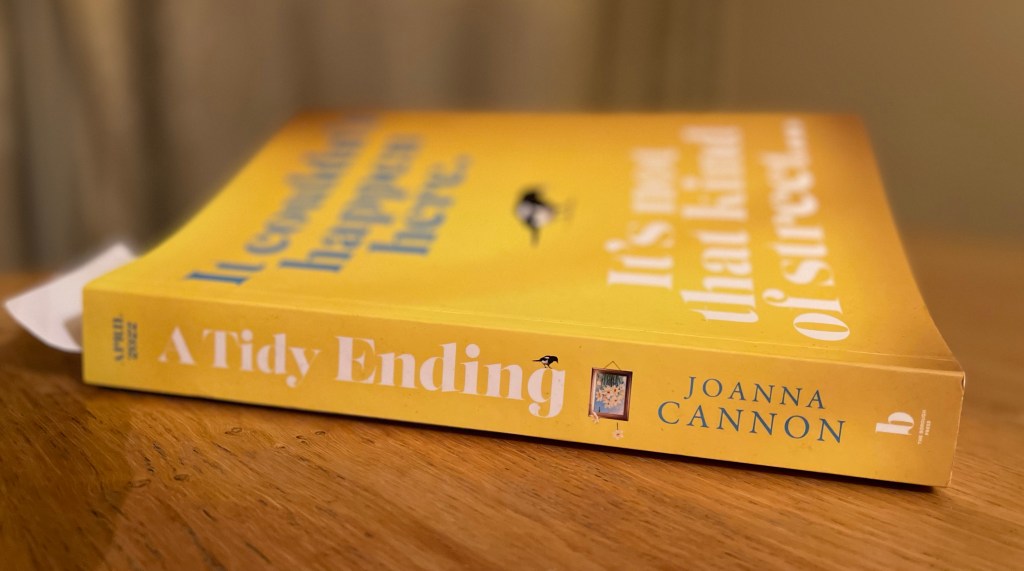
A Tidy Ending by Joanna Cannon

A Tidy Ending by Joanna Cannon

Published by The Borough Press

Available from West End Books

and all Good Bookshops

What They Say

A NICE, NORMAL HOUSE

Linda has lived around here ever since she fled the dark events of her childhood in Wales. Now she sits in her kitchen, wondering if this is all there is – pushing the Hoover round and cooking fish fingers for tea is a far cry from the glamorous lifestyle she sees in the glossy catalogues coming through the door for the house’s previous occupant.

A NICE, NORMAL HUSBAND

Terry isn’t perfect – he picks his teeth, tracks dirt through the house and spends most of his time in front of the TV. But that seems fairly standard – until he starts keeping odd hours at work, at around the same time young women start to go missing in the neighbourhood.

A NICE, NORMAL LIFE…

If Linda could just track down Rebecca, who lived in the house before them, maybe some of that perfection would rub off on her. But the grass isn’t always greener: you can’t change who you really are, and there’s something nasty lurking behind the net curtains on Cavendish Avenue…

What I Say

How often in our lives do we walk around not really noticing the people who are right in front of our eyes? As the world becomes a place where women are expected to conform to a certain aesthetic and behaviour to be deemed normal and seen, there are so many women for whom simply existing and settling for what they have means that they become invisible to the world around them, in spite of the hopes and dreams they may have once had.

Linda could easily be described as one of those women. She is married to Terry, and her life is now best described as one of routine and mundanity. While Terry goes out to work, Linda splits her time between looking after their house and working part time in a local charity shop. So far so unremarkable.

Yet as the novel’s narrative slowly and deliciously unfurls, we start to see that Linda has not only had an unsettling childhood, due to her father being alleged to have done something while he was a piano teacher, but that she also seems fixated on ensuring that she and Terry move into a very specific house. Linda seems to know what she wants and won’t rest until she gets it, and right from the start, where we realise Linda is in some kind of psychiatric ward, do we understand that this is a layered and intriguing story.

As catalogues arrive at Linda and Terry’s house for the previous tenant Rebecca, Linda starts to open them and is transfixed. They promise a world filled with glamour and sophistication, and Linda starts to wonder if she tried to be more like the person Rebecca clearly is, whether she would have a chance to finally be seen at last.

Meanwhile, Terry is going to work and coming home, and expecting his dinner on the table, and for Linda to be there for him. As he increasingly spends more time at work, the news is filled with stories of young girls going missing, and as the reader, our imagination starts to wonder exactly where Terry has been and what he has been doing when he isn’t at work and hasn’t arrived home..

While Terry becomes increasingly absent from the house and their marriage, Linda becomes more and more obsessed with Rebecca. Using some incredibly clever deduction, she manufactures ‘bumping’ into Rebecca and her boyfriend Jolyon. Meeting them only fuels Linda’s desire to be more like Rebecca, copying her hair and clothes, and believing that she has found a new friend. Yet Rebecca and Jolyon see her as an unwitting victim for their money making ‘scheme’. In a heartbreaking scene for the reader, Rebecca believes she has found the perfect candidate to be her new cleaner – which Linda sees as an extension of their friendship – and a way to really get close to Rebecca.

From the moment that Linda slides into Rebecca’s life, Linda starts to feel more confident and ready to have the life she feels she truly deserves. In doing so, she sets off a chain of events that no one could ever have foreseen, and one thing is certain – everyone in Linda’s life will never be the same again.

A Tidy Ending is a brilliantly thoughtful and captivating novel that shows the lengths we will go to in order to protect those we love. Joanna’s prose completely articulates the minutiae and at times mundanity of every person’s every day life, our hopes and dreams, and there were lines and paragraphs that were so perfectly written I wanted to underline them. Joanna understands emotion and the psyche of people so well, that she really effortlessly connects you with the characters, because although you may not like what they do, you understand why they do it.

Joanna has written an absolutely absorbing and utterly convincing story about a woman who refuses to be ignored. Linda is a wonderful character, whose seemingly insignificant life and treatment by those around her, makes us want to protect and look after her, and want only what she wants for herself. What Joanna’s pitch perfect characterisation and writing shows us, is that the people we pay the least attention to, sometimes should be those we watch the most.

I absolutely loved it.

Thank you so much to Ann Bissell and The Borough Press for my gifted proof copy.

You can buy your copy of A Tidy Ending here.

One Day I Shall Astonish The World by Nina Stibbe

Published by Penguin Viking on April 21st 2022

Available from West End Lane Books

and all Good Bookshops

What They Say

Susan and Norma have been best friends for years, at first thrust together by force of circumstance (a job at The Pin Cushion, a haberdashery shop in 1990s Leicestershire) and then by force of character (neither being particularly inclined to make friends with anyone else). But now, thirty years later, faced with a husband seeking immortality and Norma out of reach on a wave of professional glory, Susan begins to wonder whether she has made the right choices about life, love, work, and, most importantly, friendship. 

Nina Stibbe’s new novel is the story of the wonderful and sometimes surprising path of friendship: from its conspiratorial beginnings, along its irritating wrong turns, to its final gratifying destination.

What I Say

Before I tell you about Nina’s novel, and what I think of it, I have a confession to make. I usually write my reviews by referring to the notes I have taken as I write it,

I didn’t write a single note about One Day I Shall Astonish The World because I was too absorbed, and didn’t want to put it down! I was sat outside on my patio on Easter Sunday (possibly with an Easter egg!) reading it, laughing out loud and reading numerous passages to Mr Years of Reading.

It’s a brilliantly funny, incisive and emotional novel that absolutely understands not only the complexities of female friendships, but also the realities of life for so many women that it’s impossible not to be genuinely moved by it.

Susan and Norma are lifelong friends, who first meet when Susan starts working in The Pin Cushion, the haberdashery shop that Norma’s family owns. Norma breezes into Susan’s life and wants to learn about literature from her so that she can apply for courses and leave her life at The Pin Cushion behind.

While Norma forges ahead with an academic career, Susan has stayed in Brankham, married Ray – the marketing manager of the local golf club and and has dropped out of her degree course to be a full time Mum to their daughter, Honey. Norma seems scornful of the life choices that Susan has made, and yet makes her own romantic choices based on the opportunities the men afford her. She marries her first husband, Hugo Pack-Allen, the man who has invested in The Pin Cushion, and Susan cannot understand what the attraction is. Unfortunately, after they Norma and Hugo are married, certain proclivities come to light that reveals Hugo to be someone who is not what Norma thought, and a twist of fate means that she finds herself alone a lot sooner than she thought.

As Norma sets on a path of carving out a career in academia for herself, Susan is feeling increasingly trapped at home. She is knows she is ever more isolated from Ray, and when they discover Ray has a daughter called Grace from a previous relationship, Susan starts to question exactly what she is getting from the life that seems to be whizzing past her without her making any mark in the world.

It’s also important to say that Norma and Susan’s relationship is an interesting one. They are in each other’s lives, but there always seems to be an ebb and flow in the relationship, and they seem to take a delight in the passive aggressive towards each other. Yet that is what made me love them even more. The fact that they quite frankly wind each other up and sometimes seem to take delight in the other woman’s misfortune is what adds another dimension for me. I loved the fact that their friendship wasn’t saccharine sweet and cosy confidences – because friendship isn’t always like that.

The turning point is when Susan decides to apply for a role at the local University – first in the Estates Office and eventually she ends up working for the Vice Chancellor. As someone who worked in a University, I can tell you that Nina has absolutely nailed what it is like to work in a place like that! On the one hand it is steeped in tradition with a dedicated group of people determined to ensure the University never changes, on the other is the outside ever changing world and the voices of those who know that in order to thrive, it has to understand the very students it needs to come through it’s doors.

Susan feels herself increasingly drawn towards the enigmatic VC and finds herself romantically imagining a life with him, Norma is suddenly again putting herself front and centre into Susan’s life. She decides she wants the VC for herself – while also keeping other relationships on the back burner just in case! Norma soon marries the VC and Susan wonders if she ever really had a friend in her at all.

As we follow both women through their lives from 1990 right up to the onset of the Covid-19 Pandemic, we see how their worlds weave in and out of each others, and how whether they like it or not, in the absence of other female friends, they have this really deep, but not always comfortable bond that always brings them back together.

One Day I Shall Astonish The World is an incredibly funny and touching novel about women, friendship and the lives we somehow find ourselves in. For me, one of the many brilliant things about Nina’s writing is that she has that perfect balance of humour and emotion. She intuitively understands her characters and it is testament to her writing that each and every one of them is unforgettable and relatable, and that is why you can’t put this book down.

If I had to tell you just one reason why I loved One Day I Shall Astonish The World, I would say that in a world which at the moment for me seems unsettling and confusing, this book brought me such utter joy, that to be able to lose myself completely in it was just what I needed until I really did have to put it down. That for me is the sign of a brilliant writer, and Nina Stibbe is undoubtedly that.

I absolutely loved it, and this is without doubt one of my favourite books of this year.

Thank you so much to Ella Harold and Penguin Viking for my gifted Proof copy.

You can buy your copy from West End Lane Books here.

The Fell by Sarah Moss

The Fell by Sarah Moss

Published by Picador on November 11th

Available from West End Lane Books and

all Good Bookshops

What They Say

At dusk on a November evening in 2020 a woman slips out of her garden gate and turns up the hill. Kate is in the middle of a two-week quarantine period, but she just can’t take it any more – the closeness of the air in her small house, the confinement. And anyway, the moor will be deserted at this time. Nobody need ever know.

But Kate’s neighbour Alice sees her leaving and Matt, Kate’s son, soon realizes she’s missing. And Kate, who planned only a quick solitary walk – a breath of open air – falls and badly injures herself. What began as a furtive walk has turned into a mountain rescue operation . . .

Unbearably suspenseful, witty and wise, The Fell asks probing questions about the place the world has become since March 2020, and the place it was before. This novel is a story about compassion and kindness and what we must do to survive, and it will move you to tears.

What I Say

To write about a family going through a period of self isolation many of us have lived through is an interesting premise. In some ways, we may feel exasperated that we are reading about something that was so all consuming that we don’t need to see it in our literature, but at the same time for me, reading about other families experiences and ways of dealing with it made me feel more connected to others.

In The Fell, Sarah Moss has perfectly articulated what it means to live through such a complicated and unsettling time, whilst also ensuring there is a very human and relatable story at the heart of the novel.

Kate, like so many people is being forced to self isolate after being in contact with someone who has Covid. Having no symptoms herself, she and her son Matt are stuck in their cottage in the Peak District. Matt seemingly loves the prospect of lie ins, massive gaming sessions and a break from everyday life. Kate on the other hand is not coping at all. Right from the start you can see how she feels confined by the rules which means she can only venture as far as the garden.

Tired of cleaning the house, unable to settle on ways to keep herself occupied, she is left alone with her thoughts and she is not coping. For a woman who is used to taking a backpack and walking wherever she likes, whenever she likes, we understand how frustrated and hemmed in she must feel by the law which is imposed on her and how little control she has over her situation.

When she decides to leave the cottage and go for a walk, rationalising that as it is at dusk she won’t see anyone, and her familiarity with her environment means she can be out and back without anyone knowing, I completely understood why she decided to do it.

Their next door neighbour Alice, is widowed and her immediate family live far away. She is shielding due to her immune system being compromised by chemotherapy. Alice has been relying on Kate and Matt to help her get the supplies she needs as well as them giving her some much needed human interaction. Alice’s narrative is an interesting and necessary one, because on the one hand she realises how much she has in terms of financial security and a family at the end of a zoom call, but she misses the basic human interactions. As a daughter whose widowed Dad was in Wales during the lockdown, it was at times hard to read Alice’s words, because I kept thinking of my Dad, and although he is not an emotional man, he too had so little face to face interaction or hugs during that time, I just wanted to get in my car and drive to see him.

This is also why Kate’s actions are understandable. Many people would try and rationalise it by focusing on reasons why in our situation it doesn’t count, and why it doesn’t really matter in the grand scheme of things, and that everyone else is doing it, but always at the back of our mind are the same concerns Kate has. She is meant to be self isolating, and being found out means she could be faced with a fine she can’t afford – especially now the café she works in is closed, and she can’t get gigs singing at the pub like she used to.

Then Kate falls and badly injures herself. With no phone she realises that by alerting people, she runs the risk of legal action and losing what little stability she and Matt have. She is completely conflicted, but the thought of Matt is what makes her determined to try and get home in spite of her extensive injuries. It is only when Matt becomes concerned and attempts to talk to Alice in a really touching scene where he is making sure he is following the rules and is always at an appropriate distance, Alice realises what has happened and raises the alarm.

The interwoven narratives of the four main characters are an effective device for Sarah Moss to give us different perspectives on Kate’s actions. Matt doesn’t know where his Mum is, and can’t reach her because she has left her phone behind, Alice sees her leave but doesn’t know what to do and doesn’t want to get her into trouble, and for Rob, part of the Rescue Team who is mobilised to help find her, he has to explain to his self obsessed daughter why he has to find the missing woman and cut short their time together.

The novella is written as almost a stream of consciousness which I have to admit took me a few pages to get into, but once you start, you understand exactly why this is the perfect form. You are party to each character’s thoughts, and see like us the way their minds dart around from topic to topic. We learn about Alice’s happy marriage and Kate’s experience of a violent relationship and a dull marriage, of Matt’s worries about his Mum and Rob’s determination to both try and do his job and keep his daughter happy.

The Fell perfectly captures what it felt like to live through this lockdown. We rationally understood how it was critically important to ensure we we stayed at home, even when it made no sense, but it seems that the enforced isolation also made what we weren’t allowed to do seem even more desirable and necessary. The sense of claustrophobia, families forced to spend all day every day together without respite or a chance to see others only served to exacerbate our need to do the most basic of things we had never considered before. To be able to walk and experience nature, to go to the shops, to see and connect with people outside our bubbles became things we understood we had so often taken for granted. This is why I believe The Fell will resonate so deeply with so many people.

Sarah Moss’ writing works so well because it is not the grand gestures or explosive events she talks about, it is the small things and everyday routines we all understand and connect with. There is also this sense of how nature and the world beyond our doorstep is so incredibly important, and how small and insignificant we can feel when we are lost in it. It is another thing we can’t control, and Sarah’s beautiful and measured prose only adds to the sense of awareness as to how fragile our world is.

The Fell may not be very long, but when I had finished it, I kept thinking about it, especially what Kate had gone through, because I had felt it too. You can feel Kate’s frustration at her situation seeping through the pages, and her rationale for stepping out of her front door is understandable because hand on heart, we all felt it, lived through it and have had to deal with a new and unpredictable world that we have been forced to navigate.

I absolutely loved it.

Thank you so much as always to Camilla Elworthy for my gifted proof copy.

You can buy it from West End Lane Books here.