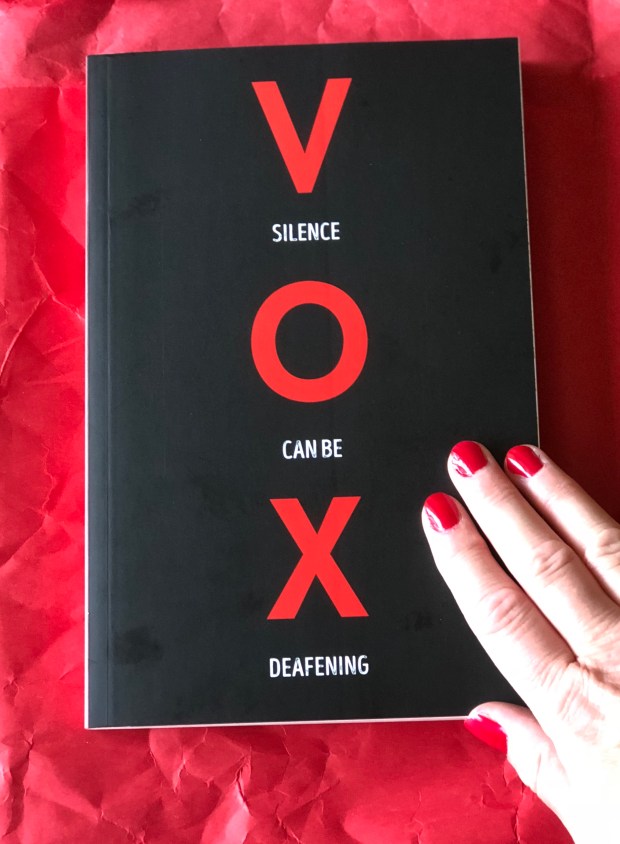
VOX by C V Dalcher

img_1586

VOX by C V Dalcher

Published By: HQ

Buy It: here

What The Blurb Says:

Silence can be deafening.

Jean McClellan spends her time in almost complete silence, limited to just one hundred words a day. Any more, and a thousand volts of electricity will course through her veins.

Now the new government is in power, everything has changed. But only if you’re a woman.

Almost overnight, bank accounts are frozen, passports are taken away and seventy million women lose their jobs. Even more terrifyingly, young girls are no longer taught to read or write.

For herself, her daughter, and for every woman silenced, Jean will reclaim her voice. This is only the beginning…

[100 WORD LIMIT REACHED]

What I Say:

Every day we are assaulted by a cacophony of words and sounds from the moment we wake up until the moment we go to sleep.  We chat, laugh, text, post comments and in my case, settle down with a book and talk some more.

Now imagine a world where women are limited to 100 words a day.  If you go over your limit, a bracelet on your arm will administer an electric shock.  If you go further over the 100 word limit, the intensity of the electric shock will increase until you inevitably die.

This law includes all females, so girls from a very young age also have a bracelet fitted which ensures that they too cannot use more than 100 words too.

So, VOX must be set way in the future, in an alien world far removed from ours?

Guess again.

Welcome to modern day America, ruled by a megalomaniacal President and his brother, assisted by a power hungry Reverend who is the head of the Pure Movement.  A Presidential Election has facilitated the infiltration of this Movement throughout America, which believes that not only is a woman’s place is in the home, under the complete control of her husband, but that she should be seen and absolutely not heard, which is why the bracelet has been introduced into American Society.

Single women are given the laughable ‘choice’ of marrying someone, anyone, or are made to work in brothels.  Anyone who is not heterosexual is criminalised and forced to work in camps where they are ‘re-educated’ to become straight again.

Jean McClellan is a doctor of neurolinguistics, who, like millions of other women is a virtual wordless prisoner in her own home. She is not permitted a bank account or a credit card, and has had to give up her career.  She is trying to ensure that she not only does not flout the rules, but that her young daughter Sonia never goes over the 100 word limit too. Sonia and her brothers attend school, but as a girl, Sonia is not allowed to learn to read or write, and chillingly, her greatest achievement is receiving a certificate for speaking the least number of words (just 3) in a day.

Little by little, the government ensure that women are becoming nothing more than silent, passive bodies, ghosts who glide through their lives absolutely controlled by the men who rule the White House and the men who share their homes.  Even more chillingly, Jean’s eldest son Steven, is being indoctrinated into this state controlled misogyny through school, as the curriculum is changed to reflect the teachings of the Pure Movement, so as soon as the boys start their education, they learn about the place of women in their world.

The scene is set as Jean and her family attempt to live within the horrific misogynistic confines of their world, as she is unable to do anything to protest against the President, because quite simply, to vocalise her anger means she will die and her family will be put in danger. Added to this, Steven is now falling under the spell of the Pure Movement, and has started to treat his mother appallingly, quite simply because that is what he is meant to do in this world.

So far, so depressing.  Until one day, the men from the White House arrive at Jean’s house offering her the chance to remove her bracelet and resume her academic career.  Ironically she is asked to give the power of speech back to the person who was responsible for taking hers away, as the President’s brother is unable to speak following a brain injury.  Jean is placed in an awful dilemma  – should she take the offer and be able to speak and use words (even if it is only until the cure is found) while helping the man who has inflicted this situation on America, or should she morally refuse and stay imprisoned in her silent world instead.

After much soul searching, Jean decides to research a cure for the President’s Brother. She also demands that Sonia has her bracelet removed too.  The fact that Sonia is bewildered and scared by her freedom, unsure and unwilling to use her words because she has never had that opportunity makes VOX a difficult read at times. I cannot imagine how heartbreaking it would be, to live your life in fear of your child attempting to express themselves, for them to have to quell every creative thought in them so that they do not risk injury or more appallingly, their own death.

From this moment on, Jean is pulled into a presidential world filled with intrigue and lies, where she and her research team discover that what people say are not always what they mean, and that their intelligence and determination has the potential to change their world – but not always for the best.

For me, Jean is a completely relateable protagonist.  You feel her pain and sense of frustration that she is forced to live in this way. Her drive to succeed is powered by her desire to ensure that her daughter and all women in America no longer has to live under this chilling and barbaric regime.  VOX shows us how when we are faced with impossible and life changing choices, sometimes we have the greatest power within ourselves to do what it takes to succeed.

VOX is a novel that deserves to be read, discussed and shared with everyone.  If you feel nothing while reading it, if it doesn’t make you rage and feel angry, or make you want to ask how this could possibly happen, then I am not sure we can really be bookish friends!

C V Dalcher has written a novel that works so brilliantly because in today’s world, with the recent political events that have happened, women losing their ability to use words is scarily not something that seems so truly far fetched any more.  Setting the action in modern day America means that we can easily visualize the day to day world, which makes it even more chilling.  The awful idea that something like this could happen in our lifetime makes this a timely and absolutely relevant read for all of us.

In creating a world that is so scared of giving women a voice, it seems that the men in charge of VOX’s world are fearful. Maybe they subconsciously realise that when women come together to stand up against something they believe in, nothing, not even a deadly bracelet can stop women being the ultimate force for change for the world we deserve.

I loved it.

The Rules Of Seeing by Joe Heap

Joe Heap: The Rules Of Seeing

Published By: HarperCollins

Buy It: here

What The Blurb Says:

Nova is 32 years old and she is about to see the world for the very first time.

Jillian Safinova, Nova to her friends, can do many things. She can speak five languages. She can always find a silver lining. And she can even tell when someone is lying just from the sound of their voice.

But there’s one thing Nova can’t do. She can’t see.

When her brother convinces her to have an operation that will restore her sight, Nova wakes up to a world she no longer understands. Until she meets Kate.

As Kate comes into focus, her past threatens to throw them into a different kind of darkness. Can they each learn to see the world in a different … and open their eyes to the lives they could have been living all along?

What I Say:

Rules of Seeing is a novel that I really wanted to read – I have to admit that the cover made me want to get hold of a copy!  The beautiful proof that I was sent by Charlotte at Harper gave nothing away about the story, it was white, resonating with calmness and I thought I was going to be reading a simple love story.

What I found instead was a unique and powerful, genre defying book about what it means to be able to see, and how sometimes the things that are right in front of us are what will change our lives the most.

Jillian Safinova (Nova to her friends) is a police interpreter. Fiercely independent, witty and kind, she lives her life to the fullest and is not prepared to take any rubbish from anyone.  She also happens to be blind, and has been from birth.  Nova has learned to live in a world of darkness, negotiating everything we take for granted and living happily enough as she juggles her personal and professional life.

Nova’s brother Alex, who is a doctor, tells her of an operation that would potentially restore her sight, and she is then faced with a massive choice.  Take a huge leap of faith and change everything she has ever known to be able to see, or carry on as she is.  The thing is, when Nova decides to have the operation, this is not one of those trite cinematic moments where Nova’s bandages are removed and she jumps from her bed, runs outside and drives a car away.  Imagine going from a state of no vision to a world where everything hurtles towards you at once – you have to learn the rules to survive.  The Rules of Seeing.  Nova has to work her way through all of these in order to understand the world around her that we take for granted.

As she struggles with recovery and rehabilitation, she meets Kate. An architect married to a policeman, Kate is increasingly realising that her husband is far from the upstanding member of the police force he pretends to be.  As well as having a side line in dealing the drugs he has seized in various drug operations, he is an abusive husband.  Kate’s existence is punctuated by the vicious and unprovoked attacks she suffers at his hands.  She believes that she is not worth anything more, and is resigned to living her days in the restricted world that he allows her to inhabit.

So, when Kate bumps into Nova attempting to destroy a vending machine to get the snack she wants, the two women are set on a course that will change their lives permanently.  Kate and Nova are both faced with learning new rules for their lives, and this brings them even closer together as they realise that they are attracted to each other.

What I loved about this novel, was that you really understand what it means to be blind, and more importantly, how truly challenging and frustrating it is to be invisible because of your disability.

Getting your sight back must seem to be the most incredible thing, but what Joe does is show how it can also be the most frightening and isolating thing too.  Imagine going from darkness to a world where you have to learn the rules that everyone else has known from birth.  The difference between objects, what it’s like to travel on a bus or in a car, to learn what an object you know the word for actually looks like.  How do you know how big a car is or how you distinguish colours and shapes?  Nova has to relearn every little thing, absorb it and put it into practice at the same time as continuing with her personal and professional life.

As Nova battles to accept her sight, Kate is stuck at home in London, living with a man who takes pleasure in finding ways to distress his wife.  One of the most appalling things he does is to slowly and deliberately skin a rabbit in front of her, knowing how upsetting it is, relishing the distress he causes and the power he has over her.

All the time, Kate is trying to stop herself falling for Nova, but she can see a glimpse of how happy she could be, if she could make the decision to move away from her husband.  However, when they finally do kiss, Kate, perhaps scared of what Tony would do to Nova if he found out, sends Nova away.  The journey for Nova into a world of sight is at a critical point.  She could carry on with her therapy, or purposefully forget everything she has learned to this point, and retreat into her blindness again. Rejected by Kate and bewildered by what has happened, Nova decides to return to the world she knows best.

A final awful attack on Kate by Tony, gives her the courage to leave him and stay in the flat she was renovating.  It is only then, when Nova comes to see her, that Kate is able to tell her how she has really seen Tony for who he is, and the truth about her home life comes tumbling out.  Joe’s tender and eloquent writing shows how in loving each other, Kate and Nova have found a way to navigate the life changing events they are facing, and that by being together as a couple, they can start to heal and live the lives they truly deserve.  For me, the fact that they do have ups and downs, doubts and fears about their relationship makes them seem even more real.  Who hasn’t read and re-read a text before, during and after sending it. or worried about how long is too long before getting in touch?  Their tentative steps in the relationship means that we are completely engaged by them and want only for their story to end happily

If only life was that simple, and happy ever afters were found with the turn of a page.. Tony, infuriated by his wife’s abandonment has other ideas, and Kate and Nova fall victim to his sadistic nature as he attempts to finally destroy the relationship they have fought so hard for.  Of course, as always, I am going to say nothing more other than you will need to buy The Rules of Seeing to find out whether Kate and Nova’s love triumphs.

The Rules of Seeing is a novel unlike any I have ever read.  It is a powerful, complex and challenging book that shows us unflinchingly not only what it means to be blind, but also how shocking and upsetting living in a violent relationship is.  Far from being a cosy and straightforward love story, it is a novel about how too often we settle for the way things are, and that by having the courage to be willing to really see ourselves and the world around us, we can truly have the life we deserve.

I loved it.

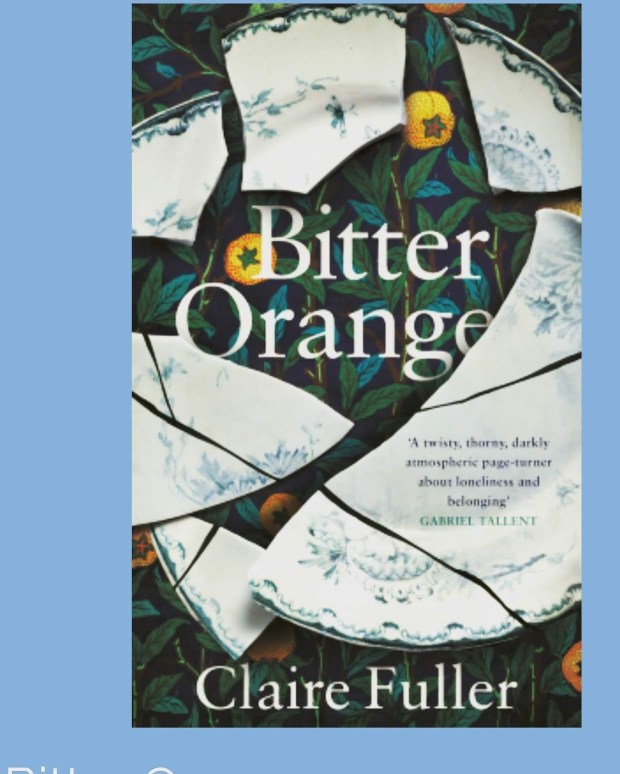
Bitter Orange by Claire Fuller

img_11552

Claire Fuller: Bitter Orange

Published By: Fig Tree

Buy It: here

What The Blurb Says:

From the attic of a dilapidated English country house, she sees them – Cara first: dark and beautiful, clinging to a marble fountain of Cupid, and Peter, an Apollo. It is 1969 and they are spending the summer in the rooms below hers while Frances writes a report on the follies in the garden for the absent American owner. But she is distracted. Beneath a floorboard in her bathroom, she discovers a peephole which gives her access to her neighbours’ private lives.

To Frances’ surprise, Cara and Peter are keen to spend time with her. It is the first occasion that she has had anybody to call a friend, and before long they are spending every day together: eating lavish dinners, drinking bottle after bottle of wine, and smoking cigarettes till the ash piles up on the crumbling furniture. Frances is dazzled.

But as the hot summer rolls lazily on, it becomes clear that not everything is right between Cara and Peter. The stories that Cara tells don’t quite add up – and as Frances becomes increasingly entangled in the lives of the glamorous, hedonistic couple, the boundaries between truth and lies, right and wrong, begin to blur.

Amid the decadence of that summer, a small crime brings on a bigger one: a crime so terrible that it will brand all their lives forever.

What I Say:

Thank you to NetGalley for an advance e-copy of Bitter Orange in exchange for an honest review.

I kept seeing bookish people on Twitter raving about Claire’s new novel Bitter Orange.  After valiantly failing to get a printed proof via various competitions and offering to sell my children and dog, I was absolutely ecstatic to be able to access Bitter Orange via Netgalley.

So, what did I think?  Quite simply, Bitter Orange is one of those few novels that pulls you in from the first page, keeps you close throughout, and then leaves you feeling bereft when you realise you have finished it. I can honestly say that it is one of the few e-novels I have read, that I need to own a physical copy of as I want to read it again to really savour every page.

We first meet Frances Jellico as she lies on her deathbed, talking to Victor who is a vicar and her long standing friend.  As she meanders in and out of consciousness, she remembers her life, especially the hot and claustrophobic summer of 1969.

Frances has been commissioned to write a report about the follies which are in the gardens of the majestic Lyntons House.  She has left the drab and lonely existence she has in London, and is now facing a summer in an isolated and somewhat dilapidated country house as she undertakes her seemingly overwhelming task.

It is as she moves into her sparse attic room, that she meets the charismatic Peter and Cara, who are staying in the rooms below her.  Like Frances, Peter has been commissioned to write a report for the buyer of Lyntons House, and from the first time she meets the two intoxicating strangers, Frances falls immediately under their spell.

As she settles in to her attic rooms, Frances stumbles upon a telescope, embedded in the floor, which looks directly down into the bathroom that Peter and Cara share, which gives her an illicit view of the couple that she knows is wrong to look at, but can’t draw her eyes away – especially from their most private moments.

As the three strangers start to talk to each other, Frances notices that Cara seems to be evasive about her life before arriving at Lyntons, but is vocal of her love of Italy and its language, and Peter seems to be the stabilising influence she needs. Frances is a sometimes unwilling participant in their alcohol fuelled arguments, but is ultimately bewitched by her passionate and worldly wise neighbours.

The heat of the summer and the geographical isolation of Lyntons House mean that Peter, Cara and Frances start to gravitate towards each other, sharing food and free time and they begin to confide as to the paths which have brought them here.  One of the many wonderful things about Bitter Orange, (and believe me, there are many), is that Claire’s writing eloquently conveys the sense of them being almost out of step with the real world, living day to day, as they wish, with no routine or timetable, against the backdrop of a languid and all encompassing landscape that in reality seems to be closing in on them.

Life at Lyntons initially seems to suit all three of them, and very gradually, Frances starts to unwind and lose her staid and rigid routines.  She realises that she is becoming increasingly attracted to Peter, and as they get closer, he tells Frances in confidence that she shouldn’t always believe what Cara says, and that her mental state and recollection of events is at times precarious.

The balance of their relationships start to shift- Cara is now being watched by both Peter and Frances, Frances and Cara both love Peter, and Cara is becoming wary of Frances and her obvious attachment to Peter. One day, they stumble upon a door in the house which contains everything that the Lyntons owned – including furniture, crockery, china, jewellery and exquisite paintings.

Frances, Cara and Peter then make a moral choice about their discovery which will not only change everything, but will seep into the already tenuous cracks of their now brittle relationships.

Not one of them is innocent, and from this point onwards in Bitter Orange, the spell of their idyllic summer is irrevocably broken.

Day by day they start to turn on each other, uneasy and untrusting, loyalties are tested and secrets are revealed. This is what makes the characters in Bitter Orange so engaging – that Frances, Cara and Peter are flawed in their different ways, but ultimately they are just three young people, trying to find love and their place in the ever changing world that they will have to return to eventually.

Bitter Orange culminates in a truly shocking and unexpected ending, which is absolutely perfectly executed – and Frances’ deathbed confessions will, believe me, take your breath away.

Emma Healey, another of my favourite authors, has said that on reading Bitter Orange that she had to keep reminding herself that she wasn’t reading a forgotten classic. I would absolutely agree, and also add, that in writing the haunting and elegiac Bitter Orange, Claire Fuller has written a brilliant future classic novel that should be lauded and read as widely as possible.

I loved it.

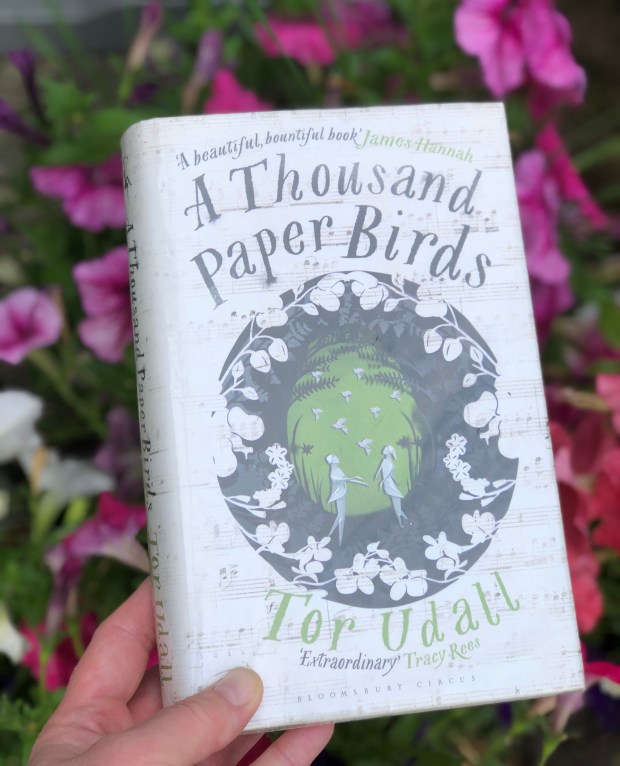
A Thousand Paper Birds by Tor Udall

img_1403

Tor Udall: A Thousand Paper Birds

Published By: Bloomsbury Circus

Buy Ithere


What The Blurb Says:

Jonah roams Kew Gardens trying to reassemble the shattered pieces of his life after the death of his wife, Audrey. Weathering the seasons and learning to love again, he meets Chloe, an enigmatic origami artist who is hesitant to let down her own walls.

In the gardens he also meets ten-year-old Milly, and Harry, a gardener, both of whom have secrets of their own to keep – and mysteries to solve.

What I Say:

“Perhaps,” says Jonah, ‘love is when you hold on to something and fall through the air.  You don’t know if you’re flying or falling – ‘

‘Until you crash,’ she says.

I have to tell you straight away that I had no intention of blogging about A Thousand Paper Birds.  I had it on my Reading Pile, one that is just for me, so I don’t put myself under any pressure by promising reviews when sometimes all I want to do is read.

The thing is, when you start reading a novel like A Thousand Paper Birds, it needs to be shouted about, recommended and pushed into the hands of anyone who has ever known what it is to love or be loved.

Jonah’s wife Audrey has passed away.  He understands how important Kew Gardens was to her, and so as well as arranging for a bench dedicated to her to be installed, Jonah spends many hours roaming the gardens in an attempt to feel closer to her.  While he is there, he meets Chloe, a young artist who is passionate about origami, and as they start to form a connection, Jonah finds himself feeling conflicted about opening his heart to someone else whilst the presence of Audrey is everywhere.

Harry has dedicated his life to working in Kew Gardens, and works tirelessly to ensure that it stays as beautiful as he can make it.  Milly is a typical ten-year old, energetic, inquisitive and seemingly fearless.  Jonah encounters them on his trips to Kew, and as he starts to try to get over his devastating loss, Chloe, Henry and Milly all provide him with different things he needs to help him move forward.

So far so straightforward? Sounds like a feel good novel that will have Jonah, Chloe, Harry and Milly living happily ever after?

A Thousand Paper Birds will not give you a formulaic feel good, tick box neat story.  It is so much more than that. It is a complex and passionate novel about what love is, what it means, and the lengths we will go to in that elusive search for happiness.  It tackles many different issues, such as death, grief, what it means to be a parent, and what dying means for those who are left behind.

One of the many things I loved about the novel are the characters who inhabit Kew Gardens. Jonah is a grieving husband, but he is not a model of decorum and mourning.  He attempts to forget about Audrey by sleeping with numerous women, trying to find a way back to some sort of normality that will start him living his life again.  Chloe is the same, brittle and wary of forming any connection that will make her confront her past and what she has witnessed.  For me, that made the novel even better – I want real, relatable people, who react in ways that I can understand, and make me want to see them find the resolution they need.

Harry and Milly initially seem always to be just on the edge of Jonah and Chloe’s world, but they in fact are so pivotal to their lives, that without them, they will not be able to move past the grief they both hold inside.  Page by page, chapter by chapter, Harry and Milly move from the background of Kew, into the centre of the plot, and we start to understand exactly why they are there, and so interested in Jonah and Chloe.

All the time, the magnificent and stately Kew Gardens weaves its way through the story.  Most of the novel takes place here, and like an all-seeing and all-knowing entity, it holds the key to why all the characters are drawn here.  The ethereal quality that Kew has, provides the perfect backdrop, as the novel progresses and we start to understand that all is not what it seems.  All the time, Kew is there, bringing people in to its heart and holding them there until they are ready to move on.

Audrey is the link between all these characters, and like them, before she died, she too was dealing with her own grief.  Unable to carry a child to full term, she and Jonah move further apart as they bluster through their daily lives, never really talking about their marriage, or how sad they feel.  Like all the people in A Thousand Paper Birds, Audrey is not held up as a paragon of virtue.  She is increasingly drawn to Harry, wondering whether their shared love of nature and gardening is a solid enough foundation to risk her ending her marriage to Jonah.

However, as we know, Audrey dies, and leaves behind her four people who are trying to make sense of what has happened.  When Chloe stumbles on Audrey’s diary, explaining her feelings towards Jonah and her growing attraction to Harry, she knows she has stumbled on something which will blow apart their lives and ultimately risk her own growing relationship with Jonah.

As the novel moves seamlessly towards its conclusion, there are subtle clues, which become more and more blatant, and finally reveal to us who Harry and Milly are, and Audrey’s involvement in their lives.   I could tell you what it means, but as you know by now, I am not going to ruin it for you.

All I will say is that A Thousand Paper Birds is a beautifully poignant, poetic and courageous novel.  Tor eloquently deals with many themes in a unique, almost magical way.  It is a book that I didn’t want to finish, and had to think about how on earth I was going to be able to articulate this review to convey its power and tenderness about love, life and death.

If you haven’t read A Thousand Paper Birds yet, I would urge you to add it to your reading list immediately.  Savour it, fall in love with Tor Udall’s wonderful writing and the Kew Gardens inhabitants, and appreciate your loved ones and the time you spend with them.

I loved it.

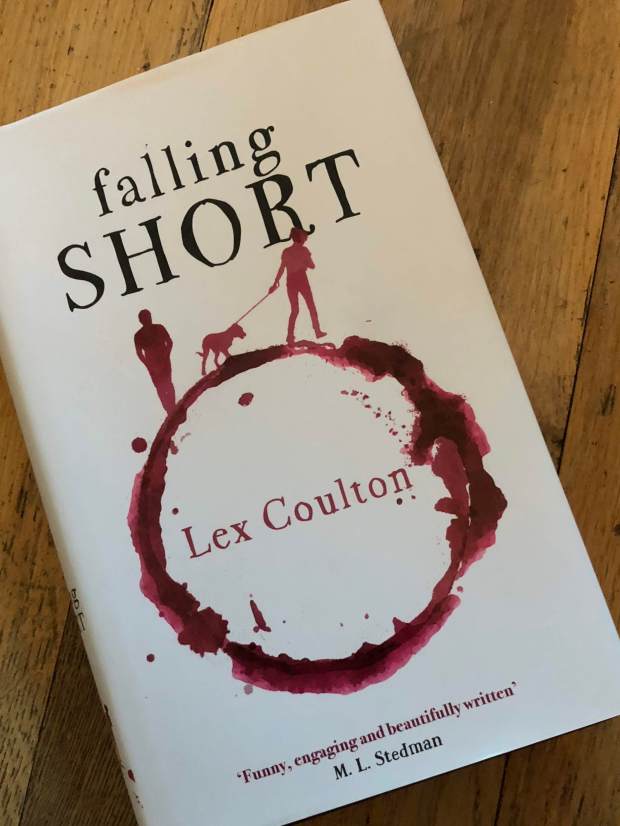
Falling Short by Lex Coulton

img_1184

Lex Coulton: Falling Short

Published By: John Murray

Buy It: here

What The Blurb Says: 

Review

A remarkable book: warm, moving and very funny (Jess Kidd)

Taking up the mantle of acute, humane observation from Muriel Spark, Falling Short is funny, engaging and beautifully written. A really refreshing read (M. L. Stedman)

A remarkable book: warm, moving and very funny

Taking up the mantle of acute, humane observation from Muriel Spark, Falling Short is funny, engaging and beautifully written. A really refreshing read

Book Description

A witty, charming and moving novel about finding things where you least expect them

About the Author

Lex Coulton studied English and later creative writing at Oxford. She spent fourteen years teaching English in secondary schools before taking a sabbatical year in Paris, to focus on her writing. Lex grew up in Herefordshire, and has recently returned to live there with her husband, John, and their dogs Bazil and Sadie.

What I Say:

Thank you to John Murray who sent me a copy of Lex’s novel, and it was so good, that I decided I had to write this blog post to tell everyone about it!

I had seen Falling Short talked about a lot on social media, and knew that it would be the sort of book that I would really enjoy – and I was right!

Frances Pilgrim is thirty-nine, teaching Shakespeare to sixth formers and has fallen out with her best friend, Jackson, who also teaches at the school.  As well as having to deal with the daily grind of being an adult in a world where you have to keep going because you can’t stop, Frances’ Mum is behaving in an increasingly erratic way as she battles Alzheimer’s.

Frances is an only child, and has always believed that her father disappeared at sea when she was five years old, and she is now having to juggle her professional life with the increasing demands of her personal one.

Falling Short eloquently shows how the cared for becomes the carer, an issue so many of us can relate to, and like Frances, we don’t just live around the corner from our parents.  Frances’ days are filled with numerous demands and pressures, trying to ensure she can maintain her professional reputation at school, whilst at the same time shuttling back and forth between her flat and her mother’s home as her mental health deteriorates.

Jackson is back in the UK, after having spent some time away in South Africa – the country where he grew up.  As the novel progresses, we learn exactly why Jackson had to leave the country so quickly, and why he is now sliding towards retirement in a school which seems to irritate him in every way.  His relationship history is, to be diplomatic, a rather colourful one, and he still has a reluctance to settle down.  Jackson seems at odds with the world, around him and simply wants an easy life.  He attends training sessions with the weary resignation of someone who has seen it all before and knows that fancy ideology does not work when you are at the coalface on a day-to-day basis.

Frances and Jackson have been great friends, but one night when the line is crossed, and they spend the night together, everything changes.  Frances distances herself from Jackson, and as she spurns his attempts to contact her, the friendship lies in tatters. What Lex does in an understated way throughout Falling Short is to make it obvious to us that Frances and Jackson are in love, and that they are the only ones who cannot see it.

All through the novel, I was willing one of them to make the first move, as they circle around each other, never quite getting close enough to say the right thing.  As they have to work together at school, you can really feel the unease and awkwardness between them as they try to professionally co-exist in an environment which throws them together constantly.

What elevates Falling Short for me, is the revelation that sends Frances off on a road trip like no other.  Her mum lets slip that her father did not pass away, and Jean, the neighbour who treats Frances like one of her own, confirms it.


Everything Frances has ever believed about her father and mother has been turned on its head, and now she has to decide whether she wants to take a chance and make contact with him.  Frances and her dog (brilliantly called Dog!) embark on a road trip to Yorkshire to discover the truth, to find her Dad, and Frances’ place in the world.  When Jackson and her friend Silv, discover what she is up to, and are unable to contact her, they too make the rash decision to follow her and for Jackson, he slowly realises what we knew all along, that he is in love with Frances.

I am of course, not going to give away what happens when Frances arrives at her father’s house, but the way in which the closing chapters of the novel use of the harshness and energy of the landscape are all-encompassing and powerful, as they seep out of the pages and into our desire to see Frances finally find the happiness and resolution she craves.

Falling Short is a stunning debut novel full of flawed, relatable characters, who flail around trying to make sense of each other and the world around them.  However, this is one of the many brilliant and endearing things about the novel – that for a change, our heroine and hero are not perfect, tee total, whip smart, organic vegetable eating, clean living yoga buddies.  They are just like us  – getting through every day in the best way they can, and I loved them all the more for it.

I loved it.