
The End of One Chapter – and the Start of a New One?

Like thousands of families across the UK this week, Thursday 17th August was a really important date for us. Not only because it was our 27th Wedding Anniversary (I can’t believe it either), but also because it was A level results day for Youngest Years of Reading.

When he found out his results, and he knew that he was finally going to study Sociology at Uni, which is what he had wanted for such a long time, for all of us, there was a mixture of happiness, relief, pride and exhaustion that all seemed to collide at the same time.

Now as we are organising and getting ready for him to go to University, it was only yesterday that another emotion settled into place – sadness. For nearly eighteen years he has been here, and now (quite rightly!) he is getting ready to experience the world without us. It is his time to find his way, and I want him to do it so much, but honestly, I don’t know how I feel about not having him here every day to talk with, to laugh with, to see his eyes rolling at my bad jokes or the embarrassing things I apparently do. My husband calls him my wingman, which he absolutely is. With everything we have gone through as a family, and all the kindness and resilience he has shown, I am so proud of the compassionate and incredible young man he has become, and hope his University finds out how very lucky they are to have him.

The other thing this means is that when he leaves, it will be just my husband, myself and eldest Years of Reading, and although I have been a full time carer for a while, what it brings more sharply into focus is that now, when my husband is at work, it will be just the two of us (plus Jasper the Labrador!) all day every day.

When you look after someone as an unpaid carer, as I’ve explained before, it can be really lonely and isolating, but at least with Youngest Years Of Reading being here, there was a change in the dynamic, a new breath of energy when he burst through the doors at the end of the school day, or came back from a night out, hungry and wanting to tell us all about what had happened.

As there are probably only three of us that will read this post (including my Dad – hi Dad!), I think it’s ok to admit that I am finding being a full time carer really hard at the moment. When the person you care for doesn’t want to go outside the house, and has huge anxiety about everything, and they wake up before six every morning, it’s a long, Groundhog Day every day. I am talking about it because we don’t say it enough. We think as unpaid carers we have to carry on because that’s what we should do, but I want to tell you if you are finding it too much, it’s okay to say that – and at the moment I am.

Half of me also thinks that when Youngest Years Of Reading goes, that it’s the perfect time to stop blogging and focus more on my eldest son, but the other half of me thinks that this maybe could be a chance for me to put more time and energy into pursuing something I love so much, find a new direction, because without reading and blogging, I honestly don’t know what I would do.

Yet increasingly, I’m also feeling a sense of invisibility to the book world because I’m over fifty.

Just because I choose not to make reels or record a video, or be on booktok doesn’t mean I don’t know how to talk about books. I really do, and I think I’m quite good at it too. For the first time in seven years I am feeling left behind and have genuinely wondered whether it’s time for me to stop blogging.

It’s so frustrating when you know how many incredible older bloggers and reviewers there are who write so brilliantly and passionately about books. I feel that there just seems to be this disconnect I can’t work out, and it makes me wonder whether we can change it, or it’s just the way it is, and I just have to carry on and accept it, or stop blogging.

Maybe trying to make sure that those voices and those of carers are heard could be part of my new chapter, and it might just be the thing that makes Youngest Years of Reading leaving home a little easier to bear..

Lots of love,

Clare

Xxx
My Summer of Reading Selfishly

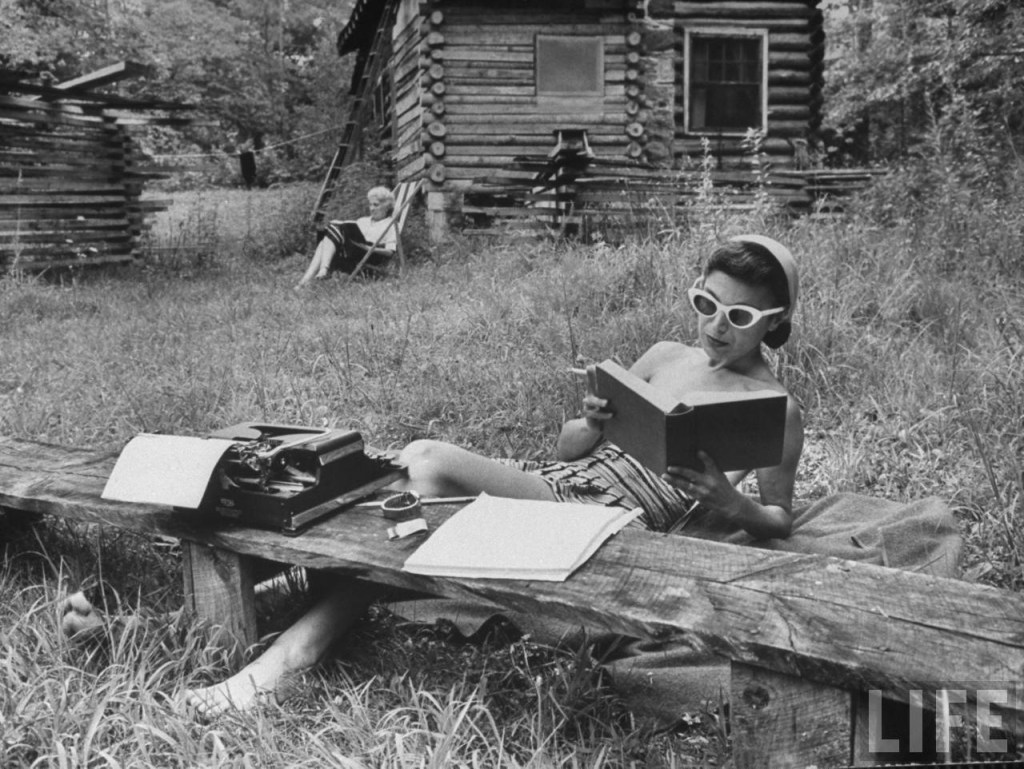
A Woman Reading in the Woods, 1959 (Life magazine)

I had my Summer Reading all perfectly planned.

A stack of books, selected, piled, all ready for an introduction on Twitter (refuse to call it X), a lovely filtered picture on Instagram and a cheeky post on Threads. There is so much bookish stuff going on – the Booker Prize Longlist, the notabene prize Shortlist, the Diverse Book Awards, the fabulous Women In Translation month, not to mention the books that are coming out in August and all the ones I haven’t managed to read and review yet, and don’t get me started on the books sat on my bookshelf glaring at me..

I don’t know what happened, I sat looking at them all and I just felt completely overwhelmed.

I always feel when you announce to the world “These are the books I want to read this summer”, that there is an obligation to read them all – even if you don’t really love them, because you have put it out there, and as a book blogger, I always try to do what I say!

I ended up with a full on case of The Dreaded Book Slump, not wanting to read anything at all, and instead spent my days watching re-runs of Real Housewives and sat staring at my books.

So this Summer, I am trying to do something a bit different. It might not be for everyone, but for me, I know that with everything else I have going on (hello real life!), that I need to stay interested and feel that reading is a pleasure, not a bookish chore I need to get through – otherwise those Real Housewives are going to get watched a LOT.

This Summer is going to be my Summer Of Reading Selfishly, and if you have read this far, thank you, and you are probably (hopefully) wondering what it means, and whether you could do it too.

I have picked a new pile of books to read over the Summer – in fact, as I write this blog post, they are sat on the table in front of me, and I have decided that I am not going to share what they are.

I am not setting myself any deadlines, I might post a review if I feel like it – although am not quite sure where works anymore – but that’s a whole other blog post. If I love the book I have read – I will tell you about it, if it’s not for me, I won’t say a word, and move on to the next one.

For me, that’s the best bit – this is a win win for everyone! I shout about books I love, the authors know I love their books, and if I read a book from my stack that I don’t love, I just put it down and move onto the next one – and no one knows. More importantly, I don’t feel under any pressure to read and review everything I have in my pile – because I am the only one who knows what’s on there.

So for this August, that’s my Summer Reading sorted, and honestly, for the first time in a long time I am looking forward to just reading for the sake of it. I might even start to remember a time when I used to read without thinking about how I would review it!

One thing is for sure, I promise to let you all know when I read a brilliant book – and here’s to my Summer of Reading Selfishly.

Take What You Need by Idra Novey

Take What You Need by Idra Novey

Published by Daunt Books Originals

on 3rd August 2023

Available from All Good Bookshops

What They Say

Take What You Need traces the parallel lives of Jean and her beloved but estranged stepdaughter, Leah, who’s sought a clean break from her rural childhood. In Leah’s urban life with her young family, she’s revealed little about Jean, how much she misses her stepmother’s hard-won insights and joyful lack of inhibition.

But with Jean’s death, Leah must return to sort through what’s been left behind. What Leah discovers is staggering: Jean has filled her ramshackle house with giant sculptures she’s welded from scraps of the area’s industrial history.

Set in the Allegheny Mountains of Appalachia, Take What You Need explores the continuing mystery of the people we love most, zeroing in on the joys and difficulties of family with great verve and humour, and illuminating what can be built from what others have discarded.

What I Say

There are novels that when published, seem to be everywhere, with so many people shouting about them, that often there are quiet novels of pure brilliance that don’t get the attention they truly deserve. I hope that Take What You Need really does find its way onto your bookish radar, because I think it should be front and centre on your reading lists.

In Take What You Need Idra Novey perfectly articulates the complexities and realities of living in modern America while the world beyond your four walls, and the people you love change beyond your control.

Jean and Leah are stepmother and daughter, who are now living in different parts of the country after Jean had to live the familial home when Leah was only ten. Although Leah’s father tried to discourage their relationship, they stayed in touch via sporadic emails and phone calls. Leah is now living in New York with her husband and young son, while Jean lives in Appalachia, a place ravaged by poverty and addiction. When Leah receives a phone call from a stranger, telling her that Jean has died and left her artwork to her, Leah and her husband undertake the journey to the Allegheny Mountains with their young son.

After a life of working, Jean had devoted herself to her art, and used steel and lots of different ephemera that she collected from flea markets and wherever she could to create her works she called her ‘manglements’ – a body of work that ranges from small boxes to huge totem pole sizes that she has inside her house.

When Jean’s neighbour asks to use her stand pipe so she can get water for her family after theirs is cut off, it is then she meets their son Elliott. Realising how little money the family has, she starts to offer him food and the use of her shower. After Elliott helps Jean when she has an accident making her art, they start a tentative friendship, and Elliott starts to help Jean construct her artwork. Jean sees a young man constrained by his environment, who has the potential to change his life – if only he can see it – and this is part of the backdrop of this novel, the very different lives that play out when you do or don’t have the financial means to survive.

All the time Jean is also thinking of Leah, and when a visit from her goes spectacularly wrong – with both women describing very different perceptions of what happened, the relationship breaks down again. Jean is alone, with only her art for company, and Elliott is becoming more and more distant as he becomes an addict, starts to turn to theft and is thrown out of his family home. Leah finds it difficult to understand how Jean can possibly want to speak to Elliott after everything he has put her through, but Jean instinctively understands that this is a young man who never stood a chance as the world around him collapses and pulls him under with it.

The narrative moves effortlessly between Jean and Leah, both women aware of the closeness they have lost, and realising that if only they can find the words, they could once again have the relationship they both miss so much. I felt it was also a way for Idra to show the reader two very different experiences of living in America, at a time when the MAGA movement and Donald Trump’s presidency is a reality, and we are constantly aware of the socioeconomic backdrop to the plot. Elliott’s trajectory is one that is all too familiar and harrowing, yet there is also a humanity and need for connection that means he cannot let Jean go, as he recognises that she saw him as a person with potential, and although he doesn’t always know how to deal with it, he eventually understands the emotional debt he owes her.

Take What You Need is a beautiful and thoughtful novel about how art intersects with so many parts of our lives, and how powerful and life changing it can be. This is also a novel about how sometimes family is not necessarily those people you are related to, but instead can be found in those people who understand and love you for what you are and the potential they can see in you. Jean understands both Leah and Elliott completely, and although they are seemingly disparate characters, it is Jean’s love and desire for both of them to fulfill their potential that unites them after she is no longer in their lives.

I absolutely loved it.

Thank you so much to Jimena Gorraez and Daunt Publishing for my proof copy

Seventeen by Joe Gibson

Seventeen by Joe Gibson

Published by Gallery UK and Simon and Schuster on 20 July

Available from all Good Bookshops

What They Say

It’s 1992. Like every other seventeen-year-old boy, Joe has one eye on his studies, the other on his social life – smoking, Britpop, girls. He’s looking ahead to a gap year full of travel and adventure before university when his teacher – attractive, mid-thirties – takes an interest in him. It seems like a fantasy come true.  

For his final two years at school, he is bound to her, a woman twice his age, in an increasingly tangled web of coercion, sex and lies. Their affair, a product of complex grooming and a shocking abuse of authority, is played out in the corridors of one of Britain’s major private schools, under the noses of people who suspected, even knew, but said nothing. 

Thirty years on, this is Joe’s gripping record of the illicit relationship that dominated his adolescence and dictated the course of his life. With a heady dose of nineties nostalgia and the perfectly captured mood of those final months at school, Joe charts the enduring legacy of deceit and the indelibility of decisions made at seventeen. 

What I Say

You may have seen on my Twitter feed that I talked about a book that had stopped me in my tracks, and I haven’t been able to stop thinking about since I read it (you can possibly tell by the number of post its in my copy in the picture!)

Lots of people were curious to know, and so today, I can tell you that the book I am talking about is called Seventeen. It is a memoir written by Joe Gibson (this is a pseudonym), which tells the story of Joe, as a seventeen year old, who had an affair with his thirty five year old teacher called Miss P.

Joe was awarded a bursary to study at a private school which was 150 miles away from his parents. They sorted out accommodation for him with some family friends, who were caring people, but basically left Joe to do what he wanted to do. He finds a group of friends quite quickly, and settles into school life, but then discovers that his Dad is leaving and his mum and dad are getting divorced.

Understandably upset, and realising how far away from home he is, he goes to a pub to drown his sorrows. It is there he bumps into Miss P, who listens to and comforts him and Joe realises that he is attracted to his teacher.

One evening Miss P asks him to help her tidy up the classroom, and they eventually end up at her flat where they drink wine together and kiss. Very quickly, this turns into a fully blown affair, and Joe, although he knows this is his teacher, and this is not right, realises that he loves Miss P – or Ali, as she now becomes to him.

Joe’s seventeen year old voice comes through very clearly throughout the memoir. He at times seems almost proud of their relationship, their sex life, and relishing the time they spend together, desperate to see her again, yet also still having to be the person his friends know. He has to be the seventeen year old they know – half listening to his friends as they debate which girls in their classes they fancy, trying to maintain the facade of a normal student, but harbouring this secret that he knows would blow his whole world apart if it ever comes out. So he says nothing.

What becomes clear to the reader very quickly is that this is not an equal relationship. Miss P controls every aspect of it – she devises the most incredible plans, comes up with the complicated and seemingly safe logistics to make sure that they can see each other, but also making sure little by little that Joe is entirely under her control. Miss P decides when and where they can see each other, she ignores him for periods at school, and taunts him about being a school boy when it seems that he is trying to think for himself.

As they become more and more involved, Joe distances himself from his friends and family, his school work starts to suffer, and his hopes of going to Oxford slip from his grasp. At the same time, his relationship with Ali intensifies, and her insistence that they spend time together in increasingly dangerous ways are to be honest, jaw dropping to say the least. Joe is so far entrenched in this relationship that he can’t see what we all can – that he is powerless, and entirely under Miss P’s control.

Seventeen honestly reads like fiction -as if Joe and Miss P are characters in a novel that you read, talk about and put on a shelf. Of course this is a memoir, these are real people, and their lives still go on. One of the most incredible parts of Joe’s story is what happens to the relationship – and no, I’m not going to tell you what that is.

I couldn’t stop thinking about Seventeen when I read it because I have so many questions. Why Joe? Had she done it before? Why didn’t the friends she told report her? What was her motive for getting involved with Joe? Was Ali telling the truth about her past relationships at all?

Yet something else supersedes all that, because I keep thinking about my seventeen year old son and what it would be like for him if it happened to him, and that is what Joe illustrates so clearly. At the very heart of all this, we need to understand that Joe is a seventeen year old school boy, and Miss P is his thirty five year old teacher.

It should never have happened, but it did, and if Seventeen does one thing, it made me start a conversation with my own son about what had happened to Joe, and how that behaviour from an adult is never acceptable. We also learn that it wasn’t until 2000 that it became illegal for a teacher to have a sexual relationship with a 16 or 17 year old – which makes you wonder how many times this story played out in other schools, and what happened to those people whose stories we may never know.

This is why I think it’s such a thought provoking memoir, because it made me stop and think about how I communicate with my son – when Joe was seventeen, there wasn’t social media and mobile phones, you had to either use the home phone or find a pay phone to contact someone, or even go physically to see them. Here and now, our teenagers are so busy looking down, connected to a world we can’t access, it is harder and harder to really find out what is happening in their lives, and that is why Seventeen is such an important book.

Now more than ever we need to be present for teenagers, to make sure that Joe’s story is something that can’t happen again. Joe says in the acknowledgements that he hopes by finding his voice seventeen years later, and articulating his experience that he can encourage other people to do the same. I think Joe has also started a timely conversation about power and control and needing to make sure that in a time of digital communication where we aren’t party to everything that happens on a screen that we don’t forget about simply talking to and listening to our children too to make sure Joe’s story is not repeated.

I absolutely loved it.

Thank you so much to Sabah Khan at Simon and Schuster for my finished copy in exchange for an honest review.

The Whispers by Ashley Audrain

The Whispers by Ashley Audrain

Published by Michael Joseph on 20th July

Available from all Good Bookshops

What They Say

The whispers started long before the accident on Harlow Street . . .
Was it at the party, when Whitney screamed blue murder at her son?
Or after neighbour Blair started prowling Whitney’s house, uninvited?
Or once Rebecca and Ben’s childlessness finally puts a crack in their marriage?
But on the terrible night of the accident, the whispers grow louder, more insistent.
Neighbours gather round. Questions are asked. Secrets are spilled. And the gloss on everything begins to rub off. Everyone is drawn into the darkness.
Because there’s no smoke without fire.
No friendship without envy.
And no lie that does not conceal a devastating truth . .

What I Say

You might have already read Ashley’s first novel, The Push – which quickly found its place as one of my favourite books.

When I was asked if I would like a proof of The Whispers, of course I said yes, but there is always that slight concern that it won’t be so brilliant, and then how do you review it?

Readers, let me tell you, I think The Whispers is even better.

This is a novel which puts motherhood and relationships front and centre. What does it mean to be a mother? What does society expect from mothers? Does it mean losing ourselves as we strive to make sure that our children’s needs are always the most important, and what if you don’t fit the template that everyone expects you to?

With Whitney, Blair and Rebecca, we see three very different women living in the same street, all dealing with motherhood and their relationships in very different ways.

Whitney feels overwhelmed by motherhood, and instead spends as much time as she can out of the house at her business, leaving the parenting to her husband and anyone else, revealing how dull and boring she finds it, resentful of all the mundanity and routine it brings.

Her best friend Blair is the complete opposite, her world is her daughter, and her own wants and needs have been subsumed by her daughter and husband. Yet Blair is not fulfilled either, is desperately lonely, and yearns for something that is her own. Blair slowly starts to suspect that her husband is having an affair – with Whitney.

Rebecca is an ER Doctor, and in spite of trying, is unable to carry a child to full term. Although originally she wanted to stop trying, she now wants to have a child with her husband. As they try to conceive, the gap between them becomes wider, and Rebecca feels that her marriage is failing.

Whitney undoubtedly seems to have the world and her neighbours in her picket fence perfect suburb of Harlow Street at her beck and call. Until one day at a party held in her home, they hear her screaming at her son, Xavier. A few months later, Xavier is in a coma, having apparently fallen from his bedroom window, and as she rushes to his bedside, seemingly bereft, his accident shows us exactly who Whitney really is. and little by little, the seemingly perfect facade of Harlow Street slowly cracks to show us exactly what secrets the residents are hiding.

As the events leading up to Xavier’s fall start to become clearer, and the women’s lives start to unravel before us, you understand that each of these women have one thing in common – that they have put the needs of others first, and that although on the surface they seem content, very slowly you understand that each of them is burying the anger and resentment that they feel, because to show it outwardly would deem them as socially unacceptable.

Ashley Audrain’s incisive and intelligent writing reflects this. If all these women were perfect examples of motherhood – then we wouldn’t engage with them, and the story would feel vacuous. It is the very fact that these women articulate what so many of us express privately is what makes us feel a connection with them. They are not perfect, they are vulnerable and at times bewildered by a world that judges them for their ability to conform to standards that are old fashioned and unforgiving.

The power of this novel also comes from the way in which the plot moves along at a rapid pace, but never feels forced or contrived. Ashley knows that in order for us to engage with and care about the characters, that there has to be a distinct line between scintillating plot twists and truthful character portrayals, and in The Whispers, she achieves this perfectly.

The Whispers is a brilliantly constructed and effortlessly plotted novel that once you start reading you cannot put it down. Ashley absolutely understands not only the dynamics and pressures of families, but also the complicated and sometimes limiting roles we find ourselves in as partners and parents. As the novel draws to its conclusion, Blair and Rebecca find the confidence to determine what they want from their lives, putting themselves first. We also sense that Whitney will finally get the chance to be the mother she realises she wants to be, but be prepared, because life is never that straightforward is it?

I absolutely loved it.

Thank you so much to Jen Breslin for my proof copy.

Is It Just Me?

Here’s the thing.

I’ve been blogging about books since 2017 and have loved every single minute.

Honestly? For the last few years, I have felt that I am shouting into the void, along with eleventy billion other bloggers too. You know when you read a book that’s just so brilliant you want everyone to know about it – there’s only so ways you can say “Trust me, you will love this book, please read it!” How do you not lose heart or lose faith in your judgement when it feels like no one is listening?

I love reading, and I love talking to people about books, but thanks to the constant changes in the algorithm on Twitter and Instagram, I am starting to wonder why, and doubting myself as a reader and blogger.

Recently, I have found it sometimes difficult to be enthusiastic about books, and have been feeling overwhelmed by my reading pile – I can’t get through them fast enough to talk about them, and the reading slumps have been coming more and more frequently. At one point, I started to wonder what was the point of reading and posting about books for publication day, when it feels for me that the views and likes and retweets are less and less with every week.

People will tell you that it shouldn’t matter, that you do it because you love it, and that you are creating an online document of the books you have read and loved. I do love what I do, but I still want to feel that my words are reaching people. Having worked with quite a few authors now, I know how important it is to them that we talk about their books – especially when you find that special one that you want everyone to read.

Then you start to think it must be you – that you have done or said something to offend people, and that in a world of screens and scrolling your posts are whizzed past or ignored.

After some personal decisions were made this week, I realised I could sit around and feel sad – or I could do something about Years Of Reading and take the chance to shake things up and move in a direction that I want to go in.

So here we are.

The funny thing is, that once I had a chance to process everything, I realised that if I was brave enough, that this could actually be the chance for change, for me to sit back and think about what I love doing and what I don’t, and that now my bookish future is up to me.

Reader, I started to think of what I want Years Of Reading to be and have already done a few bookish things way out of my comfort zone – will they come off? I don’t know. The thing is I tried, and at least it’s made me realise that you don’t know unless you ask. For the first time in a while, I feel enthusiastic and inspired about Years Of Reading – because I know that it’s up to me what happens next – and do you know what?

That’s the most exciting thing of all.

brother do you love me by Manni Coe and Reuben Coe

brother do you love me by Manni Coe and Reuben Coe

Published by Little Toller

Available from Little Toller Website and All Good Bookshops

What They Say

Reuben, aged 38, was living in a home for adults with learning disabilities. He hadn’t established an independent life in the care system and was still struggling to accept that he had Down’s syndrome. Depressed and in a fog of anti-depressants, he hadn’t spoken for over a year. The only way he expressed himself was by writing poems or drawing felt-tip scenes from his favourite West End musicals and Hollywood films. Increasingly isolated, cut off from everyone and everything he loved, Reuben sent a text message: ‘brother. do. you. love. me.’ When Manni received this desperate message from his youngest brother, he knew everything had to change. He immediately left his life in Spain and returned to England, moving Reuben out of the care home and into an old farm cottage in the countryside. In the stillness of winter, they began an extraordinary journey of repair, rediscovering the depths of their brotherhood, one gradual step at a time. Combining Manni’s tender words with Reuben’s powerful illustrations, their story of hope and resilience questions how we care for those we love, and demands that, through troubled times, we learn how to take better care of each other.

What I Say

I have really struggled with writing a review of brother do you love me. The reason being is that I want to share endless paragraphs and pages and chapters with you, to show you how brilliant Manni’s writing is, and how perfectly Reuben’s words and illustrations show us what their relationship means to them. This is a memoir that is quite unlike any I have read, and it moved me deeply.

Manni was living in Spain as a tour guide, and his brother Reuben who has Down’s Syndrome was living in a residential home. Reuben sent Manni a text message that read ‘brother.do.you.love.me’. As soon as he read that message, Manni knew that his brother needed him, and that Reuben had to be out of that care home as soon as possible. When Reuben moved in with Manni in a cottage in the UK, Manni was shocked to see how far his brother had regressed physically and emotionally, and was desperate to get his brother back.

This is a memoir not only of the incredible bond that Manni and Reuben have, and how their love for each other transcends the frustrating limitations that the professionals tried to constrain their world with, but is also a book about the realities of caring for a family member when you know exactly what they need even if those in positions of power disagree.

Their situation is further complicated by the fact that Manni’s partner Jack is in Spain, and the rest of their family are spread throughout the world, so even though everyone is involved and supporting them, Manni is the one dealing with all the day to day decisions and being the support for Reuben on his own. What echoes throughout the book is the fact that on one hand, for Manni, having your brother who is also your best friend, living with you is the best thing, but at the same time caring for Reuben and trying to help him regain his confidence as well as dealing with all the people and teams who are involved is also incredibly exhausting and isolating. I know from my own experience that you spend so much of your time convincing the people making the decisions that honestly, yes, you really do know your family member so much better than the snapshot they have gleaned from all the forms and phone calls you have been forced to repeat time and time again.

One of the elements of the book which I think will resonate with many people, is the way in which Manni describes the realities of the social care system in the U.K. It is one stretched to its limits, with those people who use it often become little more than a set of initials moving from team to team as decisions are made sometimes with the family involved, and sometimes not. One of the worst things (and I am speaking from personal experience) is how often you find someone who absolutely understands the person you are caring for, and what they need to thrive, only to have them move on or leave, and you are left either without no one, or a new person that you have to explain everything to – never quite sure if you have said the right thing, or told them enough, or too much.

As Manni tells their story, he weaves his family’s narrative in effortlessly, as we learn everything about their family, from their childhood in Leeds, to the rift that happens when Manni tells his religious family that he is gay, to their reconciliation – and always at the heart of the story is the love and determination that the family and their friends have to ensure that Reuben is happy and living the life that he wants. In doing this, Manni also subtly shows us the difference between the Reuben of those times, and all the things they did together, and the Reuben who is now a very different man. Manni perfectly articulates not only the all consuming love you feel for the person you care for, but also the ingrained hope and desire you have for them to be accepted by the world and for them to live the life they want, rather than the life that others feel they deserve.

The book is also filled with the art that Reuben has produced, which adds an intensely personal and emotional element to the book, and Reuben also talks about having Down’s Syndrome and what that means to him. We learn how he feels about the world around him, as well his own hopes and dreams for his future. I think it’s one of the most important parts of this book, that Reuben’s voice and identity are so clear and we learn so much about him and his personality, and his relationships with his family and friends.

I wanted to finish my review by saying thank you to Manni and Reuben, who helped me think about my own situation and my own relationship with my son, who has a range of special needs, and I am his full time carer.

I know am guilty of doing too much for him, for sometimes treating him like a child at times even though he is twenty two, and for thinking I know how he feels, and not really trying to make him do any more than I think he can cope with. Hearing how Manni and Reuben talk together, and Reuben talking about himself and his identity have really helped me reassess how I relate to my son, and has opened up a whole new world for us, and for that, I can’t thank them enough.

I don’t often say this, but please try and read this book however you can. #BrotherDoYouLoveMe is not only an incredible testament to the love that Manni and Reuben have for each other, but is also a book that absolutely captures the realities of caring for a family member, and how important it is to ensure that what they want and deserve is always at the front and centre of every decision that is made.

I absolutely loved it.

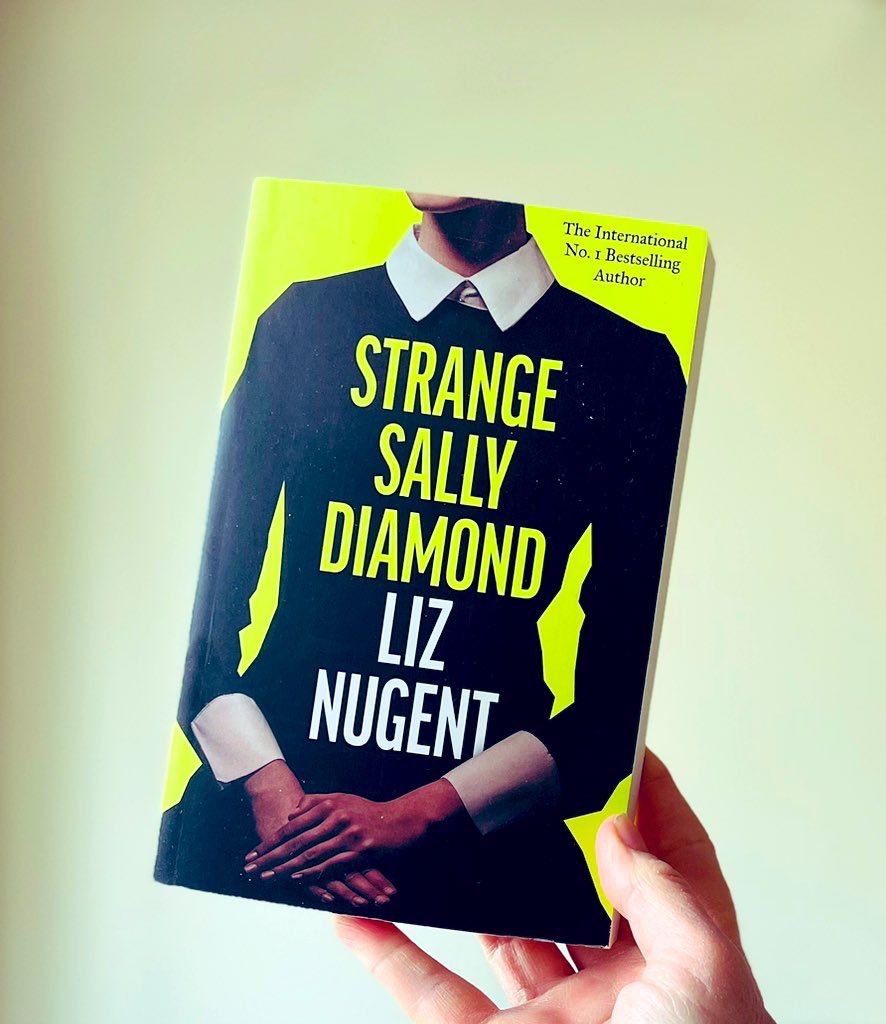
Strange Sally Diamond by Liz Nugent

Strange Sally Diamond by Liz Nugent

Published by Penguin Viking on 2nd March 2023

Available From All Good Bookshops

What They Say

Sally Diamond cannot understand why what she did was so strange. She was only doing what her father told her to do, to put him out with the rubbish when he died.

Now Sally is the centre of attention, not only from the hungry media and police detectives, but also a sinister voice from a past she cannot remember. As she begins to discover the horrors of her childhood, Sally steps into the world for the first time, making new friends and big decisions, and learning that people don’t always mean what they say.

But who is the man observing Sally from the other side of the world? And why does her neighbour seem to be obsessed with her? Sally’s trust issues are about to be severely challenged . . .

What I Say

There are some authors who quite simply are auto read authors. For me Liz Nugent is one of them, because her brilliant writing where the domestic and the macabre are mixed together effortlessly, propel you into a world that is absolute proof of the saying that you never know what goes on behind closed doors.

Strange Sally Diamond starts with Sally throwing out her Dad’s body with the rubbish – because that is what he told her to do. From the opening paragraph, it is obvious to see that Sally is an unconventional protagonist, and that her literal translations of instructions, distance from the world outside and her awkwardness with people and social interactions mean that Sally is very much walking her own path in the world.

When the family doctor Angela discovers what Sally has done, having known Sally and her family for years, she steps in as Sally’s protector, navigating both the legal and personal minefield that Sally now finds herself in. As we fall deeper into Sally’s world, what becomes patently obvious is that from the moment she was born, Sally’s life has been a traumatic and incredible one, which means her own self awareness and understanding of what she has had to navigate leads her to deal with the world around her in a way that she feels she is in control.

Left alone in her family home, Sally starts to unravel her own history, and discovers how she became a member of the Diamond family – and with it, a whole barrage of secrets and things never told start spilling into Sally’s life. When Sally starts to receive mysterious presents, and messages she doesn’t understand, the past that she has no recollection of starts seeping into her present.

Little by little, as the narrative weaves backwards and forwards, and by the introduction of the character of Peter into the text, we are slowly able to see exactly what happened not only to Sally’s mother, but also the awful reality of what their life was like at the hands of her father.

As always, I think it is important to let you know that Strange Sally Diamond has some very dark themes that run through this novel, there is domestic violence, physical and emotional abuse, and a prevalent theme is paedophilia. While this is undoubtedly a very difficult and challenging novel to read, Liz’s incredible skill as a writer means that these are all tackled with extreme sensitivity, and the way in which they are the backbone of the narrative never feels anything other than absolutely integral to the plot and understanding what has brought Sally and Peter to this point in their story.

I thought it was interesting to see how Sally develops as a character as the narrative moves on, and how everything we do so easily and take for granted are huge victories for her. The confidence she gains comes from working with her therapist, and her own motivation to finally embrace the world she has been detached from for such a long time. Liz’s depiction of Sally always feels that it comes from a place of compassion and curiosity, wanting us to understand that this woman has endured so much, but in learning to process her past and know that people can be trusted, that a new world is waiting for her – which can be an amazing thing, or something that brings complications that no one could have envisaged.

Strange Sally Diamond is a novel that perfectly balances the gradual development of Sally’s character once she allows herself to open up to the world around her, set against the incredibly challenging history and life she has lived in a way that feels measured and controlled – much like Sally herself. It is a novel that show us the darkest and most macabre stories of human existence and survival are often so much closer to us than we could ever possibly realise. Liz Nugent brings us into Sally’s world so completely that as we are witness to every small victory and devastating setback she faces, and all the time want only for her to finally be able to embrace the normal life so many of us take for granted every day.

I absolutely loved it.

Thank you so much to Jasmin Lindenmeir and Ellie Hudson at Penguin Viking for my gifted proof copy.

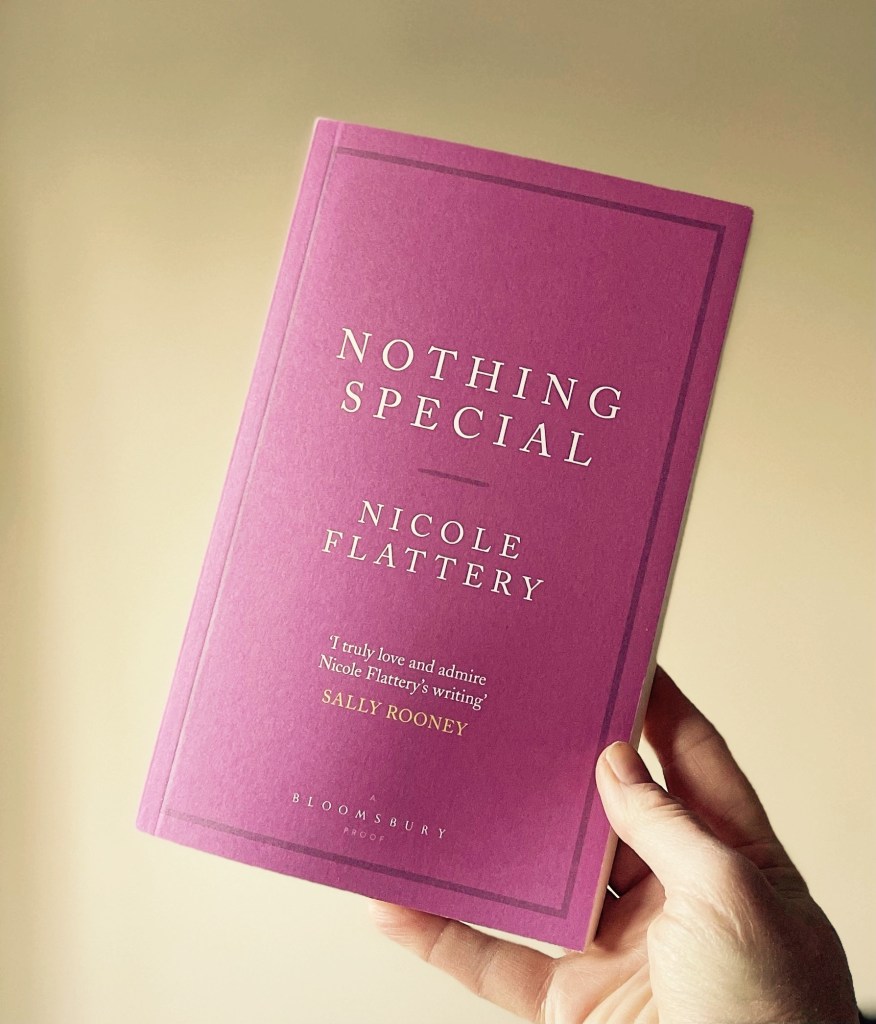
Nothing Special by Nicole Flattery

Nothing Special by Nicole Flattery

Published by Bloomsbury Books

Available from All Good Bookshops and Online

What They Say

New York City, 1966. Seventeen-year-old Mae lives in a run-down apartment with her alcoholic mother and her mother’s sometimes-boyfriend, Mikey. She is turned off by the petty girls at her high school, and the sleazy men she typically meets. When she drops out, she is presented with a job offer that will remake her world entirely: she is hired as a typist for the artist Andy Warhol.

Warhol is composing an unconventional novel by recording the conversations and experiences of his many famous and alluring friends. Tasked with transcribing these tapes alongside several other girls, Mae quickly befriends Shelley and the two of them embark on a surreal adventure at the fringes of the countercultural movement. Going to parties together, exploring their womanhood and sexuality, this should be the most enlivening experience of Mae’s life. But as she grows increasingly obsessed with the tapes and numb to her own reality, Mae must grapple with the thin line between art and voyeurism and determine how she can remain her own person as the tide of the sixties sweeps over her.

Nothing Special is a whip-smart coming-of-age story about friendship, independence and the construction of art and identity, bringing to life the experience of young women in this iconic and turbulent moment.

What I Say

I am always fascinated by fiction books that find their starting point in real events, and Nothing Special is the story of Mae, a young woman who finds herself working at The Factory – Andy Warhol’s studio in New York City.

Her job, along with another woman called Shelley, is to transcribe audio cassettes exactly as she hears them – every single sound and pause must be captured and typed, however insignificant they sound. This seemingly repetitive and cryptic task, was actually published as A, A Novel by Warhol in 1968. This forms the backdrop to Mae’s evolution emotionally and personally as she slowly falls under the spell of this cultural revolution, while attempting to navigate the difficult time in our lives when we are no longer children, but not yet an adult.

Mae has a problematic relationship with her erratic mother, who seems to go from no interest to an obsessive interest with her daughter. Home life veers between times of calm and times of chaos, as her mother deals with her own issues by drinking and dating, while at the same time keeping her ever present doting boyfriend Mikey hanging around – who in fact is perhaps the most stable parental figure Mae has in her life.

As Mae becomes more involved with her project, she starts to view the world differently, and feels that the life she has lived up til now has been so small and narrow. We see the power of celebrity and notoriety, and how much people want to be part of what is happening at The Factory, to be able to tell people that they are in some way connected to Andy Warhol – even if they are just famous for fifteen minutes.

Nothing Special is also about the notion of the artistic gaze, and how we view both the art itself and those who create and participate in it. Mae finds herself more involved with The Factory, and the reader become more aware of how important it is for those around her to be seen, and to be part of Warhol’s history whatever the cost. We see how many of the people – including Shelley, want to be immortalised by Warhol, and have no scruples in doing whatever he wants them to do on screen in order to be able to say that they have been filmed by him.

Mae and Shelley are only needed until they finish transcribing the tapes, and when A is published, they are not mentioned, so are eradicated from the history of the very place they were so desperate to be part of. Nicole Flattery’s understated style of writing works so well for me, in scenes like this, because when life changing and at times upsetting things do happen to Mae, they are made even more poignant by the fact the language used and the words chosen focus you explicitly on her.

Nothing Special captivated me from the very first page, and when I had finished reading it, I sat and spent time reading about Warhol and more importantly, the people who came and went from The Factory. The captivating thing about Nicole’s brilliant novel is that Warhol is a figure on the periphery, the enigma around which everyone else orbits, and Mae’s life becomes the focus. This is a novel which asks us to consider not only the notion of how art is made and the legacy of Warhol, but also makes us think about the people whose names we will never know, but without whom, Warhol would not have been able to create the art we admire today.

I absolutely loved it.

Thank you so much to Tabitha Pelly and Bloomsbury Books for my proof copy.

Other Women by Emma Flint

Other Women by Emma Flint

Published by Picador Books on 23 February 2023

Available from West End Lane Books and All Good Bookshops

What They Say

Mesmerising, haunting and utterly remarkable, this is a devastating story of fantasy, obsession inspired by a murder that took place almost a hundred years ago.

In a lonely cottage on a deserted stretch of shore, a moment of tragedy between lovers becomes a horrific murder. And two women who should never have met are connected for ever.

Six years after the end of the Great War, a nation is still in mourning. Thousands of husbands, fathers, sons and sweethearts were lost in Europe; millions more came back wounded and permanently damaged.

Beatrice Cade is an orphan, unmarried and childless – and given the dearth of men, likely to remain that way. London is full of women like her: not wives, not widows, not mothers. There is no name for these invisible women, and no place for their grief.

Determined to carve out a richer and more fulfilling way to live as a single woman, Bea takes a room in a Bloomsbury ladies’ club and a job in the City. Then a fleeting encounter changes everything. Bea’s emerging independence is destroyed when she falls in love for the first time.

Kate Ryan is an ordinary wife and mother who has managed to build an enviable life with her handsome husband and her daughter. To anyone looking in from the outside, they seem like a normal, happy family – until two policemen knock on her door one morning and threaten to destroy the facade Kate has created.

What I Say

A very long time ago, when Years of Reading wasn’t even an idea rattling around my head, I picked up a novel called Little Deaths by Emma Flint. I was completely captivated by this novel of a woman called Ruth Malone, and whether or not she was implicated in the disappearance of her children. You know when you love a novel so much you can’t wait to read what the author writes next? Well, I have been waiting since then to read Emma’s next novel, and let me tell you, I think Other Women is even better.

Using a real life case as its inspiration, Other Women tells the story of Beatrice Cade and Kate Ryan. Beatrice is an older single woman, with no immediate family, living in London, with a room in Bloomsbury, and a job as a book keeper in the City. Existing but not really embracing life, she wants to find love and to have a family, but this is the world after the First World War, still reeling from cataclysmic events and processing the incredible loss so many people have had to endure as a result of so many men losing their lives.

Beatrice feels slightly out of place in her office, with the younger women so much more confident in themselves and what they want, and while she dutifully carries out her job, and tries to engage more with the women she lives with, it all just feels slightly forced, and you feel her discomfort as she tries to fit in.

When Tom Ryan comes to work in her office, she is totally and utterly captivated by him, and dares to think that he might feel the same way soon. Their tentative friendship slowly blooms into a relationship, and for the first time, Beatrice allows herself to believe that she might actually be able to get the domestic dream she has wanted for so long.

Their relationship is conducted privately, away from prying eyes and the possibility of being seen by anyone who shouldn’t see them. While to Beatrice this seems romantic and passionate, slowly it becomes clear that there is a very good reason as to why Tom doesn’t want anyone to know about their relationship.

Kate Ryan has always been the dutiful wife that Tom wants. She has created an idyllic home life for him and their daughter Judith, but Kate is not naive, and knows that Tom has had relationships with other women through their marriage. Kate is also very aware of the implications of not staying married, and that divorce is not an option. Their life may seem perfect from the outside, but only Kate and Tom know exactly what happens when they shut the door at night.

As Tom finds himself further involved with Beatrice, who is utterly besotted with him, and Kate realising that Tom is pulling away from her again, a desperate chain of events unfurl that leaves Kate reeling, as her carefully constructed world starts to implode. Tom has done something that she cannot believe or comprehend, but as the puzzle starts to come together, Kate is faced with a choice that brings her closer to Beatrice than she could ever imagined. After years of having to ignore what Tom has chosen to do to their marriage, she now has the power to change everything – if she is brave enough to do it.

One of the many things I loved about this novel is the way in which you are totally immersed in the women’s lives, and the society they inhabit. Emma’s writing transports you completely to post war London and you feel part of this strange new world where people are trying to get on with their daily routines, adjusting to what has happened to the world. There is always this ominous sense of tension right from the start of the novel, that never feels forced or calculated, but instead slowly seeps through the pages and as a reader you know something awful is going to happen – and when it does, it is all the more devastating because of the unwavering belief Beatrice has that Tom is the man of her dreams.

Undoubtedly, this is a novel about women and how they are treated by a society still reeling from the after effects of a World War. Beatrice never quite fits in – she is unmarried, has no children, and quietly goes about her business, but wants to achieve the domestic dream she believes Kate Ryan has – Beatrice even turns up on her doorstep once, desperate to see Tom. Yet as the novel progresses, we see how Tom also tires of Beatrice when she becomes too demanding of him, and he treats her appallingly, as an annoyance rather than a person. Even in court, she becomes an exhibit to procure evidence from, her life is reduced to a series of statements and reports, and Beatrice will be forgotten when the case concludes.

Kate seemingly has it all – a loving husband, beautiful daughter and a desirable home, but at what cost? The image of the dutiful and benevolent wife hides the fact that Kate is attempting to hold her marriage together by constantly excusing Tom’s behaviour and accepting that this is her life – because that is what good wives do. Emma’s understated and measured characterisation of Kate, and the way in which she perfectly captures Beatrice’s change from unassuming and invisible, to a woman who believes she finally has everything she wants with a man who doesn’t really want her is heartbreaking to witness, and testament to Emma’s absolute understanding of the women she is depicting.

Other Women is a truly unforgettable novel, that gets completely under your skin as soon as you meet Beatrice and Kate. As a reader you realise that in this world where a man’s word is deemed to carry more power than a woman’s, lives could be changed forever in a simple sentence. Kate and Beatrice may be poles apart in terms of the trajectories of their lives, but they both simply wanted the same thing. To love and be loved, and to live their lives believing that the man they had chosen to share it with loved them back too.

I absolutely loved it.

Thank you so much to Picador Books for my proof copy.